
Navigating the new world disorder
Follow on


Share
.svg)

.svg)
.svg)
About the episode
Conflict and disaster displace millions of people around the world every year, and millions more live with food insecurity, unreliable access to electricity, or no electricity at all. These same populations are also the most adversely impacted by climate change, geopolitical competition for resources, and global instability. David Miliband, CEO of the International Rescue Committee (IRC) and former UK Foreign Secretary, says the world is at a "hinge moment."
In this episode, Alfred Johnson sits down with Miliband to discuss the breakdown of the post-WWII international order and what it means for the world’s most vulnerable populations. Miliband explains how "energy poverty" severely cripples humanitarian recovery and highlights the infuriating paradox of our time: the world has never been richer or more technologically advanced, yet distributed clean energy remains out of reach for those who need it most. They discuss concrete, scalable solutions the International Rescue Committee is pioneering, like solarizing health clinics and water pumps, and fueling breakthrough market solutions through Airbel Ventures.
Critical Capital is a co-production of Crux and Latitude Studios. Learn more about how Crux is financing the future of energy.
Episode transcript
David Miliband: The people we serve, if we say "Energy," they say, "What energy?" Energy poverty is the reality for tens of millions of people.
Alfred Johnson: Conflict and disaster displace millions of people around the world every year. Millions more live with food insecurity, unreliable access to electricity, or no electricity at all. Increasingly, the places facing the greatest instability are the ones most affected by climate change, resource scarcity, and geopolitical competition.
At the same time, we're living through a paradox of sorts. There's a growing sense of global scarcity of energy, minerals, compute, water, fertilizer, even cooperation. But the world has never been richer or more technologically capable. Energy solutions like solar power and batteries are cheap enough and scalable enough to make a real difference in the world's most vulnerable communities.
So why are so many still struggling?
David Miliband: What makes this obviously completely infuriating for people like us is it's never been cheaper or easier to get people distributed energy.
Alfred Johnson: This is Critical Capital. I'm Alfred Johnson, the CEO of Crux, the capital platform for the clean economy. For more than a decade, David Miliband has been thinking about the breakdown of the post-war international order, not as some abstract geopolitical concept, but as something people experience every day in places affected by conflict, displacement, and extreme poverty.
Since 2013, David has been the president and CEO of the International Rescue Committee, or IRC. It's one of the world's leading humanitarian organizations working across conflict zones and fragile states. Before that, David was a member of the British Parliament and served as the UK's foreign secretary.
Through the IRC, he's busy tackling big problems and finding solutions, like providing solar power for water pumps and health clinics in sub-Saharan Africa, and he's getting closer to answering a question that keeps him up at night: What does it take to build energy systems that work in the world's most vulnerable communities?
David Miliband, welcome to Critical Capital.
David Miliband: Thank you, Alfred. Great to be here.
Alfred Johnson: I've been looking forward to this conversation for a very long time. I've enjoyed talking to you over the years, and what I always appreciate is the moral clarity and incisiveness you bring to understanding global issues, particularly the issues that impact the most vulnerable people.
With your concern being the most vulnerable, you've made this point before that the post-World War II order breakdown is not some theoretical condition. It's an observed reality that people are experiencing across the world, and particularly people that are in the most acute humanitarian crises. Where is that breakdown most visible to your teams on the ground, and how is it showing up?
David Miliband: Thanks, Alfred, for saying that. I really appreciate it, and I think you are right to see this in a historical context. Let's have the conversation as if we were doing it on the 27th of February this year, so before the Iran war, because that will exacerbate and exemplify many of the trends that I'm talking about, and there couldn't be a worse time to start a globally significant war. Why do I say that? One hundred and twenty million people are fleeing for their lives from conflict and disaster around the world. About 310 million people are at crisis or worse levels of hunger, and 800 million people are living on less than $3 a day. Now, the interesting point about that 800 million figure is not that it's the largest figure ever. Thirty-five years ago, at the end of the Cold War, 30% of the world's population lived in extreme poverty. Today, it's 10%.
What's changed — and this is directly relevant to your question about the new world disorder — is that 60% of those 800 million people are concentrated in states affected by conflict and disaster. They're called fragile and conflict states. In 1990, it was 10%. So what we're seeing now is that the biggest division in the world is whether you're born in a relatively stable state — it could be a democracy, it could be an autocracy — but the division between those people and those who are born in the fragile and conflict-affected states is the biggest division today. You're 10, 20 times more likely to be in extreme poverty if you're born into a fragile and conflict state.
And you asked, where is that? Because I can say the International Rescue Committee is an unusual, unique international humanitarian organization founded by Albert Einstein in the 1930s, but going granular is important. The world's biggest humanitarian disaster — and this is a humanitarian disaster that is bigger than anything recorded since World War II, so it's a big historical perspective — is in Sudan. Sudan in northeast Africa, a country of 45 million people, there was a civilian government after the overthrow of a dictatorship in 2019. There was a coup in 2021. In 2023, the two sides of the coup, they started a civil war that affects 30 million people.
Alfred Johnson: Astonishing number.
David Miliband: Astonishing number. Thirty million people have fled for their lives. Sudan exemplifies the modern nature of disorder for the following reasons: It's a so-called civil war. There's nothing civil about it; it's brutal and grotesque, but it's an, it's a conflict within a state. It's sponsored by outside states. States across the Middle East and the northeast African region are supporting different sides of the war. The so-called superpowers, America and China, aren't able to click their fingers and get the fighting to stop. They're sort of wringing their hands at the side. There's gold and other minerals that are at issue supporting the different interests that exist inside Sudan. And this has global significance because Sudan is right on the Red Sea. And so at a time when the Straits of Hormuz are getting a huge amount of coverage for obvious reasons, there's another choke point not very far away that has potential global ramifications. And then the final kicker that makes Sudan typical of the current world disorder is that the humanitarian effort to keep people alive is massively underfunded, grotesquely underfunded. That's the sort of canvas that we're dealing with.
Alfred Johnson: Let's paint on that canvas. So we have these hyperlocal conflicts that are happening everywhere at increasing pace and velocity and extremity, and it exists within this framework of a world that is taking a different shape than the world that we grew up in. And so as you see that fragmentation play out, one thing I've been really aware of is that the rich countries have never been richer, right? And yet there is still this profound sense of scarcity. Scarcity of everything — scarcity of energy, scarcity of AI compute, scarcity of chips, scarcity of minerals, water, food, all of these different things. And we're suddenly in this seemingly more adversarial stance as a world as we look at this range of issues.
How do you make sense of all of that in the context of your work?
David Miliband: Well, there's a lot in that. I think that the straight answer is: I make sense of it that the competition is greater because the interdependence is greater. This is a hyper-connected world, and that means risks have gone global. You can see that in the Iran war context, the Straits of Hormuz. Who knew it? Thirty percent of the world's fertilizer goes through there, 20% of the world's oil and gas goes through there. Well, actually quite a lot of people knew it. That's why they didn't start the war with Iran over its nuclear program over the last 30 or 40 years.
So number one, I think that the competition reflects the connectivity. We're living in a world of multiple power centers. We're also living in a world — and it's interesting if you think back to your list of things that you thought were scarce — we're living through a technological revolution of seismic proportions, and that intensifies the competition.
I'd just say one thing, though, to you. You said the richer countries have never been richer. True, but they've rarely been as unequal as they are now. The dividends of the growth that has existed in the industrialized countries over the last 30 years has been distributed in a grotesquely unequal way, and that has contributed to the sense of scarcity, as well.
Alfred Johnson: Yes, and certainly we've seen that in the US, and we've seen it in Britain with Brexit and Europe. And so if you take your notion of this multipolar world with shifting alliances that are more transactional in nature, how do you see the US and European alliance evolving?
David Miliband: Well, I think that we're living through a hinge moment, and it's an unhappy marriage at the moment between Europe and America, but neither side wants a divorce. So it's a bit of a separate-bedrooms situation, I think.
Alfred Johnson: That's always a pleasant reality.
David Miliband: I think it's important that we take seriously what the Trump administration said they would do, and they said they wanted a different relationship with Europe. The president made clear, he sees the Ukraine conflict in a very different light than his predecessor did. They want to give meaning to quote-unquote, "America first," and they see Europe as more of a problem than as a partner. And that is a very, very big change. Of course, it's been a desperate yearning of the Russians for a very long time to split America from Europe, so this is music to their ears. And of course, there's a global scene here because the Chinese are watching.
And I think that is a fundamental change. It holds quite a lot of peril because net-net, despite all the mistakes, I believe the transatlantic alliance has been an enormous source of stability, prosperity, and progress over the last 80 years. But we are in a hinge moment with a new reality that we have to face. For Europeans, what's been dramatized are the risks of assuming that America will always be there.
Alfred Johnson: I like this notion of a hinge moment, and it strikes me that we're in that moment in so many different respects, right? We're in it with respect to alliances, we're in it with respect to technology, and we're in it with respect to energy and climate. You've written and talked a lot about the climate conflict interface as one of the key structural factors that's influencing change across the world and the conditions of the most vulnerable people.
How do you see the resource strain on energy impacting people in the world that you operate in?
David Miliband: I'd like to give you two parts of an answer, if I might, to that question. First of all, I mentioned earlier that Sudan is number one on our emergency watch list of countries in greatest trouble. There are 20 countries on that list. They constitute 90% of the people in humanitarian need. It's a data-based system. Here's an interesting thing, I think. Sixteen of those 20 countries are in the top quartile of the Notre Dame index of climate vulnerability.
So, the most climate crisis-affected states, there's at least a correlation with conflict, but I would say it's more than a correlation. Climate stress produces resource stress. Resource stress is one of the drivers of conflict. And so the climate crisis is an indirect driver of people flow, as well as a direct driver of the movement of people within countries.
Second thing that I want to flag is that, the people we serve, if we say "Energy," they say, "What energy?" Seven hundred fifty million people around the world lack access to electricity, and it's increasing by two million a year because the population is rising faster than the progress in electricity delivery. In Sub-Saharan Africa, 15% of health facilities have no access to electricity. About 90,000 health facilities across Sub-Saharan Africa have either no or interrupted access to electricity. So energy poverty — I don't know if that's the right word, the right phrase to use — electricity poverty, "Energy, what energy?" is the reality for tens of millions of people.
And what makes this obviously completely infuriating for people like us is it's never been cheaper or easier to get people distributed energy.
Alfred Johnson: You mentioned the 20 countries that you list in the watchlist. I noted that some of them are places like Lebanon and Haiti and Ethiopia, and as you mentioned, they have this fundamental scarcity and inaccessibility of energy and fuel. You framed the conversation at the beginning of what if we were talking about the world as it stood in February. If you were to recut the list today, how do you think it would look different from when you produced it in February?
David Miliband: I think that wouldn't be that much of a shuffling in the top 20, but the situation in the top 20 will get worse. The places with the greatest needs are the Sudans, the South Sudans, the eastern part of the Democratic Republic of Congo, the northern part of Nigeria, some parts of Ethiopia. They're all on our list. But the indirect effects of the rise in oil prices, the blockage on the fertilizer, I mean, we're missing the fertilizer season, the planting season in West Africa now. The Council on Foreign Relations calls the blockage a slow-motion famine machine.
And obviously you're right that the fuel cost rise plays through into all of the challenges that are faced in these countries. Everything costs more in America, and that's tough for people. If you're in Sudan, if you're in Gaza, if you're in South Sudan, it's catastrophic.
And here's the thing that I always want to keep coming back to. Of course, running a water pump with diesel is not just bad for the environment, it's expensive compared to running it with solar. Running a health center with diesel is more expensive than running it with solar. And so that's, you know, you're all about transition. This is a transition, yes, it is from diesel to solar, but it's actually intermittent diesel. It's unreliable diesel. It's diesel that doesn't get to the right places in a steady way. And it's expensive.
Just to give you a very practical example, when we're running a diesel-supported water pump, it's $10 per person per year, more or less. Solar, the operating expenditure, $3 per person per year. Diesel is expensive everywhere, but it's doubly damaging, trebly damaging when people have no money of their own.
Alfred Johnson: I wanna go deep into what the IRC is doing, because you have some really concrete programs that you're doing to support that problem. But I wanna first finish this picture of what's happening. And there is this connection between the accessibility of energy and the byproducts that are associated, like fertilizer. I was at the IMF World Bank meetings a few weeks ago with a representative from Zimbabwe who was talking about just how scarce their access to potash has become because it comes through the strait. And he was talking about how they're having to divert coal that might have otherwise been used for energy into producing fertilizer so that they can grow avocados that can be sent internationally.
So we have this cascading set of dynamics that energy costs impact accessibility, impact the fundamental materials that are required to do these things to keep people alive. And one place where I've been particularly interested is in the materials and minerals themselves, because in a lot of places, the minerals are fueling the conflict.
I know you do a ton of work in the DRC. That is one of the world's largest sources of cobalt and some other particularly rare critical minerals, where the DRC is the dominant producer of those things. And some of those facilities are controlled by warring factions in the conflict. So how do you see the resources that those countries may have that are in some sort of extreme vulnerability contributing to the outcomes that we're seeing on the ground? Because it's one of these, like, very profound underbellies of what is ultimately a good thing, right? It's a good thing that we are building more energy components and infrastructure that can be more durable and lower costs, but it also comes from places that are in various forms of extreme risk.
David Miliband: Well, Alfred, that is a very, very interesting point. And obviously, on one hand, you could think the global distribution of power has been changed to benefit poorer countries because suddenly they are needed. Which on the one hand you'd think, well, this is leverage for them. On the other hand, we know the resource curse. You can be cursed by lack of resources, but you can also be cursed by resources because of the intense competition, military as well as social, and the enormous corruption and extraction that's taken away from the people, not for the benefit of the people.
And I would say that what we know is that at the moment, the people are not benefiting from the extraction of resources. So the fight for leverage is not benefiting the local people. And so what we see on the ground, frankly, is an intensification of competition and conflict from local and regional actors in places like the DRC that is a fuel for the conflict. I mean, we're seeing that in Sudan, as I mentioned, as well. And so the great rebalancing is not happening. And there's no global system for this; it really is a competition which is hyperlocal, as you say, with many players, all sides backed by different players for economic reasons as much as anything else.
Alfred Johnson: Yeah, and when you're in a country like that, when you're in the DRC, when you're in Sudan and you see China leaning in to being a part of the economy there and extracting some of the resources that are there, the US potentially leaning out in the form of aid, but maybe leaning in in the form of extraction and wanting to have access to the supply chains, what does it look like in practical reality?
David Miliband: It looks like a scramble. I think that's the best way of putting it. It looks like a scramble without many rules. There's a lot of violence and a lot of terror really about what the future holds because the intensification of competition is not being resolved around tables. I mean, it's being resolved at gunpoint in too many places.
So I think that — you know, it's a very old story, the scramble for Africa — there's a new scramble.
Alfred Johnson: And in that new scramble, as you presented, there's this potentially bright spot, which is the distributed energy resources that could be deployed in places across Africa or places that have less access to international energy sources. You're leaning in quite a lot there. You and I connected recently about a particular set of proposals and ideas that you have to support energy access in markets like Sudan and Ethiopia and Niger.
What are you specifically doing there, and how can the IRC lean into this resource and energy scarcity that's happening in those places?
David Miliband: We lean in because we're there. I mean, I should make clear that the 12,000, 13,000 staff members we have around the world and 300 field sites, they're local people. This is their community. We're not jetting people in from New York City to go and run these programs. We're local. So we are the credible, legitimate, local integrators of end-to-end service from market mapping to installation to security to funding in a circular way that keeps the facilities working well.
And we do it in three areas. One, health clinics, which I mentioned. We support 2,700 health clinics around the world. We think it's about $100,000 to solarize the health clinic. We've only been able to do it for 10% of the clinics, but the obvious benefit... I mean, if you do the numbers, each clinic serves a catchment area of about 10,000 people. So if we solarized those health clinics, 27 million people suddenly have health centers supported with steady energy that is much cheaper than the diesel but is also, critically, not interrupted. So number one, health facilities.
Number two, water and boreholes. We've helped about two and a half million people, but there are many, many millions more. Steady water supply is obviously critical.
And then thirdly, livelihoods, entrepreneurship, business support. Everything we know about stabilizing crisis-ridden situations is that if you can support the economy as well as do the social work, you have more than double the benefit.
And I'll be absolutely frank with you. On the operating costs, people cover the costs. There's enough money in the system, but the initial capital expenditure is what we lack, and it's not big sums of money. I mean, what we talked about was really $25 million to make a quantum leap in these three areas in, in five countries. So we're not promising to return the initial capital investment. There needs to be a philanthropic, “For God's sake, let's just sort this out” approach. But it's not a bottomless pit because the operating expenditures are pretty low.
Alfred Johnson: One thing I've loved talking to you about over the years, David, is you apply this huge view of the world and how it is shaped, and then you come to concrete solutions. And something like the solarization of the health centers is a very important way in which you can scale an intervention, right? 'Cause it can touch so many different people.
You also gave such big numbers at the beginning of the conversation, hundreds of millions of people that are in some form of scarcity. If we, as a global community, were to really try to solve that problem and apply the level of investment and infrastructure, what do you think it could look like to create much more ambitious infrastructure where everybody could win in a construct like that?
David Miliband: I mean, what it would look like is dignity and progress in place of fear and hopelessness. You can see it in people's eyes. When the electricity supply is supporting the water supply, you can improve your health. Well, hang on, it can begin to support the education as well, so the kids with no education or interrupted education, you can begin to work on that. You can support the entrepreneurship. You can get it going.
But I just want to go back to the beginning of your question. People often say to me: What's the difference between being the foreign minister of the UK and being the head of an NGO? Well, one obvious difference is you have more power if you're a government minister than if you're running an NGO, although I always say you have more blockages on using that power in government than you do in an NGO. But there's a different thing which I think speaks to your question rather more directly. The biggest difference is that if you're in government, you can see the big picture, but the danger is that you lose sight of the people. If you're running an NGO, you have in front of you every day the people, the danger is that you lose sight of the big picture.
What we at the International Rescue Committee try and do is join the big picture with the granular. So we'll talk about a war crime in Sudan, and we'll also talk about an age of impunity that exists globally. We'll talk about the immediate situation in Tawila in western Sudan or the situation in Gaza or the situation in Myanmar, and we'll also talk about the big numbers.
And what we're about is saying, "Don't believe there's an excuse that nothing can be done." Because you can look at big numbers and think, "Oh, that's impossible." So when I give you the big number of 800 million people living on less than $3 a day, that sounds like I'm asking you to climb Mount Everest. When I say, "Hang on, there's 20 countries that have the vast majority of these people. Let's work in those 20 countries." And by the way, in Sub-Saharan Africa, there are 90,000 health facilities that lack continuous access to electricity, and it's $100,000 per installation, you suddenly begin to get granular about it. But I think the way I would put it to people listening is it's the difference between the hope of the future and the fear of the future.
Alfred Johnson: As you contend with that hope and fear, you are also innovating on the form factors by which you participate and support people in these very vulnerable conditions. I recently had the chance, at your introduction, of meeting with the Airbel Ventures team. Airbel is — you can describe it better than me, but it's a venture fund that you all have created to make investments in companies that are making a difference in these local markets.
Why investments, not grants? How are you thinking about that as a tool that you will use?
David Miliband: Airbel was the name of the safe house that was set up in Marseille in 1939–40 by the first employee of the International Rescue Committee, a man called Varian Fry, and he faked passports for people to escape from Nazi-occupied France. People like Marc Chagall, the painter, he escaped from Nazi-occupied France with a forged passport from the Airbel safe house. And so when we built our R&D lab, we called it Airbel because we wanted it to be a safe house for new ideas, because obviously in a big organization, the danger is that you get trapped and you're not thinking innovatively enough. So Airbel is about a whole range of approaches to research and development to innovation. And we've established an impact fund, which is a small part of the wider Airbel effort. It's called Airbel Ventures, and it's founded on the following proposition: For 10 years, we've been doing some fantastic innovation ourselves of products and services that could revolutionize the way in which humanitarian action takes place, and that's to do with the way we treat malnutrition or the way we educate kids, and it's gone very well. But we also know that the humanitarian sector, which has historically been a sort of $45 billion, $50 billion sector of the global economy, is now, after the cuts of the last year, a $25 billion to $30 billion sector of the global economy. We also know that it's too closed a market, and it's not good at bringing ideas from outside in. So our historic approach to innovation has been to innovate inside and to grow inside the sector.
Now, Airbel Ventures is all about how do you invest in companies that have a big idea that could do a lot in the humanitarian sector but can't penetrate? And so one example we're starting with is — it's very Africa-focused, there's a company, Signalytic. It is all about constant connectivity in places where there's a lot of interruption in connectivity, and it's about storage of data in health centers so that we don't lose data when internet connectivity is lost. Our promise is not just to invest a little bit, we're co-investors. It's also to test and to develop and to use that product ourselves to try and break open the market. So that's what Airbel Ventures is trying to do as part of the wider Airbel effort.
Alfred Johnson: David, I, I love this moral clarity and ambition that you bring to your own work. I find myself curious in this moment, where does that come from for you?
David Miliband: My parents were refugees from the Nazis. They brought us up with security that they didn't have in England, in the UK. And I think I was brought up to think, if you can make a difference, you should, and if you don't, it's a waste. I think why be here if you're not gonna do stuff? That's my approach to this. And if you're learning — as you can tell, I'm not a finance expert, I'm not an energy expert, but I enjoy learning about some of these things, and I'm learning in this organization. That's a privilege, and that's my renewable fuel. If you're learning something, then you're moving.
Alfred Johnson: David, I wanna end where we started. So you have said the old order has clearly disappeared, but a new order has yet to be created. And you've also said the task is to match the courage of those living through crisis with leadership worthy of their resilience, and to prove that even in an age of disorder, humanity still has choices, and those choices matter. Where do you see real courage in the world today, and where do you think we need more of it?
David Miliband: My last foreign visit, I went to Beirut, and the women and men who were holding their heads up despite losing everything, I mean, that's real courage. The aid workers who, despite the dangers, they're not looking to get out. They're actually recommitting to their own communities.
And I don't think this is an age of great political heroism. What I see is this opportunity stroke challenge that there are more resources to do more good than any time in human history. There's more people educated, especially the revolution in education of women, which has been an extraordinary force over the last 30 to 40 years, not just in countries like the ones we're most familiar with, but around the world. That's the opportunity.
The danger is that we've got 10% of the world's population cut off from progress, and we are not cut off from their danger and misery. And I think it's really important to make a moral argument for why people should be interested in electrification in Sudan, but it's also important to make an instrumental strategic argument. It's a connected world, and problems that start in Sudan don't end in Sudan. And the great virtue, I referred to this earlier, of the transatlantic partnership of the post-war period, which — you can say that it was flawed, but it had an enlightened sense of self-interest about it. It was not short-term greedy. It had an enlightened sense that the world was becoming more interdependent. JFK made a speech in 1961 about the age of interdependence. It was actually on your July the 4th, which is a significant day, I gather, in the American calendar. Deliberately on his Independence Day speech in Philadelphia was a declaration of interdependence. I mean, that's 60 years ago, and we need to relearn that lesson, is my point.
Alfred Johnson: And if we're in a hinge moment and we could come out the other side of that hinge moment with more interdependence, more constructive engagement across the world, and this is a moment that we look back on 40 years from now and we said we got it right, what would have to happen?
David Miliband: I think there will be multiple coalitions of the willing: public, private, citizens, governments, multiple coalitions of innovators, funders, implementers, integrators who push back against the forces of obscurantism, division, impunity, and show the most simple point that yes, competition's important, but when human beings cooperate, there's nothing they can't do. And I'm very taken with this idea that the answer to a new world disorder is not a new world order. It's multiple orderings, multiple coalitions, multiple interventions that achieve the network effect positively to match the network effect negatively that is swimming around the world at the moment.
Alfred Johnson: Well, David, whenever we talk, we talk about some of the most acute crises that are facing people around the world, but I somehow come out hopeful and glad that you are in the fight.
David Miliband: You are too, Alfred, so I'm honored to be with you.
Alfred Johnson: We all have to do our part. There's a lot of infrastructure to build of all different kinds. But David Miliband, what a joy. Thank you for being on Critical Capital.
David Miliband: Thanks for having me on.
Alfred Johnson: David Miliband is the president and CEO of the international Rescue Committee. Be sure to subscribe to Critical Capital on Spotify or Apple or wherever you get your podcasts. Critical Capital is a co-production of Crux and Latitude Media. Our production team includes John Sheehan, Jenna Herzog, Anne Bailey, Stephen Lacy, and Shawn Marquand. Matthew Filler mixed the show. Additional production by Emily Hughes and the excellent team at Crux, the capital platform for the clean economy.
I'm Alfred Johnson. Thanks for listening
Want to explore more conversations like this?
Browse all episodes
Hosted by
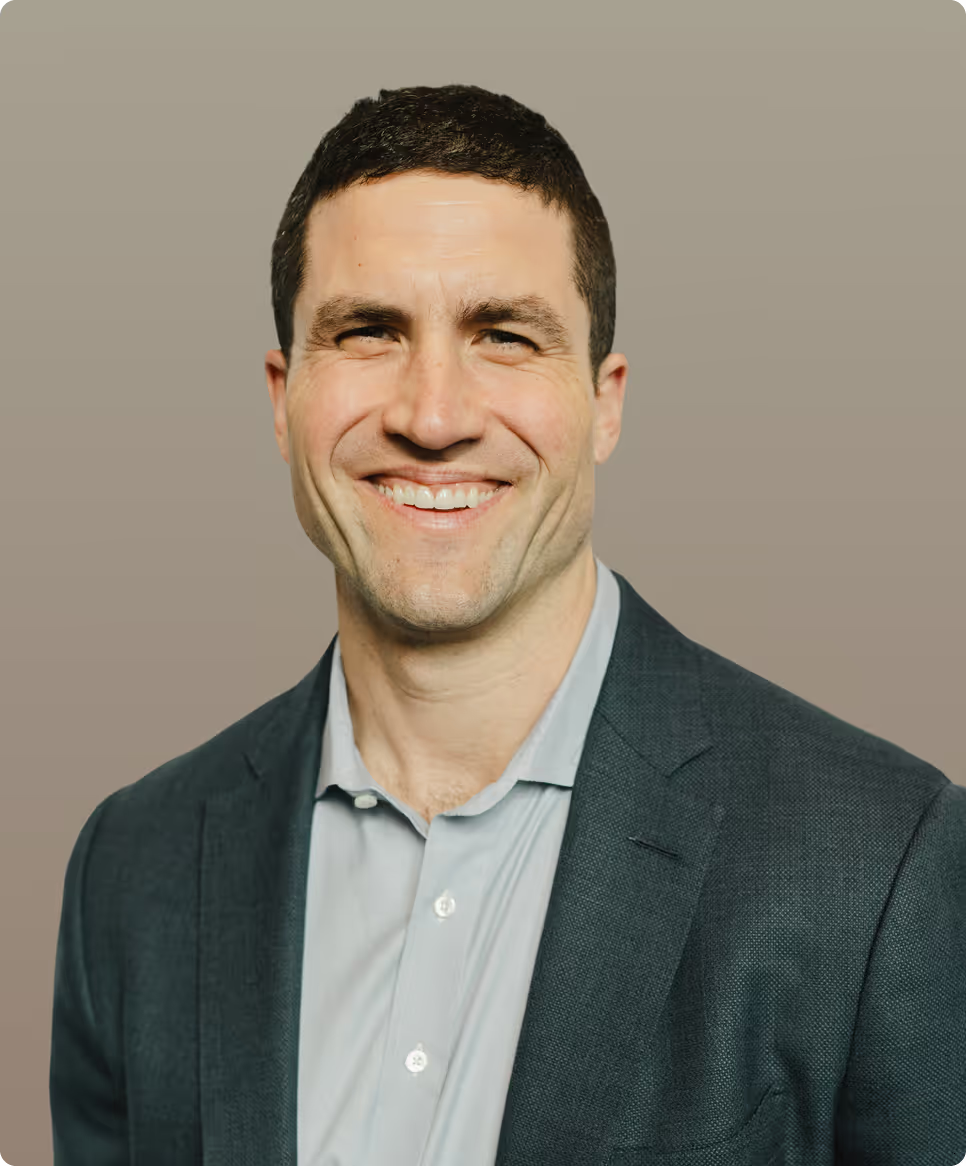
Alfred Johnson is co-founder and CEO of Crux, the capital platform for the clean economy. Before founding Crux, Alfred served as Deputy Chief of Staff to Secretary Janet Yellen at the US Department of the Treasury. Earlier in his career, Alfred was Vice President in Financial Markets Advisory at BlackRock, Senior Advisor for Financial Markets at the US Treasury, and Special Assistant to the White House Chief of Staff.
.svg)
.svg)
Share
.png)