

What it costs to make power cheap
Share
.svg)

.svg)
.svg)
About the episode
Home energy has spent most of a decade being sold as a premium product, priced at a margin homeowners would pay for something they wanted. Zach Dell says there’s a better way. He argues that electricity is a commodity, that the cheapest version is the best one, and that getting there means owning the supply chain that produces it.
In this episode, Alfred Johnson speaks with Zach, co-founder and CEO of Base Power, about what it costs to make power cheap. Zach argues the number that matters is the fully landed cost, the parts, manufacturing, logistics, financing, and tax credits added together — and that solving for any one alone gives the wrong answer.
Together, they dig into why residential batteries are the fastest capacity to add to the grid, why a supplier that works at one unit a day breaks at a hundred, and what last summer’s sourcing rules did to whether a Chinese part still makes sense. They also discuss Base Powers' markets in Texas and Illinois and growth from 60 to 650 people.
Critical Capital is a co-production of Crux and Latitude Studios. Learn more about how Crux is financing the future of energy.
Episode transcript
Zach Dell: Our view is that the best electron is the cheapest electron, and we're gonna be the most affordable and reliable power company on the planet, and we're gonna do that by building infrastructure that has a structural cost advantage because of our vertical integration and technology. That'll be a very capital-intense endeavor, but if we're able to do that in the best way possible, we'll generate really high returns on invested capital, which will drive down our cost of capital and allow us to spin the funding flywheel faster and faster and faster and increase our moat.
Alfred Johnson: For most of the last decade, home energy was sold as a premium product. Think rooftop solar, smart panels, backup generators. Homeowners bought those things because they wanted them, and they bought them at a margin that reflected that desire. But now there's a different way of thinking. The idea that electricity is a commodity and the best version of a commodity is the cheapest one. And to drive the price down, you need to own the supply chain that makes the electricity. All of this turns a technology company into an infrastructure company, and it moves the binding constraint. What sets the price on a customer's bill isn't the hardware, it's the cost of the money and the tax rules that decide where the parts can come from.
The question is whether the company can control its cost of capital to scale as fast as its customers demand.
Zach Dell: And for us to really put a dent in the problem, we have to go big. We have to go build a 20-gigawatt-hour factory, and then go build another one, and then another one. And we have to finance those things, and we have to set ourselves up to actually go execute on the opportunity in front of us.
Alfred Johnson: This is Critical Capital. I'm Alfred Johnson, the CEO of Crux, the capital platform for the clean economy. My guest today is Zach Dell, the co-founder and CEO of Base Power. Zach started the company in Austin in 2023 with his co-founder, Justin Lopas, to manufacture home batteries and sell electricity. So far, Base has raised more than $2.5 billion, most recently a billion-dollar round in August that valued the company at $13 billion.
It runs a factory in Austin, it sells power in Texas and Illinois, and it has utility partnerships with El Paso Electric, Austin Energy, and CoServ. Crux has worked with Base on tax credit sales since the company's early days. As you'll hear, Zach isn't making an argument about the technology. He's making one about the cost. A battery, a factory, a truck, and a tax credit are all lines in the same equation, and the cheapest electron wins. We talked about why he thinks residential batteries are the fastest way to meet demand, how the cost of capital ends up on the customer's bills, and what last year's sourcing rules did to the way that Base Power buys its parts. Zach Dell, welcome to Critical Capital.
Zach Dell: Thanks for having me. Glad to be here.
Alfred Johnson: So I have been listening to some podcasts you've done recently, and you've talked about this love of puzzles that you have. You've been particularly attracted to puzzles in and around energy. What has attracted you to that problem, of all the problems that you could be focused on and thinking about?
Zach Dell: Yeah, I got bit by the energy bug in college. As you know, it's not a hard one to get bit by. It's endlessly fascinating, it's massive, it's incredibly important. I think we all have the energy consumption per capita, GDP per capita correlation chart burned into our brains, and it's just massively important and impactful. And energy is the lifeblood of humanity, and our ability to consume it really is a predictor of human progress and quality of life. And that just took me in college.
Alfred Johnson: So one of the early puzzles that you tried to solve was taking human waste in India and creating an anaerobic digester to create a positive outcome from something that you wouldn't necessarily assume can be positive. How did you come around that puzzle, and what'd you learn from it?
Zach Dell: Yeah, it was a really fascinating, challenging experience, but I was struck by this problem, or two problems — there's a massive part of the population in the world that doesn't have access to sanitation infrastructure. Largely, that same population doesn't have access to affordable and reliable electricity. And we've been using the chemical process of anaerobic digestion in the US to process waste for a long time, and there's nothing particularly premium or technical or expensive about that process. You can actually do it with parts that you can buy at a local hardware store. And so as an 18, 19-year-old college kid, it struck me that there was an opportunity to solve both of those problems with a very simple, elegant solution.
And while we may have been right about some of the technical parts of the solution, there's not really a commercial opportunity there, and we had to learn that the hard way, and I think that was a good lesson to go through, but a very interesting puzzle nonetheless.
Alfred Johnson: So one thing I've always loved in talking about you is you are fascinated by both the problem of the energy system and the problem of the financial system. And I was reading this letter that Ribbit [Capital] wrote recently about the intersections and similarities of the electricity system and the financial system. It starts with that great quote by Albert Einstein that everything is energy and always has been. And they draw these parallels in the complexity and inertia of the energy system with the financial system. How have you thought about the interaction of finance and energy that are these two very complicated, labyrinthian systems, and how do you process how they interact with each other?
Zach Dell: Look, I think a couple of things. One is that they're both commodities, and commodities have properties that are inherent to them that are worth studying and understanding. And we treat electricity like a commodity, which sounds a little ridiculous to say out loud, but being very familiar with our business model, mission, vision, and strategy, we exist to make electricity more affordable and reliable. We also happen to believe that the best form of a commodity is the most affordable and reliable, but primarily affordable version of that commodity. And so we've oriented the entire business around the commodity structure and the fundamentals of a commodity business, which is a compounding cost advantage, right?
And using our tools, our strategic tools of technology and vertical integration, to establish and then continue to expand on that cost advantage over time. You also are dealing with a massive and capital-intense industry. Now, it doesn't have to be capital intense, but we think the capital-intense approach is the best fit for solving the problems of the industry.
Said differently, you need infrastructure in power to have a cost advantage. And if you look at most of the energy companies, particularly the home energy companies over the last decade, they've not been infrastructure companies, they've been product companies. And their whole product suite, business model, market approach has been oriented around this very premium product valence, selling things at a high gross margin green premium or these kinds of things. And our view is that the best electron is the cheapest electron, and we're gonna be the most affordable and reliable power company on the planet, and we're gonna do that by building infrastructure that has a structural cost advantage because of our vertical integration and technology. That'll be a very capital-intense endeavor, but if we're able to do that in the best way possible, we'll generate really high returns on invested capital, which will drive down our cost of capital and allow us to spin the funding flywheel faster and faster and faster and increase our moat.
And so it's all downstream of the fundamentals of the industry, which comes back to a commodity, and that's how we think about it.
Alfred Johnson: Yeah. I love the focus on vertical integration. It reminds me — I've heard you compare it to Tesla, who's done the full vertical integration of the supply chain. How do you see that for Base, and why do you think people haven't done that before?
Zach Dell: Well, I think that vertical integration is complicated and there's sequencing to it. We're not gonna start mining lithium tomorrow, and we're not in the cell business today. And you have to take these things, you have to sequence them, and you have to think about them in steps, and you have asymptotes in the value of doing certain parts of the step, and then you go to the next part of the step because you reach a certain scale where you justify it. Said differently, if you're buying 5% of the world's supply of anything, there's a pretty good argument to make that thing.
If you're buying 0.0005% of the world's supply of that thing, there's probably not a very strong argument to make that thing. Now, there might be because there's some kind of techno-operational reason, access to it, some other benefit you get downstream of it. That's analysis that you have to do. But we think about it in terms of what makes sense to vertically integrate today, what might make sense tomorrow, what might make sense in a decade or multiple decades from now, and we just try to see the ball as clearly as possible across that spectrum.
Alfred Johnson: One thing that I have found interesting about the way that you've talked about Base, and I think it comes back to this comparison that you drew to commodities, is you use this four-part cycle. You really break it down, and it's make, move, store and distribute. Have I got that right?
Zach Dell: Yeah, we say it make, move, store, and sell, but that's practically the same thing. That's all there is to it when it comes to energy, right? You have to generate it. You gotta move it 'cause it's often not used where it's made. You gotta store it 'cause it's often not used when it's made, and you've gotta sell it. And we see opportunities to create value across all four of those pillars. But if you really get in the weeds of these problems — which you have, and I have, and we've spent time talking about — and you spend a lot of time with these utilities who are now increasingly becoming our partners and our customers, you realize that a lot of the problems are coordination problems across the stack.
And so there's a bunch of opportunity in building products across make, move, store and sell in an individual way. But when you can optimize them together and you can solve these coordination problems with your utility partners in the regulated markets or through the vertically integrated dereg competitive market business, you create even more value and you unlock new kinds of solutions to the puzzle.
Alfred Johnson: How do you think about the vertical integration across make, move, store, and sell? Where do you wanna play in that over what progression of time?
Zach Dell: Yeah, it's a similar point around the sequencing, and as you know, running a company, growing quickly, focus is the most important thing, and we've had a lot of really incredibly talented people join the company. We've been able to raise a lot of capital. We've got a lot of momentum. Customers really like our product. And when you start to drink your own Kool-Aid, you could get very reachy in terms of things that you decide to do, and just projects you decide to take on and do those things a little bit too early, perhaps before the company's ready. Now, to some extent, you have to do that.
You have to put the team in a bit of an uncomfortable position sometimes and take risk and push the limits. But I think doing that with a perspective of focus on really establishing compounding advantages and really strong flywheels, and not taking on too much before that core business is really rolling, is something that we think about a lot.
And so we do have grand visions to build the modern power company of the electric era, and to build technology across make, move, store, and sell, optimize those things together, and get just more and more involved in and extend our resources by which we can drive down the cost and increase the reliability of electricity. But right now, we're really freaking focused on residential batteries because we think that is the opportunity to go win, and we're off to a good start, but the job's nowhere near finished. So focus is just so important.
Alfred Johnson: Say more about that. Why resi batteries? Why is that the place to start?
Zach Dell: We think it's the most scalable way to add capacity to the grid, full stop, today. We've obviously gotten off to a good start, and we'll do on the order of 500 megawatts this year and a couple gigawatts next year, and scale up from there. And I think this has been well documented — we've, I think, added more capacity to the grid in Texas than just about anybody over the last six months, and that'll become even more true across the rest of the country over the next couple of years. Because, A, there are just so many homes, there's already interconnection, you don't have to wait in the interconnection queue, and we've been able to turn the deployment process into a factory.
We have a factory across the street where we make the hardware, and we have a factory in the field. And we've designed incredible efficiency — all the way to the way the battery is designed, the way it's installed, interconnected, deployed. All these things are connected. It's because of our vertical integration, and we're able to do over 100 installs a day where we're at today, and soon we'll be at 300 installs a day, and then 500 installs a day. When you're doing two megawatts a day, and then five megawatts a day, and then 20 megawatts a day, that's just incredible scale — you can start to provide some of the supply that needs to meet this incredible demand that we're seeing in the industry, and we found that the residential model is the most scalable one.
And we can talk about other scalable models that we find interesting and why residential is better on a comparative basis, but at a high level, we think it's just the best place to deploy gigawatts of capacity really quickly and really cost-effectively. And then the most important part about it is the impact on the customer. The fact that we're able to, as our infrastructure grows and our cost structure improves, just double down on this affordable, reliable dynamic and value proposition. And it's one thing to do that for the grid and for commercial customers, but to touch everyday consumers and the American homeowner, and eventually soon the renter, and really more of the population, is really important to us — because it's just a big part of our mission, is driving that cost down for consumers.
Alfred Johnson: Zach, you talk about Texas. You have your corporate headquarters there. You took the old Austin [American-Statesman] headquarters and have built a manufacturing facility there. You're taking another very large manufacturing facility. It is also your first market. Why has Texas been the perfect place to build this business?
Zach Dell: It's really the laboratory for energy technology in the US. The ERCOT market is large, it's competitive, largely. It's about 80% competitive, 20% regulated. Although the Texas co-ops and munis, and IOUs in the case of El Paso Electric, have been great partners of ours, and we've done significant deployments with the Texas co-ops and munis, and obviously we recently announced our partnership with Austin Energy. And so Texas — regulated, deregulated — both have been just great places for us to start scaling our technology and experimenting with our solution. And it's big, it's growing fast. ERCOT is a place where a lot of innovation is happening, and it's just a really good place to build a business.
Alfred Johnson: The next place you've gone is Illinois. Why Illinois, and how is the offering different in a different state?
Zach Dell: PJM obviously is a place where the market has signaled that capacity is needed, to put it lightly, and we have a solution. And so it's back to the puzzle analogy of, hey, where is our technology most valuable? It is one of the largest deregulated markets in the country. Obviously, Chicago and the Chicagoland suburbs are a sprawling metroplex and tons of single-family homes. And so it just fits the bullseye of where can we add a ton of value? Where is there a large market for us to serve? And it's been a great place for us to scale.
Alfred Johnson: How do you think about the map from there? What are the factors that lead different states to be interesting to you? What's top of your mind on that?
Zach Dell: Yeah. Again, another endlessly interesting question that we could have a whole conversation around. So we see the dereg markets are like Texas, the Midwest, which is really Ohio and Illinois, and then the Northeast, which is like Connecticut, New York, New Jersey, Pennsylvania, Massachusetts, et cetera. Is it PJM? Is it ISO New England? How do you monetize the asset? Is it a demand response product? Is it a bulk power supply kind of wholesale market arbitrage product? Is it a capacity price concept? And these things are changing pretty rapidly, as you know, and we're pretty involved in the regulatory proceedings. And we really have two goals when it comes to policy, by the way. One is: clear the way for energy technology at the distribution grid, allow us to deploy more of it.
It's not like Base batteries have to be the only thing, right? We're very pro-energy technology on the distribution grid — allow us to deploy flexible capacity fast and cost-effectively, clear the way for that. Number two is expose that technology to the price signals required to balance supply and demand. I'm kind of a markets guy, and free markets are very powerful, and the invisible hand is kind of a genius. And when you allow that to play out, competition just leads to lower prices and better services for consumers. And so we're very pro price signal exposure and allowing supply to meet demand and have the market really decide what that's worth.
And so over time, as those dynamics play out in the Midwest and the Northeast, like they have in Texas, we think those markets become more and more interesting from a deregulated perspective. And then the regulated markets are a whole different ballgame, and this really comes down to three big buckets: the munis, the co-ops and the IOUs.
They all function a little bit differently. They're all in different RTOs and ISOs. They all have different power supply structures and constructs. And so we basically take our technology, and we fit it to the regulatory construct of the locale. And there's very strong incentives today and frameworks today for procuring batteries by these utilities. But it really varies all across the country, and we work very closely with these utilities to help them understand the value of our technology and then create the avenues by which they can go deploy it — back to the same mission: lower cost and increase reliability.
And that's why we're here. That's really our goal. In the reg markets, in the dereg markets, with munis, co-ops, IOUs, it doesn't matter. At the end of the day, we're trying to drive down price and drive reliability up, do the things that are aligned with the consumer. And look, it is hard historically for regulated industries to drive price down over time. You see that in healthcare and education and basically every regulated industry, and you've seen that in the electric utility industry. I'm not saying it's easy in deregulated markets, particularly in energy and electricity. And I think the direction of the right answer is more price signals than less — being more willing to allow technology providers to be incentivized to do their thing and produce technology and go deploy that technology, and somehow incentivizing those utilities in the regulated markets to work with those technology companies to align incentives to drop price and increase reliability.
Alfred Johnson: Yeah, dude, I love the scale of the way that you think, and it leads me to the capital that you have raised. So you just did a new $1 billion capital raise. You've now raised $2.5 billion of equity for the company. How do you think about the company's balance sheet against this massive ambition that you have?
Zach Dell: Yeah, you nailed it. We have global ambitions. This puzzle is a big puzzle, and it's just massive in scale. And for us to really put a dent in the problem, we have to go big. We have to go build a 20-gigawatt-hour factory and then go build another one and then another one, and we have to finance those things, and we have to set ourselves up to actually go execute on the opportunity in front of us. And I think that it's pretty tempting actually to try to buy down risk or basically get comfortable thinking — I won't say small, but thinking medium. When you're building a company and you're hiring a bunch of people and you're explaining the mission, vision, and strategy in the early days, if you go too far out on the ambition meter when you're explaining these things, no one will take you seriously.
And I definitely could be accused of doing that, and lots of people didn't take us seriously in the early days. But you have to strike the right balance, right? And you earn the right to get more ambitious as the company's capabilities compound. And as the team gets better, and as the proof is in the pudding, right? And we start winning, doing some things that are working, we earn the right to get a little bit more ambitious. The truth is we've always been that ambitious. We just haven't necessarily talked about it in that way because we didn't wanna scare people way too much in the early days. And you do get a dynamic where the folks in the industry who have been there a long time, who have a lot of experience seeing things done in a certain way — they take you less and less seriously, almost the more ambitious you are.
And so you have to be thoughtful about how you layer in that ambition. But energy is one of, if not the largest, depending on how you slice it, industries on the planet, and we wanna become the leading technology company in the world pointed at that industry. And so, yeah, it's a pretty freaking big opportunity, and $2.5 billion isn't gonna get us anywhere close to putting a dent in that industry. But for three and a half years in, it's a reasonably good start. But we're just getting going.
Alfred Johnson: I'd call it a reasonably good start. And when you think about equity versus debt versus the tax credits, let's just nerd out for a second on that puzzle.
Zach Dell: Yeah.
Alfred Johnson: How do you think about the different kinds of capital that you need to access into the business?
Zach Dell: Yeah. So it's a big puzzle, right? Back to the puzzle: our job is the most affordable and reliable power on the planet. And the compounding cost structure advantage provides us with the ability to drop price for the consumer. And our cost of capital is a major input in our cost structure. And as you scale and your returns go up, the cost of capital should go down. But to reach massive scale very quickly, you have to be okay with the cost of capital being high for some amount of time and deploying lots of equity to get to massive scale.
And it's very tempting — you've seen tons of companies who've tried to do this and not really made it. It's like limit the amount of equity, limit the amount of dilution because there's less risk, right? It's like you go raise a billion dollars, people are like, "Oh, congratulations, you raised a billion dollars." Now we have to turn a billion dollars into $10 billion, right? Or everyone's gonna be disappointed, and we're gonna let down a lot of people. And so it's quite risky to raise $2.5 billion in three and a half years.
But we have to, right? Because that allows us to get to the scale that we've been able to get to, and then drive that cost of capital down through these kinds of solutions — debt, tax equity. And as you know better than just about anyone in the world, these parts of the capital markets are super complicated and nuanced in their own right, and there's a scaling dynamic to them as well. We've been working since the earliest days on our tax credit monetization, and that's the beginning of a very long process of the most optimized way to monetize or optimize this part of the capital structure. The same thing is true of the debt capital markets.
We had a venture debt line like most startups do in the early days. That's obviously not the most effective cost of capital and best way to scale, of course, but you have to start in a certain place, and then over time, as you reach more scale, get more progress, returns go up, cost of capital goes down. You can optimize the capital structure. And of course, we study the crap out of all the companies that have come before us and the way they've capitalized these kinds of assets. We also study how assets that are similar, that are not really residential consumer oriented, have been financed. What are the mechanisms by which they've been financed, and how they've been able to drive the cost of capital down, and how we can actually emulate some of those things in a different industry and communicate to the capital markets how those things are similar.
And so it's a big puzzle that requires sequencing, and it's incremental steps where you're just trying to drive down the cost of capital, because that's an input to the cost structure, which is an input to the price we can charge the customer — which is why we're here, the mission of the company.
Alfred Johnson: I've been thinking a lot about how the complexity of manufacturing and energy and financial markets intersect in this very powerful way, but has this inherent complexity that's very hard for any single company or person to parse. I've seen the manufacturing facility, the complexity of the parts and the pieces that go into manufacturing what you do. Same thing is true on the capital market side, right? There's so many different kinds of capital that need to form from different counterparties with similar underwrites against each of them, but interlocking pieces that govern them. You have to innovate and be excellent on the engineering, the design, the execution, and you have to be excellent on the financial execution. How have you thought about building the right team to do that?
Zach Dell: We have to be good at a lot of things at once, which is a very hard problem because you have to go recruit all kinds of different skill sets, and you have to do that fast, and you have to keep the bar really high. But it's incredibly fun and interesting because I get to work with some of the most talented people in the world who are really passionate about solving these problems.
Alfred Johnson: When you're trying to solve these complicated problems, you are having to bring people that have all these different domain experiences under the same roof. And I love actually how much you've been talking about the mission. It shows the clarity that you have on the thing that you are trying to create. How do you create the correct language and ability for the people that are coming from radically different places to all row in the same direction?
Zach Dell: This is a great question, and the answer is, I say the same thing over and over and over and over and over again. We're all rowing in the same boat, in the same direction, talking about the mission, the vision, the strategy in a very transparent, open way constantly. So I'll just give you a couple examples.
Every month there's an update that I write, with the help of my team — three or four pages, very detailed: what happened this month, what's gonna happen next month, what are we working on, what are the problems. It all starts with how many installs did we do, right? It's the most important thing at the top of the update, and it goes to everyone at the company. Every quarter, there's a presentation I give to the whole company called Engine of Success, and it's literally how we win. It is our mission, vision, strategy, very detailed, how the business works. It's really designed for the new joiners in that quarter, but people who've been at the company for three years often join those sessions and sit in and are part of the Q&A at the end.
Every month, Justin and I do an open Q&A at lunch. Anyone at the company can ask us questions. We just stand up there and it's like anything goes, whatever you wanna know. You've been to our office a bunch. You walk around, it looks like a Best Buy in here. There's TVs everywhere. Everything that is important to measure, the metrics that matter with the company, they're on dashboards in the middle of the office for everyone to see. We run the business in an extremely transparent way, and we go out of our way to communicate the mission, vision, strategy — what are we doing, why, and how — in great detail to the team very frequently. And it's a little tiring sometimes, and it's a little repetitive sometimes, but it's actually really fun and really motivating to get to talk about these things, educate the new people joining the company, align everyone on where we're going, and just feel that energy and that passion for the mission.
But a huge part of my job is keeping everyone focused on the same stuff and moving in the same direction. And I tell the team all the time, "Hey, if you've gotten comfortable with the way the company is run today, don't." 'Cause it's gonna change. Because two years ago we had 60 people, now we have 650 people — the business is entirely different.
We're in a bunch of markets. We're building all kinds of different things. We've got a factory across the street. If you expected the company to run in the same way, you're crazy. The company is growing way faster than that, and we have to grow with it. And so the structures by which we've organized the company, managed the company, have had to grow as fast as the company, and that's really freaking fast.
And we don't have it all figured out, and we've made all kinds of mistakes, and we'll continue to make mistakes, but we will definitely just iterate until we get as close as we can to the right answer.
Alfred Johnson: Speaking of iteration and the singular focus on what you're trying to do there, you've been really focused on bringing down the cost of energy for the end user. And to talk about the supply chain piece of it, right? You're having to compose all of these components into the batteries that come from all different kinds of places. How do you think about the supply chain and the way that you are most strategic in solving the mission through the supplies that you put into the end unit?
Zach Dell: So you're solving for the lowest landed cost per kilowatt hour, net of everything. Net of the cost to buy the thing, the cost to transform the thing, the cost to move it to the place, install it, finance it. We'll talk about tax equity and tax credits and the requirements that come with that. And then you take all those things together, and you add them up to get the fully landed cost.
And if you solve for the lowest BOM cost — that might not actually be the right thing to solve for, right? Because you're buying parts from a place where you can't get credit for the tax credits in all the right ways. If you solve for the lowest manufacturing cost, you might have some things on the BOM that are a little more expensive, or the install cost might be too high because it creates something. If you solve for the lowest install cost, you create BOM problems, manufacturing problems. And so you have to look across the whole stack and have an interdisciplinary team that solves these problems together.
This takes us back to another point on company structure and organization. And again, making this up, right? This could be wrong, this could be right. This is what we've come up with. It seems to work okay so far. We'll probably change it. Most companies align in P&Ls, right? So Google is — there's a Gmail team and a Drive team and a Waymo team and a YouTube team, and there's a finance team across all, software team across all.
And some companies, it's much rarer, particularly at massive scale, align functionally, right? We have decided to align functionally, where we have a finance team and a software team and a growth team and a hardware team and a supply chain team and a manufacturing team, and that is what they do. But they do that across different geographies and different markets.
Now, what that allows is this kind of coordination, where when you have to solve for fully landed cost, you need to take into consideration the hardware design, the BOM, the manufacturing, the logistics, the installation, the financing, the tax credits, and you have to optimize across all of them. And we found that if you try to do that in these P&L-focused ways, it's really hard to coordinate — there's like seven finance people across different P&Ls that you have to talk to. It puts a lot of stress on the team. It requires you to have way better people that work way harder. That's just the truth of it, right? 'Cause everyone's running at 120% capacity, and those people need to be capable of running at 120% capacity, which most people aren't comfortable doing, and that's why we have a pretty intense culture, and we're all in the office every day, and it's the only way to make it all work and come together.
And supply chain is the crux, no pun intended, of it all, because where you buy the thing from influences the tax credits, influences how you manufacture it, influences if you can even run the factory. The people who design the part might wanna buy it from a different supplier than the people who make the part because the supplier behaves differently at different volumes, right? And so when you take things from a unit a day to ten units a day to a hundred units a day, everything breaks, the suppliers screw up.
They send you the wrong thing, it's broken, and you gotta really work with them closely to optimize across all of these parts of the stack. But it's a really hard puzzle, and one that we'll be focused on forever, and lots of companies who've come before us have thrived and died, frankly, because of their sophistication or lack thereof around supply chain. It's a part of the business that we're extremely focused on.
Alfred Johnson: Yeah, there is this really interesting intersection of supply chain and finance and you talked about how where the components come from can drive the tax credit. Just to be really specific about that for people that are listening, the law has changed a lot. So in the tax law last summer, the OB3, one of the things that they did was introduce much stricter restrictions on the use of Chinese components in order to be able to get the tax credits associated.
China has been a huge supplier of components into the energy supply chain, still is. How do you think about the relationship of Chinese components? When would you use them? When wouldn't you? How do you think about the trade-offs there given the complexity of that trading relationship?
Zach Dell: Yeah. So I'd say first things first, our domestic manufacturing capacity is a strategic advantage for the company and has been part of our thesis from day one. Our control and ownership of the supply chain is its own distinct competitive advantage, in that as you scale, being reliant on third parties is just dangerous. Whether they're located in China or they're located in Indiana, it's still just risky to have third parties control your destiny. And so we talked about the stages of vertical integration.
It doesn't make sense for us to make everything today, but it does make sense for us to design almost everything and do final assembly, test, pack — over time, the answer for what makes sense for us to do and not will change, and the geography from which we buy the parts is really a function of who's the best vendor to buy the part from, and then what do the rules allow us to do? And it's back to the question of fully landed cost, net of everything, right? When the rules change, that changes the equation on where we can buy things from. And so we have to orient the company around the facts of the game and the rules of the road.
And if you can't buy things from China, whether we like China or don't like China or feel that their products are good or bad or they're expensive or cheap, it doesn't actually matter. What matters is what can we do — run the math, run the spreadsheet math on, okay, net of all the new changes in the rules, how do we achieve the lowest cost per kilowatt hour so we can pass that value on to our consumers? And parts from China aren't inherently evil. In fact, they're often really low cost and really high quality. But if you can't buy them and claim strong incentives that exist if you can buy things from elsewhere, then it probably doesn't make sense to buy them.
For what it's worth, I think a global economy is a bigger economy, is a better economy. But I am not in charge of trade policy, so it's really not up to me and doesn't totally matter what my opinion is. What matters is what's the game on the field, how do we play it in the best way possible to serve our customers and drive prices down? And with the strategic inputs we were talking about earlier — control of the supply chain, quality vendors that we trust, that we know can scale — it's a multivariable puzzle equation, and a lot of fun to work on.
Alfred Johnson: We talked earlier about the states that you would find interesting. You intrigued me in observing that you have global ambitions for the company. How would you think about going to your tenth, fifteenth US state versus going to your second, third, fourth country?
Zach Dell: We're trying to beat the focus drum right now, and there's a lot of ground to cover in the United States of America. And so we're pretty focused on that. I think we will be probably through the rest of next year. And I think in the second half of next year, myself and Justin and some of us at the company will start to pick our heads up and look at where are there opportunities to go help customers globally and drive down price, drive reliability up.
Alfred Johnson: Zach, you've talked about how you hope Base is your first and last company. What do you think it'll look like when it's done? I know done is a charged phrase. What do you hope you're ultimately creating here?
Zach Dell: We wanna build the mechanism by which electricity becomes more affordable and reliable across the planet. We wanna build the technology company that is pointed at the energy industry and is oriented around what's important in energy, which we believe is affordability and reliability. And we think that technology is the best way to drive those outcomes. You'll hear me say affordable, reliable about a thousand times because that's really where we're focused. We believe that electricity is a commodity, and the most affordable and reliable version is the best one, and we're gonna build the best technology in the world to make that true in as many markets as possible, as fast as possible, and that's a never-ending mission. It's going to be basically impossible, and I don't even see how we would get to a point where we say, "Well, electricity's cheap enough. I think we're good." That's not going to happen.
Our ability to consume electricity is directly correlated with our quality of life, our ability to innovate, and the direction, and magnitude, of progress in the world, and we see inflecting that price down as the best thing we can do to push humanity forward, and that's a mission that will outlive me. And I sure hope that the company outlives me. If it doesn't, we've messed up somewhere, and this is a never-ending mission, and it's why I got so excited to burn the boats and go all in and commit my life to this thing, and I think Justin would say the same, and so would many of our leaders. It's really exciting and boundless, and it's in the scope of the ambition.
Alfred Johnson: What a great place to leave it. Zach, I have gotten so much value in watching you operate. You really are exceptional at it, and it has been a pleasure to be your partner at Crux as you have grown the business. So thank you. Thanks for coming on Critical Capital. We'll talk to you soon.
Zach Dell: I really appreciate it, Alfred. It's been awesome to work with you and your team and look forward to doing a lot more together.
Alfred Johnson: Awesome. Zach Dell is the co-founder and CEO of Base Power, an innovative and fast-growing home electricity company based in Austin.
If these conversations are useful, follow Critical Capital wherever you listen, and send this to somebody who's trying to finance something physical. Critical Capital is a co-production of Crux and Latitude Studios. Our production team includes Nate Peavey, Jenna Herzog, Anne Bailey, Stephen Lacey, and Sean Marquand. The show is mixed by Matthew Filler. Additional production by Emily Hughes and the team at Crux, the capital platform for the clean economy. I'm Alfred Johnson. Thanks for listening.
Want to explore more conversations like this?
Browse all episodes
Hosted by
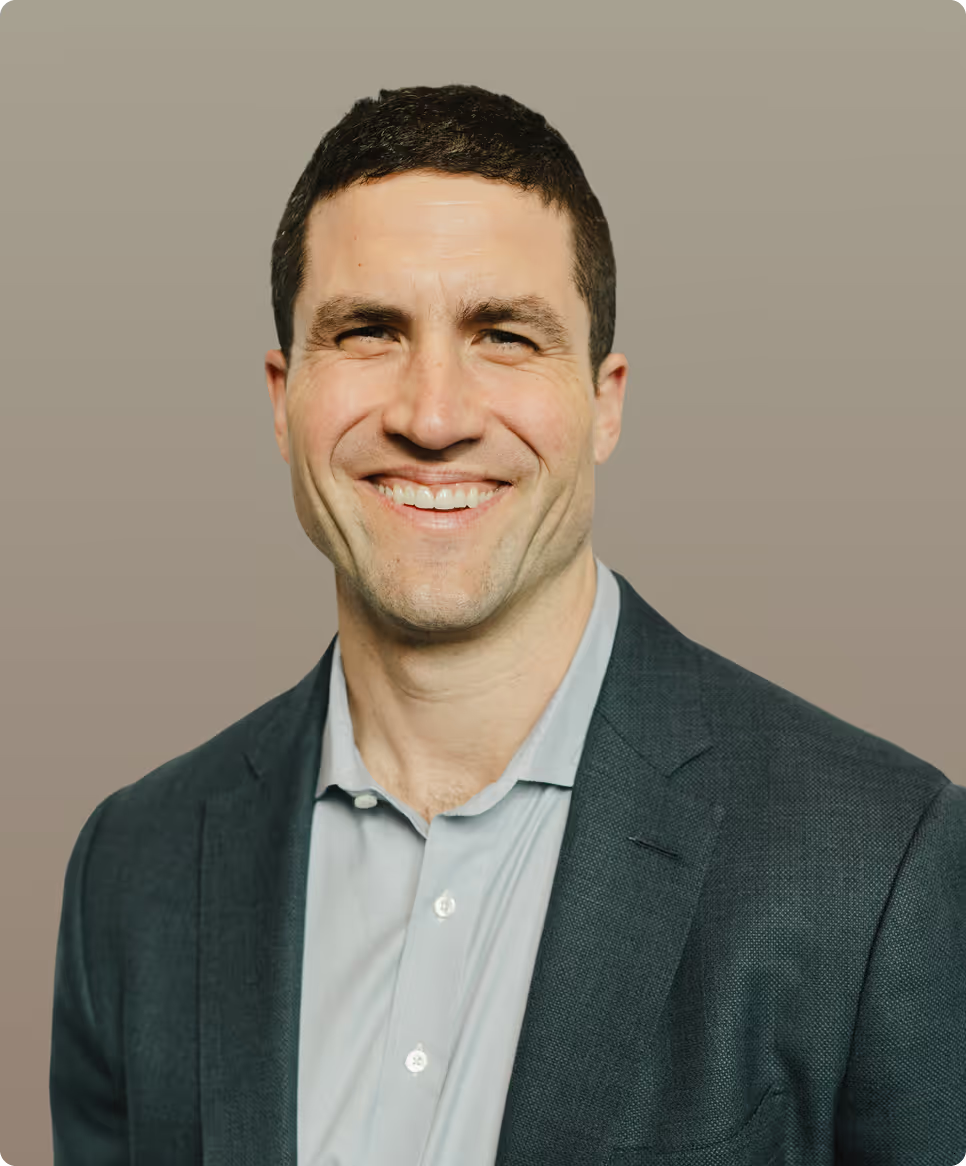
Alfred Johnson is co-founder and CEO of Crux, the capital platform for the clean economy. Before founding Crux, Alfred served as Deputy Chief of Staff to Secretary Janet Yellen at the US Department of the Treasury. Earlier in his career, Alfred was Vice President in Financial Markets Advisory at BlackRock, Senior Advisor for Financial Markets at the US Treasury, and Special Assistant to the White House Chief of Staff.
.svg)
.svg)
Share
.avif)