
What it takes to build in America again
Follow on


Share
.svg)

.svg)
.svg)
About the episode
American industry is building factories, mines, and grid hardware at a scale not attempted in decades, and the capital is there. But Erin Price-Wright says the cost of money no longer sets the return on an industrial project. It’s the time spent waiting on a regulator.
In this episode, Alfred Johnson speaks with Erin, who joined Andreessen Horowitz's American Dynamism practice in 2024 to invest in energy, mining, and industry. She argues the grid's real constraint is transmission and equipment, not generation, which has made smaller, faster hardware competitive with scale.
Together, they dig into where venture equity stops and project finance begins, why credit investors distrust the timelines founders quote them, and what she wants written into law so builders can plan past one administration. They also cover Mariana Minerals winning permits to expand a southeast Utah copper mine in a reported six months, and why a first factory stays near its engineers while the second follows the fastest-building states.
Critical Capital is a co-production of Crux and Latitude Studios. Learn more about how Crux is financing the future of energy.
Episode transcript
Erin Price-Wright: The states and regions that figure out how to build — whether it's data centers, whether it's new factories and industrial facilities — are gonna be figuring out the really hard problems around how we modernize our grid. How do we bring more flexibility and resiliency to the grid? How do we do this without hurting consumers?
Alfred Johnson: For decades, electricity demand in this country barely moved. Efficiency gains canceled out growth, and the grid had room to spare. But that era is over. Data centers, electrification, and new manufacturing arrived all at once, and the country is now trying to build the physical infrastructure to carry them — the factories, the mines, and the transformers that tie them to the grid. The money is there: venture funds, infrastructure funds, and private credit have all moved into a category that barely existed five years ago. But the clock is not. A five-year fight over a permit doesn't just delay a project — it compromises it.
So the constraint has moved. It's no longer just the cost of capital. It's how long a builder waits for an answer, and whether that answer survives the next election.
Erin Price-Wright: These communities that are attracting this type of industrial build-out are gonna have to figure out what the talent and training pipelines are to get people into these jobs. The regions that figure it out will be the winners of the next 20 years of the new industrial build-out.
Alfred Johnson: This is Critical Capital. I'm Alfred Johnson, the CEO of Crux, the capital platform for the clean economy.
My guest today is Erin Price-Wright, a general partner at a16z. Erin joined the firm's American Dynamism practice in 2024 to lead its investment in the physical economy — energy, mining, and heavy industry. She spent her early career as an engineer at Palantir, much of it working on oil and gas. Her portfolio is a decent map of where the money is actually going in clean and critical infrastructure: she's invested in Base Power in distributed energy, Mariana Minerals in critical minerals, and Heron Power in grid equipment.
Erin works on the least glamorous part of this build-out — not whether the technology works, but whether a factory can get permitted, financed, staffed, and welcomed by the place it lands in. We talked about where venture money stops and project finance money starts, why credit investors don't believe the timelines founders are quoting them, and what it takes for a community to want a mine.
Alfred Johnson: Erin Price-Wright, welcome to Critical Capital. It's so great to have you here.
Erin Price-Wright: Thank you. It's great to be here.
Alfred Johnson: Okay, so here's what we do here. The thesis of the show is that energy, infrastructure, markets, and policy are all inextricably linked, but people don't talk enough about how they tie together. That's also part of the thesis of American Dynamism — that we need to be investing in the new generation of energy, infrastructure, defense, and aerospace. When you launched the AD practice in 2024, I remember that felt like an unusual thesis. Now it feels like every fund, or many funds, is doing some version of it. What do you think has changed over the past few years, and how do you see the macro forces behind American Dynamism?
Erin Price-Wright: You're so right. When we started investing in the category — well over five years ago, before I was even at Andreessen Horowitz — it was kind of lonely. It was a little cold: you'd make an investment in a company, and you had to be willing to support it through many rounds of capital raising because there was no one else there. Now the water is warm.
I think people have realized that, and there are a lot more players in the space now than there were even just a couple of years ago. We're quite happy about it. I think the amount of capital coming to these categories is a strong sign of how big the growth opportunity is, and I think it's fueled by a few different tailwinds.
First, there's broad, bipartisan recognition that we need to build in the United States again. We're feeling the effects of our aging energy grid — not just for AI data centers, but broadly across the spectrum. If you wanna build a new factory or a new industrial site today, it's very hard to get that done, and consumers are feeling that in their pocketbooks as energy prices go up. We're also realizing that we rely on foreign adversaries for 90-plus percent of the critical materials and components we use in our day-to-day lives, whether it's refined copper or rare earths.
So there's broad-based recognition on the policy side that this needs to change. And off the back of that, we had Palantir's stock price doing very well. We had Anduril performing very well as a startup in the defense category. We had a SpaceX IPO, which was a massive liquidity event for folks who'd been investing in harder tech and capital-intensive companies for a long time.
So suddenly there's a realization that you can actually make money investing in these categories — that building hardware and building physical things is truly a moat, especially in the age of AI. It's hard to build a factory, it's expensive, and it takes a long time, but if you do it, it's not easy for OpenAI or Anthropic to release a new model that suddenly displaces your factory. All of that combined makes for a very exciting time in the world of American Dynamism.
Alfred Johnson: Yes. And when you first came into the practice, the focus was on energy, and we're seeing so much development in the power system. You mentioned consumers feeling it in their pocketbooks — rising electricity prices, AI data centers hungry for power. One thing I've been looking at recently is the number and size of rounds in frontier power generation: categories like nuclear and geothermal are raising a ton of capital. How do you see the evolution of frontier power generation in this moment, when everybody is suddenly aware that everything is energy?
Erin Price-Wright: It's a great question, and it's exciting to see energy come back around. A lot of the technology on the grid is very old — installed in the '70s, and it's starting to reach the end of its life — and that's happening at the same time we need to add a lot more capacity and generation to the grid.
So this is a really exciting moment, where utilities, data centers, communities, and investors are all interested in exploring energy generation technologies we haven't really thought about in a long time, because we'd been perfectly happy with the status quo. Suddenly everything's fair game — may the best technology win.
Zach Dell, the CEO of Base Power, has a quote I love: "There's no sexy electrons." No electron is cooler or better than another. It's really about who can generate power that gets to the end user when they need it, for the cheapest price possible. So the race is on.
Alfred Johnson: If I were to quarrel with Zach's point, I'd submit that a sexy electron is one that's delivered quickly and cheaply. We're in a moment where that's what people want. How are you seeing the pressure to build new generation as quickly as possible and get it onto the grid, given all the structural constraints around it?
Erin Price-Wright: That's a great point — sexy equals fast, cheap, and reliable.
Alfred Johnson: Yes. Yes.
Erin Price-Wright: And that looks different in different circumstances. A sexy electron for the island of Guam, or an Army base in Alaska, is a different type of sexy electron than one powering the city of Austin. People tend to think about energy generation technology as: obviously bigger is better, bigger is more efficient, so we should be optimizing for massive plants — nuclear reactors, natural gas plants, whatever — because we need to add net-new capacity to the grid in a big way.
What people forget is that the actual bottleneck on the grid isn't the energy generation itself — it's how the energy gets from where it's generated to the end user. The bottleneck in our energy system today is really that transmission piece. What's exciting about Base and a lot of the other technologies we're investing in at Andreessen Horowitz is that they're bringing new models of generation and transmission to the grid, and ultimately to the end consumer. We could build as many new massive-scale natural gas plants as we want — the actual challenge is the grid interconnect.
What Base is doing, for example, is building a massive distributed battery storage system, where instead of a single point of failure on the grid, you have thousands and thousands of homes acting as little power generation sites that add resiliency and speed to the grid itself.
Similarly, you have companies like Heron Power building the technology to allow that scale, flexibility, and resiliency in the grid. Also a lot of the smaller nuclear reactor companies coming out — they're maybe not perfectly optimized for price per electron, but they're optimized for speed to power, where you can build a nuclear reactor the way you'd manufacture a car or a prefab home. You remove the need for an interconnect queue at the point of generation if you're bringing power where it's actually needed on the grid.
Alfred Johnson: Let's build on what makes this moment so unusual and take it into project finance. Software defined a generation of venture investment because it was so capital-light, and these companies are the opposite — very capital-intensive, because they have to be in order to deliver the scale they're seeking. How do you see the amount of equity investment that's gone into these categories, and the associated project finance needed to scale out the infrastructure? Where do you see the opportunities, and where do you see the gaps in access to that capital?
Erin Price-Wright: It's a really good question, and something we talk about a lot internally at Andreessen Horowitz — what's the right place to put a venture dollar? One thing we're noticing in this moment in AI is that the ability to deploy CapEx, to build factories and physical infrastructure, has been massively disrupted by AI. You need to be able to prove that out.
Let me give a couple of concrete examples. Say you're building a new industrial facility, whether for energy generation or a factory: a huge amount of time gets eaten up in the regulatory and permitting process, and it's a ton of paperwork. To approve a new nuclear reactor, for example, it's thousands and thousands of pages of documentation — and if you have so much as a period in the wrong place, your entire application can get kicked back to you, which is a six-month delay in getting your permits and approvals.
This is a great use case for LLMs. They can massively speed up the entire process of building and commissioning a factory, turning something that isn't financeable with project finance into something that is — because the time value of money really matters for project finance. The way we think about it with our companies is that factory zero, or plant zero — the first version, the first iteration — is often funded with venture dollars, and we're in a moment where venture dollars are available for that.
You can raise venture capital right now to build a factory, which is exciting. That doesn't mean every dollar you plow into the ground for the lifetime of the company should come from VC — that's your highest cost of capital as a founder. You're essentially trading away future cash flows and future equity in your company, and if you're an ambitious founder building a hundred-billion or trillion-dollar company, that's a massive thing to give away.
But it might be the case that you have to do that to get the first factory or two off the ground. Then we see project finance come in later, once some of the metrics and track record are proven — the ability to show customer deposits, the ability to show you can actually build and deliver against these project timelines.
Then you can raise project financing against that. We're starting to see large credit funds — people who'd usually play in a very different space — come into earlier equity rounds, because they're all competing to be the long-term capital partner for some of these businesses. The nature of a company's capital stack really changes over the lifetime of the business.
Alfred Johnson: It's a really interesting theme we see in the project finance and tax credit markets: there's almost unlimited capital interested in the very large-scale, utility-sized project with high-quality offtake. But there's this space in between.
Erin Price-Wright: There's the middle, yeah.
Alfred Johnson: That middle, where you need some other kind of project capital — there's a gap we see there in scaling out this stuff. What themes are you seeing, and what do you wish would start to happen in private credit and other categories to finance this scale of build-out?
Erin Price-Wright: It's a great question. I think there's still a bit of a gap, and founders tend to fill it with an array of things right now. There are enough venture players in the market that they're often filling that gap with venture capital, which I don't think is necessarily the most efficient way to do it.
I think we have to get better at telling the financial story — really rooted in the numbers and the data — to a broader credit market, showing how these business cases can actually look when you run them with software. What's hard for some of the more traditional, conservative credit investors is that founders are telling them a story that, relative to their experience, is somewhat unbelievable.
The idea that you can use AI to get a permit in six months instead of eighteen. The idea that you can use AI to project-manage ten thousand contractors and consultants on the actual build of your project and deliver ahead of schedule and under budget. That idea — delivering ahead of schedule and under budget — isn't in our industrial vocabulary anymore, because it hasn't been something we've done as a country in decades. The companies we invest in are starting to do that.
The number of board meetings I've had over the last year where the founder says "ahead of schedule and under budget, ahead of schedule and under budget" is heartening, and I'm excited about it. But how do you convince a more traditional credit investor to believe that story? It's actually one of the roles we really help our companies figure out how to hire for: the first CFO who can come in and translate this incredible vision, momentum, and technology-based speed to an audience of more traditional finance people. It's a very hard role to hire for.
I'd also say there's probably a role for government here — not to get too policy-wonky, but some of that bridge should come from government stepping up and saying these are strategic priorities, whether through loan programs, tax credits, or other financial incentives to encourage building at home. There are a lot of tools in their toolbox — some they're using, some they could probably use more.
Alfred Johnson: The gap is real, and in some cases it's just not economic for the market to fill. We've seen the government take equity stakes in companies like MP Materials in the rare earth space, and use the loan programs office, EDF, in different ways. What else do you think the government could or should do to accelerate this category of companies?
Erin Price-Wright: So much about underwriting a business comes down to certainty, and so much of the uncertainty in many of these categories is policy- and regulatory-related. Am I going to get caught in a five-year, protracted battle of public comment to build my factory or my power installation? Is there going to be public backlash that gets me stuck in approval-cycle hell, where nobody's motivated or incentivized to move my permit application from one stage to the next?
It's kind of a philosophical thing. Regulations matter — they're there for a reason, and I'm not saying we should get rid of all regulation. But what we need is more certainty that if you're a business, and you meet the letter of the law, and you go through the regulatory process, you'll get a definitive answer at the end — a yes or a no, in a reasonable time period, so you can plan for your business. And that answer needs to be final: you're not going to end up in some courtroom later; there's a statute of limitations on the decision the EPA or a local regulatory body reaches, and your project will get built.
Right now in this country, that is not the case whatsoever. If you're building a large industrial project, you could never get an answer. You could be stuck in a regulatory loop, bounced from one regulatory body to another for years and years. And that time delay is what materially impacts the IRR of a project.
So more important than any particular financing tool the government has, I think regulatory and permitting certainty — rules that let founders and entrepreneurs actually plan projects, and finance those projects with some degree of certainty for their investors that they'll happen on the schedule they expect — is the most valuable thing the government could do right now.
Alfred Johnson: I couldn't agree more. We're talking about infrastructure — which typically takes years to build and decades to pay off — and if the law around tax credits keeps changing, or it remains hard to access the permitting approvals you need to build the facility, it's very hard to build here.
Erin Price-Wright: You can't plan. It's very hard to plan. Both this administration and the last one have done great things on the executive side to push their agendas forward, but a lot of that needs to actually be codified in law, so it doesn't flip-flop between one set of pet projects and another with every change of administration. We need this codified in law so that entrepreneurs and builders in this country can look ahead — not two years, but five, ten, twenty years — and know they can actually plan their businesses.
Alfred Johnson: We now see something like 70% of critical minerals in key categories mined in China, and 90-plus percent refined there. Part of that is because it's hard to build here, and part of it is because it's been uneconomic to produce things like lithium and copper and other key components domestically. It's such a strategic advantage that China has over us. How do we change that?
Erin Price-Wright: On the permitting reform side, we have a company, Mariana Minerals, building vertical mining and refining capacity domestically in the United States. They own and operate, among other projects, a large copper mine in southeast Utah, which they're getting ready to expand significantly, massively increasing the mine's copper output. They applied for federal permits to expand that mine, and everyone told them it should take 18 to 24 months. It took six.
The Department of the Interior and the Department of Energy are very focused on this right now. It was still a thorough, detailed review with lots of comments and feedback, but they stuck to their mission of bringing critical minerals back to the United States, and got them their permits within six months.
That was very heartening, and I hope we see more examples of it, because these are things we need to be able to do again in the United States. The reality is that mining and refining technology has come a long way since we were the mining leaders of the world.
I'd frankly prefer that the mines of the future get built in the US, where we have strong environmental and labor regulations. We can make sure these mines aren't polluting, that they're operating safely, and that environmental cleanup is happening — and we get our own critical mineral supply that we can actually rely on.
So there's been a ton of activity in the space. The government's been very involved. There have been huge opportunities to bring technology into these sectors, and it's great for allowing us to mine economically in the US, at a cost competitive with mines in other parts of the world.
Alfred Johnson: I'm optimistic about this, and Mariana is one of the best examples out there. But it's still hard. I had Senator Thom Tillis of North Carolina on the show recently, and we talked about domestic mining. He used the example of a very large lithium deposit in North Carolina that had some momentum, but lost steam as the price of lithium cratered. I pushed him on how much of this we can actually have in the United States.
One of his answers was: "We can have a lot of it, but we're going to need to build the base of mining and refining with other allies, for a bunch of reasons." American Dynamism has "American" in the name. How do you think about investing in the capabilities of other allies and the rest of the world when it comes to these supply chains?
Erin Price-Wright: On the mining and refining side, one great example is lithium. We don't manufacture very many batteries in the United States — battery cells in particular, and battery packs — though that's changing. The vast majority of battery cells in the world are manufactured in China, and the ones that aren't are usually manufactured in Korea or Vietnam.
When you think about the price of lithium, and how to avoid the volatility that makes it a hard mineral to underwrite in the United States, a lot comes down to how you design offtake agreements with your partners. If the buyers of lithium are largely Korean or Japanese conglomerates who'll actually manufacture the battery pack, this becomes a State Department, geopolitical-level question — and it's an important one to solve, because we're frankly not going to be able to solve it internally, within the United States alone.
What matters is that we have the self-determination to make things ourselves, and aren't totally and completely reliant on a large global adversary for 90% of the critical things we need in our daily lives. If we can diversify away from that, and build a coalition and partnership with our allies outside of reliance on China, that gives us a lot of strength in negotiations for other things. It's all bargaining chips, and we don't have any chips to bargain with if we can't make anything domestically.
Alfred Johnson: We talked about sexy electrons earlier. Let's talk about the sexiest part of the electrical stack: electrical equipment. We're working our way from critical minerals to the thing that actually takes the power where it needs to go. You're an investor in Heron — we had Drew Baglino on the show. Talk about why transformers and other pieces of electrical equipment are so important to American Dynamism and reindustrialization.
Erin Price-Wright: As I was mentioning earlier, the grid is largely built out using technology invented in the '40s and '50s and deployed in the '70s, and all of it is reaching the end of its life and is very hard to replace. Transformers today — if you've ever driven by a utility substation on the freeway, you've seen these massive pieces of machinery. A transformer is many tons of electric steel.
There's one producer of electric steel in the United States today. It's a special kind of steel that gets coiled up, filled with oil, and deployed essentially blind. You hear talk about needing more observability for the grid — how do we get more flexible about data centers connecting to the grid, or loads, or usage, how do we understand what's really going on? Right now on the grid, we're completely flying blind, because the entire system that powers our lights runs on extremely dumb technology, and we have no ability to understand or control it at all. So you have those transformers, and about ten other pieces of equipment that are similarly bulky, cumbersome, heavy, and have a very limited supply chain — there are only a couple of players in the world that make them. It's technology that's been around for decades.
The thesis for Heron, Drew's company, was: let's take the technology we pioneered and developed at Tesla — first for the powertrain in Tesla vehicles, then for Tesla Energy — and scale it up for the grid itself, starting with the way data centers and energy generation projects actually connect to the grid, whether that's solar, batteries, nuclear, or other sources.
They're building what's called solid-state transformers. Instead of using large drums of oil to modulate electricity on the grid, they use silicon carbide — it's basically software instead of hardware for managing electricity flow on the grid. A couple of other companies are building this too, and some of the large industrial players have caught on. The space is heating up, and we're very excited — they recently announced their first factory in California, so these will be coming off the production line next year.
Alfred Johnson: One theme I've found really interesting recently is site selection, and it's gone differently than I anticipated. There was a moment where it seemed like everybody was siting these facilities in Texas, but we've also had this explosion of AI in Silicon Valley, and a lot of these companies are being formed there — Heron isn't the only one choosing to put its manufacturing in California. What themes are you seeing in where people choose to put their facilities?
Erin Price-Wright: There's huge value in having engineering co-located with manufacturing, especially for a factory zero or factory one. As you're learning how to scale processes, and what breaks on the engineering side as you get to larger scale, it's very hard to beat having those two things tightly coupled and co-located — which is one of the reasons a lot of our companies open factory zero in California: that's still where the largest concentration of engineers is today.
But we're quickly seeing that expansion move outside California, and some companies have opted out of it altogether — Base Power is building in Texas. I think the American Dynamism portfolio has close to ten companies based in Texas now. This gets back to some of the public sentiment around data centers, where you have states and communities rejecting them, and states and communities welcoming them.
My theory is that the states and regions that figure out how to build — whether it's data centers or new factories and industrial facilities — are going to be the ones figuring out the really hard problems: how do we modernize our grid? How do we bring more flexibility and resiliency to the grid? How do we do this without hurting consumers? How do we get hyperscalers and other large players to help underwrite and pay for the costs the system incurs from these upgrades and modernizations? How do we train a local talent pool for the high-skilled labor these operations require — electricians, electrical techs, equipment repair, quality engineers, manufacturing techs — high-skilled jobs that don't necessarily require a college degree? Communities attracting this type of industrial build-out are going to have to figure out the talent and training pipelines to get people into these jobs.
The regions that figure it out will be the winners of the next 20 years of the new industrial build-out. We're already starting to see some states emerge strongly in this fight — Utah has been an incredible partner to many of our companies, along with Arizona and Texas. California still has a lot to figure out.
I think there will be winners and losers, and my hope is that more states realize there's value in learning what it takes to build new industrial projects again.
Alfred Johnson: You talked earlier about how important certainty is, and one thing I've found notable is how quickly local politics are changing. Governor Abbott in Texas was at data center openings not long ago, and now there's talk of a moratorium on new data centers in the state. When you look at the landscape of states, are there places where the themes in Utah or Arizona could be replicated elsewhere, to give more certainty over a longer period of time?
Erin Price-Wright: Great question. A lot of it comes down to how state and local governments work with business leaders to prove value to the community as early as possible. You have to get creative about how you tell the story to the public, which often means putting money up front and doing things earlier — before there's necessarily an ROI for the project itself — so the community feels like the company coming in, whether it's a data center, a mine, or a factory, is genuinely committed to being part of the local economy.
One example: Mariana Minerals took over a mine site. At the height of the mine's operations before Mariana bought it, it employed hundreds of people — I can't remember the exact number, maybe 300 or so. Then the mine went bankrupt because they couldn't produce copper economically. Today, Mariana Minerals has something like 150 people at that site, which is probably close to the max pre-expansion. Some people, when they talk about AI and jobs, compare that 300 number to the 150 and say, "They're employing half as many people as the mine did previously."
But really, you should compare that 150 to zero, because that's how many people were employed when the mine went bankrupt. Mariana worked very closely with local leaders — in the public high schools, the local community colleges, the community centers — building out training and education programs to help the community understand the job prospects for young people entering not a mining job, but a high-skilled labor job. These are AI mine operators: you're learning to use AI tools and computers, learning to fix complicated robots, machines, and hardware, rather than going into a pit and swinging an axe. These are future-proof, high-skilled jobs, even coming straight out of high school into a vocational training program. And they did that community engagement very early in the process of operating the mine.
I think everybody in the industry has to feel like it's their job to do that storytelling and local advocacy work, and some are realizing that a little too late.
Alfred Johnson: Erin, one thing I've always appreciated about you is that you bring optimism to the work. You self-identify as an optimist, which not every venture capitalist does.
Erin Price-Wright: They're in the wrong job.
Alfred Johnson: We're in a moment with a lot of pessimism — about what AI is going to do to the economy, to jobs, to national security. End us on your take: what does this look like if we do it right? What does that mean for America, and for the world?
Erin Price-Wright: I fundamentally believe we're at the very beginning of the next era of true industrial growth in the US. This will be twenty years of intense build-out, and we're going to learn so much and grow our economy so much. What's exciting to me as an American Dynamism investor is that this isn't contained to the software and cloud world we've lived in for the last two decades.
The reality is that a huge swath of America has been left behind in that journey. They've benefited to some extent on the consumer side, with things like Uber and DoorDash making their lives easier, but the bottom line of their lives has been less impacted by the economic growth that software eating the world has brought than some of us in Silicon Valley might feel comfortable admitting. What's exciting about this next industrial build-out — powered by many things, with AI a big driver — is that it's going to affect every single American. It's going to affect Americans who have nothing to do with tech, Americans who don't live on the coast, and provide economic opportunity to far more people than we've seen benefit from technology over the last twenty years. I'm really excited about that, and happy to be part of it and investing in it.
Alfred Johnson: What a great place to leave it. Erin Price-Wright, thanks for coming on Critical Capital.
Erin Price-Wright: Thank you so much for having me.
Alfred Johnson: Erin Price-Wright is a general partner at a16z, where she invests in energy, mining, and industrial companies for the firm's American Dynamism practice. If these conversations are useful to you, follow Critical Capital wherever you listen, and send this one to someone who's trying to get something built.
Critical Capital is a co-production of Crux and Latitude Studios. Our production team includes Nate Peavey, Jenna Herzog, Anne Bailey, Stephen Lacey, and Sean Marquand. The show is mixed by Matthew Filler. Additional production by Emily Hughes and the team at Crux, the capital platform for the clean economy.
I'm Alfred Johnson. Thanks for listening.
Want to explore more conversations like this?
Browse all episodes
Hosted by
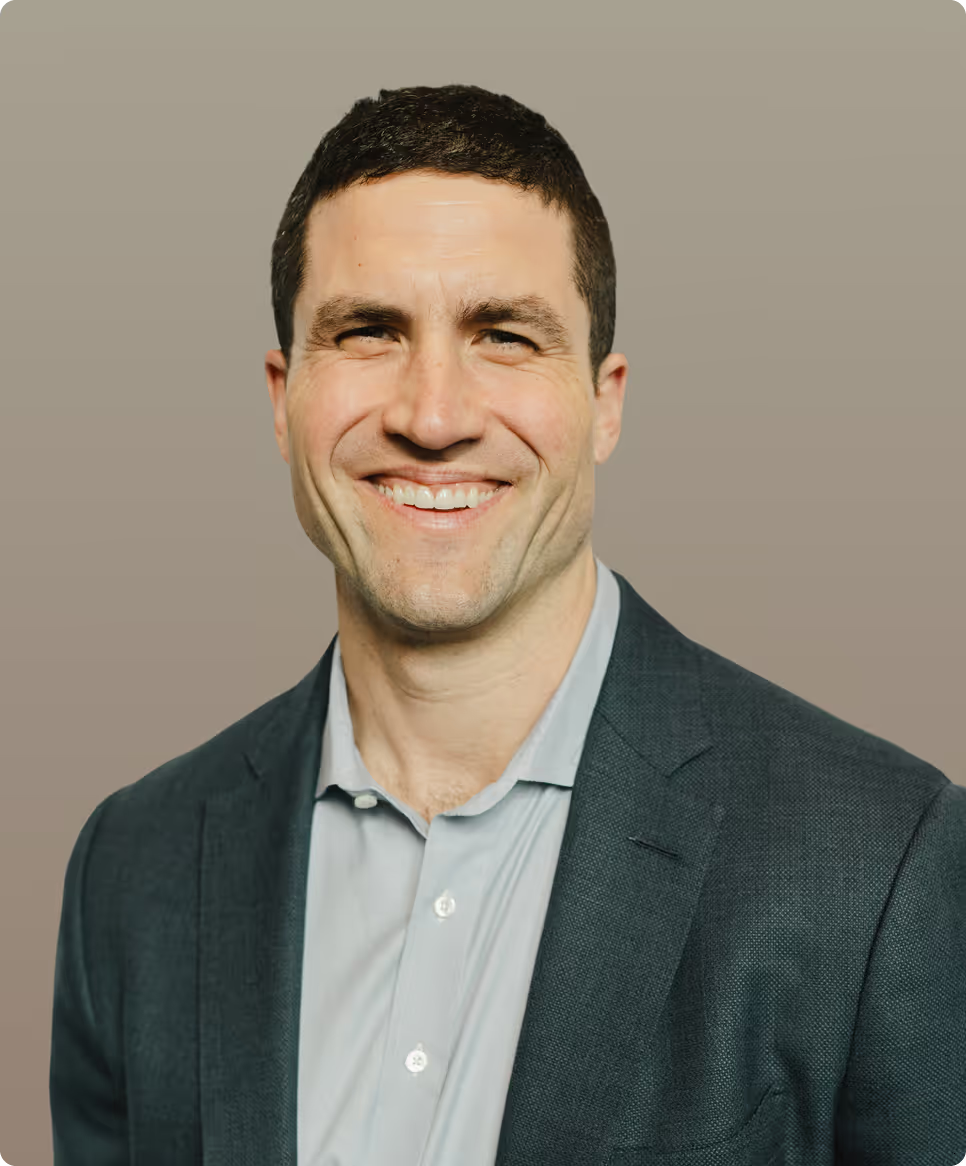
Alfred Johnson is co-founder and CEO of Crux, the capital platform for the clean economy. Before founding Crux, Alfred served as Deputy Chief of Staff to Secretary Janet Yellen at the US Department of the Treasury. Earlier in his career, Alfred was Vice President in Financial Markets Advisory at BlackRock, Senior Advisor for Financial Markets at the US Treasury, and Special Assistant to the White House Chief of Staff.
.svg)
.svg)
Share
.png)
.png)