
Data centers gave nuclear its moment. Can it deliver?
Follow on


Share
.svg)

.svg)
.svg)
About the episode
The rush to build data centers has sparked an energy debate: will gas meet the growing demand, or will clean firm power such as nuclear step in? Nuclear has bipartisan support, new contracts from tech companies, and the capital to build. What it needs, according to Lara Pierpoint, is to be built on time and on budget with government support that lasts.
In this episode, Alfred Johnson sits down with Lara Pierpoint, managing director of Trellis Climate at Prime Coalition and a nuclear engineer by training, to talk about what it will take to build clean power for the data center era.
Together, they dig into whether nuclear can get out of its own way on costs, why data centers now draw the local opposition that nuclear once did, and what AI means for the security of the grid. They also cover what hyperscalers will pay for and how to make government funding promises last from one administration to the next.
Critical Capital is a co-production of Crux and Latitude Studios. Learn more about how Crux is financing the future of energy.
Episode transcript
Lara Pierpoint: I'm not fully pessimistic that this is just a moment where we build data centers fueled by nothing but fossil fuels and that's the end of the story. I think it really is going to create some interesting opportunities for innovation and scaling of some of the technologies that we've been building for a long time.
Alfred Johnson: The rush to build data centers has opened up a strong and still unsettled debate within energy. Will gas be the primary source that meets all this demand, or will it be a historic opportunity for batteries, distributed resources, and clean firm resources like geothermal and nuclear? Nuclear looks like it's going to be one of the biggest long-term winners. The technology has strong bipartisan support and technology companies have invested heavily in plant restarts and upgrades while signing contracts for new advanced reactors. But in the short term, there are still unanswered questions about whether the industry can pull off large, complicated projects without blowing through budgets and schedules. Nuclear may have found its moment. The question is: can it deliver?
Lara Pierpoint: I think nuclear does have some unique characteristics and I think can play a really important role here. And I think the question has always been and continues to be: can nuclear get out of its own way on costs?
Alfred Johnson: This is Critical Capital. I'm Alfred Johnson, the CEO of Crux, the capital platform for the clean economy. My guest today is Lara Pierpoint, Managing Director for Trellis Climate at Prime Coalition. Trellis helps fund first-of-a-kind projects across sectors like advanced nuclear, geothermal, and carbon removal. Lara started as a nuclear engineer and she spent her career studying how money moves through the energy space, from the Department of Energy to a utility and now deploying catalytic capital herself. This was a really fun conversation. We covered a lot of ground. We talked about nuclear's window of opportunity, the data center backlash, and updated concerns about AI security. Lara also hosts The Green Blueprint. It's a great podcast about the architects of the clean economy. She's interviewed a lot of people in the energy space over the past two years and has a great perspective on technology and finance. We started first with how she views the problem set for clean infrastructure.
Lara Pierpoint, welcome to Critical Capital.
Lara Pierpoint: Thanks so much for having me, Alfred. I'm excited to be here.
Alfred Johnson: I have to say this is a particular joy because I don't get to interview other podcasters very often. And I think that's also the first time I've self-identified as a podcaster. But I've been a big fan of your show for a long time, and so it's wonderful to have you here.
Lara Pierpoint: Well, thank you. It's really fun to be interviewed for once after a while here, so I'm really excited.
Alfred Johnson: Well, Lara, we scour the world for people that have perspective at the intersection of energy, markets, and government, and I think you're unique from that perspective. You're a nuclear engineer, you have served in government at the DOE, you briefed the Senate in testimony, you have been at a utility, you are an investor, and in that sense, you reach across all these different domains that we talk about on this show. And I wanted to start at the highest level.
So, one thing I am often struck by when we talk about the problems facing us in energy is the scale of the problems, right? We're talking about trillions of dollars of new energy, new infrastructure that's required. And that is not unidimensional. It requires industry, government, catalytic capital, all the different pieces. As best you can, can you break down the pieces of that puzzle?
Lara Pierpoint: Oh, my gosh. Well, first and foremost, I really appreciate how you described my career because it sounded like it was a really coherent and fun and energizing thing. And I typically joke that I don't know what I want to be when I grow up because I just keep moving to lots of different places, so thank you for making it sound good.
Alfred Johnson: Your career made you the perfect guest for Critical Capital, so maybe that's the thing you were going for.
Lara Pierpoint: The other joke I make, which is not really a joke, is that it's like I'm unemployable, but for the jobs where I'm the only person who can do them.
Alfred Johnson: That's a good frame.
Lara Pierpoint: But no, I think you're cutting right to the heart of the matter. When we think about energy transition, one of the things in the way you asked the question was you used the word "problems" with an "s", which I think is a really critical piece of the framing here. Because when we think about what needs to happen globally, it's not a single problem. It's multiple problems. So right now, we have a really serious problem in the global oil markets. We also have a problem in energy access. We're still seeing this in all parts of the Global South, where folks don't have access to the energy they need for economic growth or even just to live their lives in many cases. And then, of course, there is the problem that I deal with on a day-to-day basis, which is the problem of climate change, and how we address the need for energy infrastructure that ultimately isn't contributing to environmental destruction of the planet. So, no big deal. Multiple problems all happening at the same time. We have to address all of them. And it's not possible to think about the infrastructure transition in isolation. All of those things are part of the puzzle.
And so, similarly, on the solutions side, I think we're seeing a whole bunch of different ways to approach the problem. I think as a community, we've generally thought, particularly of climate change, as being a technological issue. It's something where we need to invent our way out of it. And I think we're getting to the point that we've invented some things, some a long time ago, some more recently, but we're all really starting to gather around what it means to scale deployment and to actually get this infrastructure to transition. And then you pointed out, how do we do that? We do it through government, through industry, through a number of different avenues. And again, it's one of those really difficult challenges because this is a systems issue. You can't just work for government and expect to solve this problem. You need to move industry. Industry needs to be working hand-in-hand with the technology developers and with the investors and the financial flows and capital systems that are out there. All of these things need to happen all at the same time. I think that there are some places where things are going well. One of the interesting things that I think we continue to note is there is a lot of capital, and some of that capital — actually a fair amount of it — is designated specifically for the energy transition. The problem is getting the projects, getting the government incentives, getting everything else to line up such that this deployment really starts to become possible at wide scale.
Alfred Johnson: Yeah, so I love the framing on the problems and the solutions that might have to come to the table that involve all of them. I think one of the things that you often hear when you ask that question is people will point to specific technologies. And often, people point towards something that you know a lot about, which is nuclear. And there's this solutioning of, okay, once nuclear comes back online at the levels that we need in order to meet the energy demand, then all of the problems will be solved. I wanted to go back in time a little bit. You trained as a nuclear engineer and finished your PhD the same year as the Fukushima disaster in Japan. And the rest of the 2010s were defined by nuclear plant closures and very little development. And now all of a sudden it feels like there's broad support for the nuclear industry. How do you process the scale of that change and how do you see it playing out?
Lara Pierpoint: Yeah, it's one of those things where I think there are a couple of through-lines and a couple of different challenges. And I think also the way that nuclear looks is different depending on the country that you're in. So obviously in Japan, the Fukushima disaster occurred, they shut down all of their nuclear plants across the country. They've been very slow in restarting them. And this is very clearly about the public and political resistance to restarting nuclear when they've had this really dramatic and challenging accident that they've been managing. In the US, it's a little bit different. Really, the issue with nuclear in the United States and with a lot of OECD countries is simply cost. The economics have been really rough, not just for building new reactors, but also for existing reactors, which is why we saw that extended period of time where there were many nuclear closures. So that continues to be, I think, the biggest challenge towards moving us toward a nuclear future. The interesting thing on the public opinion side, particularly in the US, is that I think, if you go back to the time when you and I were kids, we'll call this the Greenpeace era, right? There was a moment where Three Mile Island had just occurred, then Chernobyl happens, there's a lot of resistance to nuclear power, particularly among the liberal left. And then that started to change, and the real reason for that is climate change.
And that brings us to where I was a graduate student and my friends would laugh at me because they were like, "You're not really that pro-nuclear." And I said, "No, the way that I think about this is that if I have to decide between managing risks associated with nuclear power and managing risks associated with climate change, I'll pick the risks associated with nuclear power every single day." And so I think that logic has started to take hold and that's part of the reason that we're seeing some bipartisan support and a groundswell of support for nuclear even in very liberal California, which I didn't think I'd live to see in my lifetime, but we are seeing some of that change. And so that's certainly helping nuclear, but really the story within the United States, and I think in Europe too, is going to rise and fall on the costs.
Alfred Johnson: Yeah, so let's go there. So Lazard does these annual Levelized Cost of Energy assessments where they price out how much a kilowatt-hour costs from different technologies. And the finding is that solar and storage and wind are about a fifth to a tenth as expensive as nuclear, even once you have the subsidy adjusted for. What would it take to make those cost curves look different?
Lara Pierpoint: Oh, my gosh. Well, first, let's talk about solar and wind. Let's do it! Let's do lots of it. I'm here for it. I really think nuclear does have some unique characteristics and I think can play a really important role here. And I think the question has always been and continues to be: can nuclear get out of its own way on costs? And it's an interesting thing because when you break down the cost of building a nuclear power plant — and that's really where the cost is, like that levelized cost of electricity that Lazard puts out — in some cases like for natural gas, it's really about the fuel cost; for nuclear, it's all about the construction cost. Once you've built it, the fuel isn't free, but it almost might as well be. It's really just about constructing the plant. And when you're constructing the plant, the big costs there are all around construction of a big megaproject. There was a really interesting study that I ran into, and this was now ages ago, maybe 15 or 20 years ago. Someone looked at megaprojects globally and they defined a megaproject as anything that was a billion dollars or more to build. And the interesting thing was, of all of the megaprojects that had ever been done really globally, about two-thirds of them were over budget and over schedule. And that's a really fascinating finding because I think what it shows is that humans are just bad at building really big, complex things, and a nuclear plant is a really big, complex thing. So to bring the cost down, we really need to focus on that piece of the puzzle. It's really about the construction costs. It's not even necessarily about the nuclear island, the reactor itself, it's about the fact that you're building a big, complex machine. And so some of these things, we really need to work on standardization, ideally the serialization of projects, although that's really hard to do if you're not in China. These are some of the things that ultimately will bring the cost of nuclear down.
Alfred Johnson: What does it make you think about the optimal size of projects? Are you on the SMR train or not?
Lara Pierpoint: Oh, my gosh. I think what's funny is that I think I've been publicly on multiple sides of this already throughout the course of my career.
Alfred Johnson: It's tough to be on multiple sides of a train.
Lara Pierpoint: It really is! Things can happen! But I think it reflects updated understandings, that kind of thing. I did get excited about SMRs for a while, but okay, so here's the story: there's a reason nuclear power plants got big. So at the end of the day, there are risks associated with managing radiation and nuclear power. You have to build in safety systems. That means you have to build in some things like redundancy. And so the more that you do that, the more you start to realize that having as much power production as possible is really beneficial because then you have more revenue to offset the cost of what you're building. So that's the reason that nuclear plants have gotten big, it's that particular kind of economies of scale. The idea with small modular reactors was that you could use a different kind of scale economy and try to build these things in a manufacturing facility and ship them around. I think it's become clear that that's not really possible. It requires a lot of orders of the same reactor, there's still going to be a lot of bespoke construction that has to happen on site, and then you wind up with all these other reasons — like data centers being a big one — that you need actually big slugs of power. So you're back in this regime of larger reactors. So I think at this stage, I'm really of the mind that we should probably be building big reactors, and we need to figure out how to bring the cost down when we do.
Alfred Johnson: What do you think about the project finance limitation on nuclear? So we haven't really project financed nuclear before. It's usually been built off of large balance sheets. Do you think that addressing that would move down the costs?
Lara Pierpoint: I think it unfortunately has to be the other way around. It's so funny because in my day job I work on catalytic investment for a lot of these technologies that are really emerging and trying to get to the point that they are project financeable. And so it's really clear that it's hard, right? There's a reason that project financiers aren't coming running. They need to have a really clear and understandable cost structure and a really clear and understandable and likely revenue structure. And nuclear in particular can't deliver on that first piece. When you look at the Vogtle reactors in the US, they wound up being 200% over budget, and you see similar things in France. So there's not a lot of confidence that would lead the project finance community to invest. So we really have to solve the cost problem and we need to solve the stability of cost problem before we get to a point that these are project financeable.
Alfred Johnson: Okay, so let me talk about data centers. You just mentioned them in the context of nuclear plants and the power demand. I was looking at some data the other day, which is remarkable. So if you look at public opinion on whether people would prefer to have a data center, a methadone clinic, or a prison — data centers are, by far, the worst performing of something that you would want in your neighborhood. And it is interesting to reflect that people are now pretty pro-nuclear and very anti-data center. And so we're in this moment where so much of that critical infrastructure is going to be built, it's going to reshape the power system. How are you seeing that as you reflect on the landscape for power?
Lara Pierpoint: Yeah, I think it's a great question. It's funny, I advise a nuclear company, and it was literally, I think, two months ago, maybe three months ago, we're having a conversation with the CEO and we're talking a little bit about some of the headwinds for the project that they're building, and he was saying, "Oh, yeah, we've actually got some public opposition challenges." And I was like, "Oh, yeah, we need to think about how we're going to activate some of the nuclear engagement style and think about what are the radiological concerns within the community." And he stopped me and he was like, "No, everyone's fine with the nuclear plant. It's the data center that's the off-taker for our nuclear plant that everyone's opposing."
Alfred Johnson: That's amazing. Isn't it great?
Lara Pierpoint: I was like — again, things that were not on my bingo card as a nuclear engineer is that I would be like, oh, there's something else that actually people want less than a nuclear plant in their backyard. So yeah, I think this is a really bizarre time in many ways. I think that the rise of data centers is creating some really serious challenges. It's certainly igniting opposition to infrastructure build-out. I think you can understand why from a public opinion perspective that there are a lot of concerns about an AI future and building big slugs of infrastructure. It's not pretty, it is a little bit noisy, there are certainly some disadvantages of having those things near you. But I think it's probably the bigger fear around AI that's really driving the opposition here. And then I think the flip side of this is that we're seeing really obviously unprecedented potential electricity demand.
And that's a funny thing because obviously from a climate perspective, that's going to create some challenges. We're certainly going to be building a lot of natural gas, we already are. That infrastructure is going to get locked in. But it's also creating some really unique opportunities, again, particularly for the nuclear sector, where there's a desire for this really big, base-load clean electricity and that's what nuclear provides. And so that's also the other thing is that when you see an area where there's growth, that creates some really unique opportunities for innovation, so I think there's some things that we can harness there. But we absolutely do need to figure out how do we communicate with the public around all of this and try to create a better narrative around building infrastructure more generally.
Alfred Johnson: Yeah, so on narratives, the narrative of the last week is AI leaders forecasting very significant risks associated with where we are on frontier models and the current competition around it. I think you're an interesting person to ask this question to because you did critical infrastructure work when you were at the DOE, you have been at a utility during your time at Exelon. When you think about the vulnerabilities of our critical infrastructure to AI threats, how do you process that?
Lara Pierpoint: I sometimes, actually pretty often, have told people that the time I slept worst in my life was when I was working on cybersecurity and infrastructure at the Department of Energy. And I had a security clearance and I knew a lot of things that I can't say, but I can and have been able to say that. I think this moment is scarier. It is crazy what is happening in the level of vulnerability that's out there and the way we are dragging our feet and I think not even really understanding what the scale of the problem is and how urgent the response is. I can tell one story about my time at DOE. There was a moment when I was part of a grid emergency exercise, and it was a whole bunch of different people from different agencies, and so we were simulating what would happen in the event of a major grid outage. And there was a moment where someone said, "Okay, we're 72 hours in and so now all the cell phone towers have gone down because they only have 72 hours of backup power. So how are we going to communicate with the public?" And someone was like, "Oh, it's not a problem, everybody's got a hand-crank radio." And I'm looking around the room and I'm like, "Who in this room back in their house has a hand-crank radio?" And more importantly, who in my generation has even heard of one of these?
Alfred Johnson: I have three of them right over there.
Lara Pierpoint: Amazing! You're good to go. And so for anyone listening to this, please go out and get a hand-crank radio. Send them to your friends and family. We've got Christmas covered here. But that was one of those moments where I was like, oh, there are assumptions built in the system, and there are ways in which we're just really not ready for these kinds of disasters. And then I think you watch what's happening in the AI world and the democratization of the threats and the ease with which bad actors can get their hands on the tools to really meaningfully create disruption — I think that has changed dramatically in just the last couple of months. And where I wish the world was, and where I wish the US was right now, is saying, "Okay, we're dropping everything and fixing this across every company in the United States, like everywhere we can think of, to shore up our infrastructure from these kinds of attacks." Because I think it's getting real scary.
Alfred Johnson: Okay, so I'm going to ask you an impossible prospective/retrospective conversation, but it's 20 years from now and humans are still alive. And we look back at the data center era. Was it good for climate, was it bad for climate? AI and data centers broadly.
Lara Pierpoint: This is a really great question. It's funny because my partner works in the AI/tech industry, and so people ask us this all the time: basically, how do you stay married when you work on climate and he's basically working on AI? And it's one of those things that, going back to innovation and the fact that growth creates innovation opportunities, I'm not fully pessimistic that this is just a moment where we build data centers fueled by nothing but fossil fuels and that's the end of the story. I think it really is going to create some interesting opportunities for innovation and scaling of some of the technologies that we've been building for a long time. I think the other huge question is efficiency of compute. How much infrastructure do we actually need to build to come to the AI future that is going to exist whether we all like it or not? I think the jury's out on that. So I guess if I had to guess in 20 years, I would say AI is way more efficient, we don't have to build as much infrastructure as we think we do, there is some of it that is clean infrastructure, probably less of it than I would like by a huge margin, but I think that would be as a betting person where I think we'd wind up.
Alfred Johnson: I'm weirdly optimistic about this point, right? Even if you look at the Levelized Cost of Energy statistics that we were talking about the other day, the reason that is so salient is because we're building so much power, right? With the demand signal from data centers and rising electricity in the market in general, we're having to make these decisions about what is the cheapest, fastest electron. And solar, wind, and battery storage are increasingly winning on the merits, also as we look at a disrupted global world in fuel supplies. So I think that the demand signal here is going to drive a lot of building.
But Lara, let's talk about capital, right? So in your initial framing, you said capital is available for this build-out, and I agree with that. We see trillions of dollars that are eager to invest in real assets with the right attributes. What makes the right attributes? And when you think about where capital is distributing today versus where it could or should, what are the factors that you see as being most determinative?
Lara Pierpoint: Yeah, I think, when we're all talking about this huge amount of capital, it really is this project finance, institutional infrastructure capital. And really what it's looking for are, as we said, really clear cost structures, really stable cost structures, and really clear revenue potential, ideally that's contracted. It's basically all looking for incredibly low-risk things to build. That's what it's used to doing, that's what it's used to pricing, that's what it's built for, and that's what it's waiting for. And so I think the gap is in certain areas where we need new solutions and those solutions really look like first- or even tenth-of-a-kind plants where there's not a hundred of them that have been built or a thousand of them that have been built where there's a really clear and obvious way of doing this, a really clear and obvious cost structure. And there is a real gap there. How do we price those projects? How do we fund those? I think we really need a lot of support from the federal government and ideally from philanthropy to move that space forward so that we have the full suite of technologies and solutions we need for the energy transition.
Alfred Johnson: What do you think about the role of hyperscalers there, right? So I look at things like the Google-Fervo deal, the Meta deals with Oklo and TerraPower. Do you think that hyperscalers have a role to play in commercializing kinds of technologies or making companies grow much more quickly that are building in a different way?
Lara Pierpoint: No, absolutely they do. And I think we probably shouldn't get our hopes up too high because they similarly in some ways, like the infrastructure investors, want to see things that are proven and that are going to happen on time and on budget. And I think for many of them, let's be clear, their highest priority is "I want all the electricity I can possibly get and I want it yesterday." So that's always going to trump their desire to do things that are innovative. But that said, again, these are companies that are run by people that understand the benefits of sustainability. They know that they have a public perception problem with data centers. They know they need to work hard to do things that ultimately are going to be good for the planet. So I think there is definitely an opportunity for clean energy to have its moment here. I think a couple of things. One is that for the really ultra-innovative stuff, it might be a little bit more challenging than the things that are a little bit closer to what we've seen before.
I think one really interesting dynamic that we're just starting to see is that there's potentially some willingness on the part of the hyperscalers to use sliding scales in how they would pay for things, which is really fascinating and not something that I was expecting. But again, I think in scenarios where they see a real benefit to a particular kind of technology, and maybe even to gaining a competitive advantage through experience with a particular technology, there's some creativity out there in how ultimately these contracts are being structured and what that means for the innovative ecosystem.
Alfred Johnson: Yeah, so back to this frame of you need it all, right? You need innovation, you need capital, you need government, you need civil society. You were in front of the Senate Energy Committee about five years ago testifying, and you brought a concrete list of things that you thought would narrow the gap between private finance and government support. What was that list and how would it be different today?
Lara Pierpoint: Yeah, we talked about a number of things that I continue to believe need to happen in order to really support the ecosystem's ability to innovate and to move things forward into deployment phases. I think really all of those things stand. Some of them were boring, like we've got to fix contracting. I think that is still true. It takes too long, it's too hard. I think the thing that has changed is that if I were in a position to be at the Department of Energy and to work on a series of things right now, I would be chucking my whole list out the window and saying, "We have got to rebuild the things that have been damaged."
And the biggest item on my list is just basic trust in government funding. I think one of the things that has been so chilling about the last couple of years is the renewed sense, or I would say new sense, that if the government signs a contract to fund something, that's no longer an ironclad agreement. That's something that may or may not be honored. And so I have seen that cascade into how the ecosystem operates and I've heard venture capitalists talk about their portfolios as quote-unquote "government proof." And so if people no longer trust that government funding is something that is going to be there when the government says it will, that just really throws a lot of things into chaos and it makes it so hard to do the innovation we need to do because the government funding, this kind of grant funding, non-dilutive funding that government provides, is vital to this ecosystem.
Alfred Johnson: So I totally agree with that and I've been thinking about it a lot. We're existing in this moment where the parties view key aspects of our energy system and supply chain and the way that we would use the tools of government dramatically differently and are approaching those things differently. And when you look at the cancellation of things like the Greenhouse Gas Reduction Fund grants, I think it does pose this question of: can you trust that kind of thing in the future? If you assume that our politics are not going to get better all at once, and that we will be in this era of bifurcation and polarization for a while, then you assume that this problem is endemic. But the scale of the problem that we need to face is also enormous. So what do you think are the things that the government could do that are more insulated to that dynamic where things can be changed by incoming political staff of a wildly different ideological bent?
Lara Pierpoint: Yeah, it's so funny because I think this is such a time-honored question, right? Going back to all kinds of previous administrations where folks are asking themselves, particularly as the administration is coming to a close, how do we make all of this stick? How do we make sure that we've got these programs in place that are going to be resistant to big changes and political swings? So I think folks have been thinking about that for a long time. I will say that one thing that's happening right now is all of the things that we assumed, but were really always based on handshake agreements — there's a whole set of things that I think we really need to think about as not just being, "Oh yeah, if something is contracted in one administration, the next administration will honor that contract." Again, something really basic, right?
So are there ways that we can really write the quiet parts down? Figure out what are the things that we have assumed to be true that would exist or last across administrations, that now it's really clear those were not sacred and they never were, and it was really just all based on how people acted ethically. Let's try to get much clearer about this: this is what we mean when we say that money is spent. This is what we mean when we say contracted. This is an extraordinarily limited set of circumstances under which the government can cancel funding. This is how we want you to treat programs that start in one administration and continue into another administration, and this is how we build in ideally legal structures that will make it so that these things have a little bit more staying power. Of course, none of this matters if the court system isn't willing to enforce this. So I think it's really clear to remember that even if we have good ideas on how to try to translate some of these things on the executive branch side or even legislative side, we've got work to do on the court side as well.
Alfred Johnson: I have been shocked and heartened by how resilient the tax credits have been. It is a place where there's a legislative mechanism that has to be implemented by the executive, but is on the letter of the law to the benefit of the taxpayers, and therefore requires legislation to change it. I think there's this third thing that you and I talked about the other day of: could you create a more scaled government funding mechanism that has some amount more insulation from incoming administrations? So unlike the DOE Loan Programs Office, LPO, there's some more continuity in something like a government-sponsored InfraBank that I think might have some real potential in a world where you can't rely on continuity.
Lara Pierpoint: I think that's totally right, and I think there's some additional advantages to that kind of strategy, right? Because if you look at the history of the big things that DOE has tried to build, there's not exactly a grand story around their ability to build big projects on time, on budget, and with purpose. And I'm thinking of FutureGen and all kinds of other crazy things that we tried to do that really went badly. And so to the extent that you're also building the right government partnership structures where the funding is there, but you bring in the best and the brightest to actually manage these projects and to do things in a way that keeps them much closer to what needs to happen in order to transfer these practices and these technologies and these deployment structures into the private sector, I think there's a lot you could do with that.
Alfred Johnson: Is there any government around the world that you think does that really well?
Lara Pierpoint: Well, it's funny because I've been thinking a little bit about nuclear in particular. I don't know about doing that in particular very well, but I will say that nuclear is an interesting example because it's very much a private sector activity in the United States and it's really not in almost any other country. In general, the nuclear utilities are basically state-sponsored utilities, and so there are some real benefits to that. If you look at South Korea, for example, that's one of the few places where they haven't seen ballooning costs as they've built more nuclear reactors. They've managed to keep costs relatively stable and even decrease them a little bit. And that can really only happen if you're essentially providing some central planning to building that infrastructure, right? Where you build these things in serial, you take advantage of the same workforce, you take advantage of learnings, those kinds of things. So I think it is possible, maybe in certain pockets, to do some things — I guess that's a case where a little bit more government intervention is warranted. But I think being thoughtful about which technologies are calling for which kinds of approaches, and how do you ultimately get these things to scale in the best possible way.
Alfred Johnson: Yeah, I was having this conversation yesterday with Josh Zoffer, who was a colleague of mine at the Treasury Department, currently at Civ, great investor, he's writing a book right now. And the example that he raised was In-Q-Tel. We always say like, "We need DARPA for this, we need DARPA for that." In-Q-Tel is actually a much more interesting example, because it is under the CIA, but it is externalized from the CIA, and operates as this independent balance sheet that contracts services, investment services, to the CIA. But it has been able to make these really catalytic bets on early-stage technology that it seems like we haven't been able to make elsewhere in the government, including at DOE.
Lara Pierpoint: Totally. I think the Greenhouse Gas Reduction Fund had some potential along these lines. Obviously, that story has not turned out as desired.
Alfred Johnson: Totally. Lara, what is one technology that you have changed your mind about in the last two years?
Lara Pierpoint: Okay, so the obvious one is AI. Let's be real here, right? It was two years ago — less than two years ago — that my friends are all circulating pictures that are AI-generated where people have like 47 teeth. And let's think about today, where it's like, oh no, this is a really serious tool that has really incredible capabilities, some of them scary, some of them extraordinarily useful. So I think that's obviously the biggest one. Obviously, AI takes a lot of energy. I think one of the big questions we ask ourselves is, is there anything that AI is going to give back to energy? And I still don't know that I'm ready to say, "Oh yeah, I see really clear possibilities where this is going to be game-changing for the innovation ecosystem." I think obviously there are some things like materials development, for example, that can be vastly aided by AI, but remains to be seen how game-changing this is going to be in that direction.
Alfred Johnson: All right, so I'm going to end where we started. So we were talking about the enormity of the problem in front of us, and how it requires industry and capital and government and civil society. If this is the moment where we succeed, and we figure out how to pull the levers in the right direction against the enormous problems that we face, how would you define success? And take some period, like five years from now, where we've been able to take this moment and channel it into some set of really useful things.
Lara Pierpoint: Oh, man. I have a lot of desires on what this would look like. I don't know how feasible these are, but...
Alfred Johnson: Dream big.
Lara Pierpoint: Let's dream big. I would love a new Paris Accord, and one that actually had, I don't know, teeth somehow. One that actually we try to implement, but real, meaningful global cooperation on all of this. I'd like to see the same thing at the level of companies and within industries, that there's starting to be collective movement toward cleaner infrastructure and it's happening together and companies maybe stop waiting for regulation. That's something that I'd really like to see. I would love to see within the next five years a set of emerging technologies — some of the things that exist in geothermal, maybe some of the cement technologies — I'd love to see them cross a threshold where you've seen a couple projects built and we actually are seeing the major infrastructure investors start to build clean infrastructure instead of just dirty infrastructure at scale. That would be the coolest. I would also love to see massive amounts of CDR infrastructure getting built.
Alfred Johnson: It's a good list, Lara. Ambitious. Again, I feel very privileged to have you on here. I have enjoyed listening to the way that you curate conversations. You have such a unique and rich perspective. So thank you for joining Critical Capital.
Lara Pierpoint: Thanks so much for having me. This was super fun.
Alfred Johnson: Lara Pierpoint is Managing Director of Trellis Climate at the Prime Coalition and the host of The Green Blueprint. You can subscribe to Critical Capital on Spotify or Apple or wherever you get podcasts. Critical Capital is a co-production of Crux and Latitude Media. Our production team includes Nate Peavey, Jenna Herzog, Anne Bailey, Stephen Lacey, and Sean Marquand. Matthew Filler mixed the show. Additional production by Emily Hughes and the excellent team at Crux, the capital platform for the clean economy. I'm Alfred Johnson. Thanks for listening.
Want to explore more conversations like this?
Browse all episodes
Hosted by
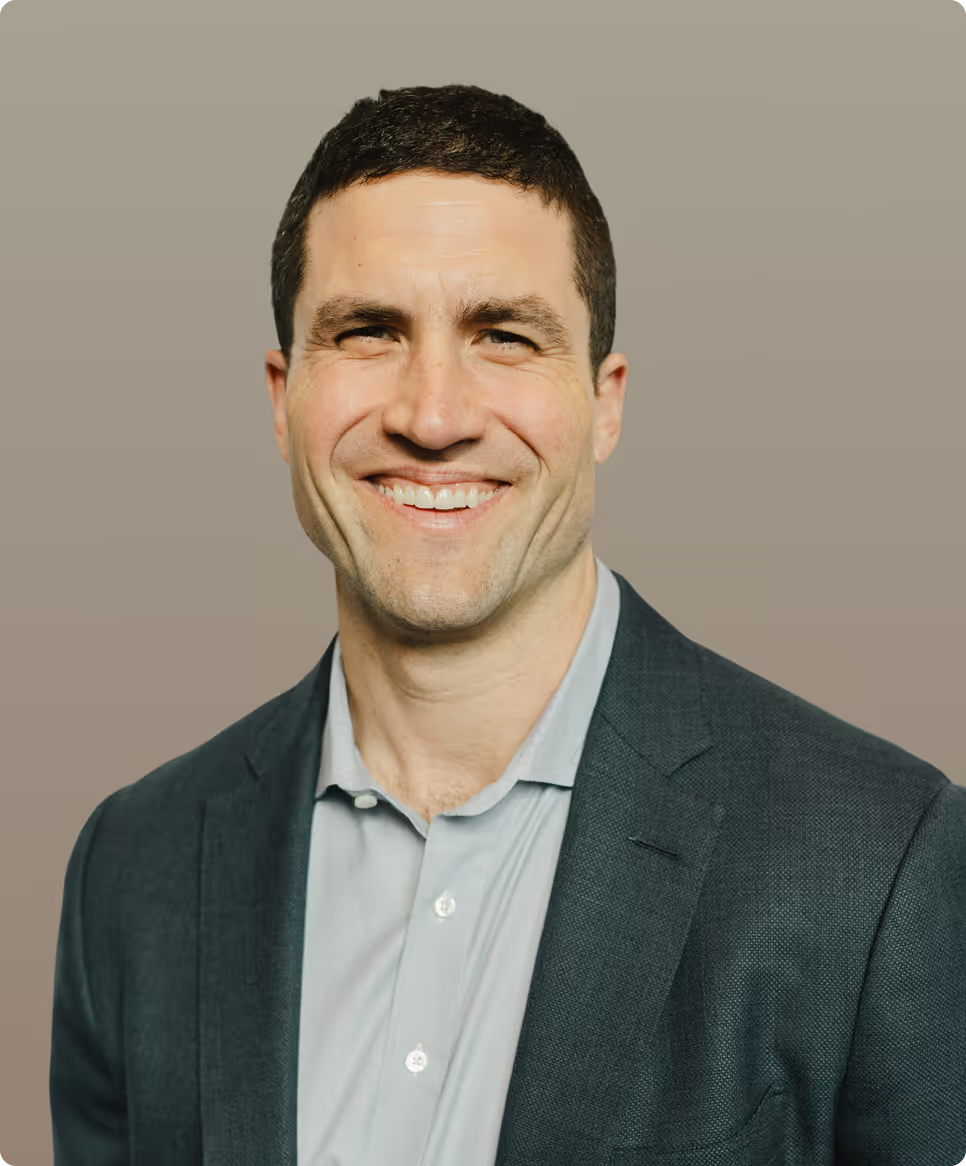
Alfred Johnson is co-founder and CEO of Crux, the capital platform for the clean economy. Before founding Crux, Alfred served as Deputy Chief of Staff to Secretary Janet Yellen at the US Department of the Treasury. Earlier in his career, Alfred was Vice President in Financial Markets Advisory at BlackRock, Senior Advisor for Financial Markets at the US Treasury, and Special Assistant to the White House Chief of Staff.
.svg)
.svg)
Share