

FEOC and PFE rules: Navigating compliance while guidance catches up

Share
.svg)

.svg)
.svg)

Want to explore more conversations like this?
View all blogs
PFE requirements can determine whether a clean energy project qualifies for federal tax credits, but market participants are still making investment and transaction decisions without complete guidance on ownership and effective control. Rather than wait for every question to be resolved, developers, manufacturers, investors, and advisors are building workable approaches to diligence, risk allocation, and transaction pricing.
The One Big Beautiful Bill (OBBB) introduced prohibited foreign entity (PFE) provisions that significantly expanded the Inflation Reduction Act’s earlier foreign entity of concern (FEOC) framework. Notice 2026-15, published on February 12, 2026, provided the most substantial PFE guidance to date, particularly on material assistance, but left important questions open. Although market participants still sometimes use the older FEOC label, eligibility now turns on PFE requirements that address ownership, effective control, and supply-chain sourcing.
Crux’s 2026 Mid-Year Market Intelligence Report shows that the market is adapting. Investor interest in tech-neutral credits is rising, just under $4 billion in PFE-exposed transactions closed in H1 2026, and buyers are pricing PFE exposure directly rather than waiting for full regulatory clarity.
To understand how that adaptation is working in practice, we spoke with Stephanie Deterding, Head of Tax Investor Coverage at Crux, and four practitioners at the center of PFE compliance: Praveen Ayyagari of KPMG, Josh Morris of Novogradac, Elizabeth Crouse of Holland & Knight, and Gary Blitz of Aon. They explained what buyers need to get comfortable, how diligence differs across transactions and capital providers, and which regulatory questions still matter most.
Key takeaways
- PFE rules can disqualify a project from certain clean energy tax credits based on three tests: ownership, effective control, and material assistance.
- Notice 2026-15 addressed material assistance, providing the most concrete PFE guidance to date. Significant questions about ownership and effective control remain unresolved.
- Crux estimates that just under $4 billion in PFE-exposed tax credit transactions closed in H1 2026, representing approximately 20% of the market. PFE exposure also became the dominant driver of tax credit pricing.
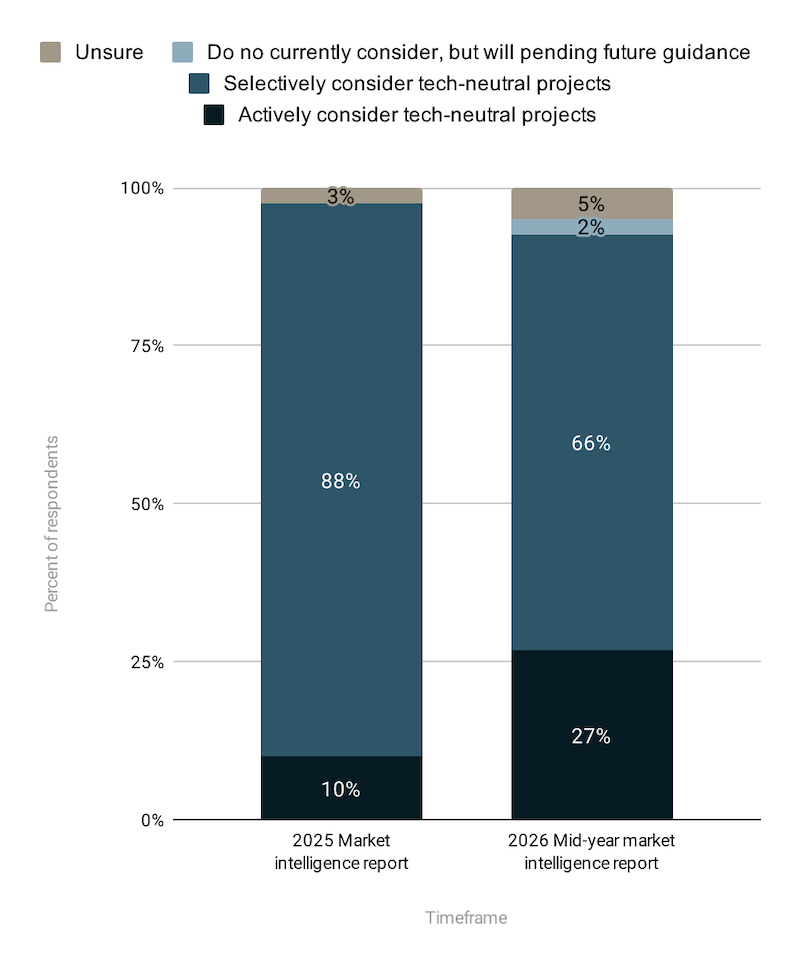
- Investor interest in tech-neutral credits is increasing: active consideration of §45Y and §48E projects rose from 10% in 2025 to 27% in H1 2026, although roughly 70% of investors remain selective.
- Section 45X deals require an added layer of diligence beyond §48E and §45Y — evaluating material assistance at the component level, not just counterparty status.
What are PFE rules?
PFE restrictions now play a central role in determining eligibility for several clean energy tax incentives, including the tech-neutral production and investment tax credits under §45Y and §48E and the advanced manufacturing tax credit under §45X. At a high level, these rules disallow tax credits when a taxpayer is a prohibited foreign entity, when PFEs exert effective control over key assets or production, or when a project's supply chain relies too heavily on PFEs.
Depending on the tax credit type, a taxpayer may need to clear three distinct PFE compliance tests to qualify for tax credits:
- Ownership: Is the taxpayer a PFE because it is itself a specified foreign entity (SFE), or because it qualifies as a foreign-influenced entity (FIE) due to sufficient ownership, debt, or officer appointment rights held by an SFE?
- Effective control: Even without any ownership tie, has the taxpayer made a payment to an SFE under a contract or license that gives the SFE control over the project? That payment is the other route to FIE — and therefore PFE — status.
- Material assistance: Does the supply chain lean too heavily on PFEs? This is measured against statutory material assistance cost ratio (MACR) thresholds.
Explore Crux's PFE compliance resource hub.
What's still unresolved?
Notice 2026-15 addressed material assistance, but significant questions remain around constructive ownership and effective control. The constructive ownership rules will determine how taxpayers count ownership held indirectly rather than directly. On effective control, the notice largely restates the statutory definition without explaining how to apply it, leaving practitioners to build their own case for where control actually sits.
Treasury and the IRS are expected to address these issues in additional guidance. The pace and substance of that guidance will help determine how much PFE-exposed transaction volume clears — and how the market prices that exposure — in H2 2026.
What to do about PFE compliance without final guidance
The market has not waited for complete guidance before moving: by the end of 2025, more than 90% of developers surveyed by Crux had already begun ownership reviews, contract audits, and supply chain mapping.
We asked practitioners who advise on these transactions every day how the market is handling PFE compliance while guidance remains incomplete. Here’s what they told us.
Are PFE-exposed deals actually happening right now?
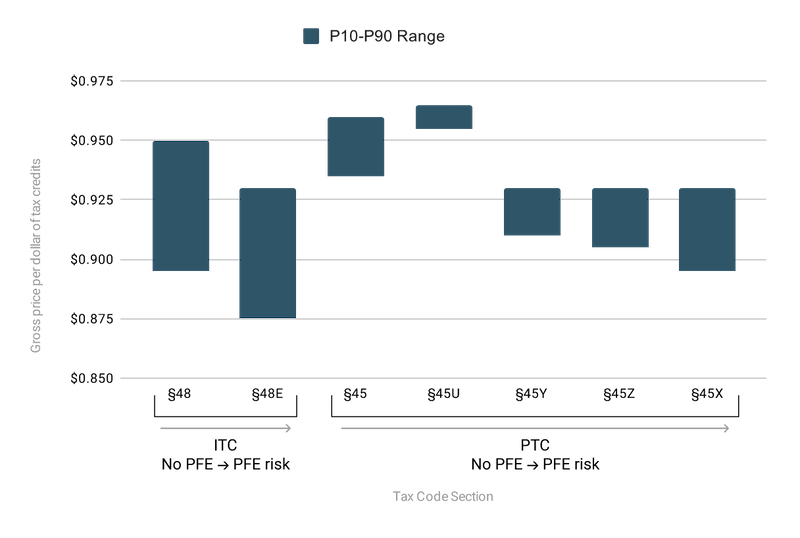
Stephanie Deterding (Head of Tax Investor Coverage, Crux): Yes. Crux estimates that just under $4 billion in PFE-exposed tax credit transactions closed in H1 2026, representing approximately 20% of the market. These transactions are getting done, but successful deals in H1 2026 generally involved low-risk fact patterns, strong diligence packages, and sellers that could provide durable indemnities. PFE exposure also became the dominant driver of tax credit pricing, eclipsing deal size and the seller’s investment-grade status.
Range of prices for tax credits in H1 2026 by tax code section (P10-P90)
What are buyers and investors telling Crux about PFE right now?
Deterding: Buyers are becoming more willing to evaluate tax credits subject to PFE requirements, but they are still approaching them selectively. Those unresolved ownership and effective-control questions matter directly to §45Y and §48E transactions. The project owner has to satisfy the applicable PFE restrictions — and in a traditional tax equity structure, so does any investor taking an ownership interest. According to Crux's 2026 Mid-Year Market Intelligence Report, active consideration of §45Y and §48E projects rose from 10% in 2025 to 27% in H1 2026. Roughly 70% of investors described their posture as selective rather than active, and no investors surveyed said they would rule out tech-neutral tax credits regardless of future guidance.
That shift is also affecting how projects are financed. Crux estimates that preferred equity investment is on track to more than double from approximately $3.0 billion in 2025 to $7.4 billion in 2026. Part of that growth reflects preferred equity investors’ greater ability to underwrite §48E exposure, making preferred equity an increasingly competitive source of capital for projects that may be underserved by traditional tax equity.
Sentiment towards tech-neutral §45Y/§48E eligible projects
What gets a PFE-exposed deal across the line?
Deterding: What we're seeing is that it takes a genuinely buttoned-up diligence package, and usually a strong balance sheet behind it, to get a PFE-exposed deal done right now.
It's not always that these deals carry more risk. A lot of it is overhead. Buyers are more likely to engage when the seller has already assembled a strong diligence package. In some early PFE-exposed §45X transactions, Crux saw third-party legal counsel provide a PFE status analysis while accounting firms performed MACR calculations. That kind of preparation can make the risk easier for buyers to evaluate and explain internally.
"What we're seeing is that it takes a genuinely buttoned-up diligence package, and usually a strong balance sheet behind it, to get a PFE-exposed deal done right now."
Notice 2026-15 allows a taxpayer to rely on a supplier certification supporting its PFE analysis unless the taxpayer knows or has reason to know the certification is inaccurate. Is obtaining that signed certification enough, or does the taxpayer need to corroborate it?
Praveen Ayyagari (Managing Director, KPMG): The "know or have reason to know" language shows up in at least three distinct places:
1. As one of the optional certification statements a supplier can make.
2. As the basis for a supplier penalty if they certify inaccurately.
3. As the standard a taxpayer must satisfy when relying on a certification they receive.
Multiple layers are operating simultaneously. The closest analogue in existing tax law is probably the withholding regime, which uses the concept of a reasonably prudent person — and I think those concepts are available to draw from here. A supplier meeting the certification safe harbor needs to check their internal records and, to a limited extent, look for any obvious public information that says something to the contrary. That is the floor.
Josh Morris (Partner, Novogradac): A signed certification is an important starting point — and often necessary if you are relying on the certification safe harbor — but it is not the end of the analysis. The standard is asking whether it was reasonable to rely on that certification — that is a process question, not a document question. You do not need to be perfect, but you need to have built a reasonable process and not had a reason to know something was off.
In practice, we are seeing people layer in corroboration: a supplier questionnaire, some high-level sourcing documentation and supply chain map explanation, and a basic sanity check against market knowledge. If all you have is a signed PDF and nothing else, that is a very hard position to defend under audit. You got the cert, you read it. What questions came up? How did you resolve them? That is the story you need to tell.
"You got the cert, you read it. What questions came up? How did you resolve them? That is the story you need to tell."
How does the type of capital partner drive the depth of PFE diligence?
Morris: It generally skews toward more rigor when somebody is buying the tax credits or being allocated them in a partnership. Banks and tier-one investors are very conservative — it is usually that party pushing the developer to do more. Geography matters too: a publicly traded US company with no obvious PFE exposure warrants less scrutiny than a manufacturer whose delivery documentation points toward a covered-nation or other PFE exposure. Follow the money.
Supplier pushback is happening and we should not be surprised — you are asking them to sign under penalties of perjury, retain records for six years, and stand behind parts of their supply chain they may not fully control. Plenty are leaning in to stay competitive. Where I see hesitancy is around upstream disclosure. A module manufacturer might provide a cert, but ask them to identify the cell manufacturer and that is often where things stall. There is a whole daisy chain: manufacturers need to collect certs from their own upstream suppliers and defend those to the project. Most understand they have to share, but they are often still doing their own homework, and there is real negotiation happening around indemnification.
Deterding: We're hearing something similar from manufacturers directly. Those managing material assistance today — mainly for §45X — are largely leaning on the certification safe harbor: taking their direct supplier's certification and confirming that supplier isn't aware of issues further up the chain. How many questions get asked about earlier tiers varies, but true cascading certificates down to tier two or tier three aren't standard practice yet.
What does a defensible effective-control file actually need to include?
Elizabeth Crouse (Partner, Holland & Knight): On diligence scope, more is more at this point. On a §45X deal, effective control shows up in two distinct ways. First, you have to cover it for your counterparty because of the payments rule — affecting whether your counterparty is entitled to the tax credits they are selling you. But §45X also requires worrying about material assistance rules, which is much harder to diligence. A simple manufacturer with a limited bill of materials is manageable; a large commodity mill with international supply chains and equipment licenses is genuinely difficult.
On §48E and §45Y, the analysis is more straightforward because the material assistance rules do not yet apply. In other words, practitioners only need to evaluate the project owner’s classification, rather than the more demanding two-layer analysis required for §45X. Our general approach is a smell test — confirm that publicly available documents and at least some internal documentation do not show red flags. We are not just taking a counterparty's word for it, but we are realistic that we will never have all the documents. You have to get to the point where you are comfortable enough to sign on the dotted line.
"You have to get to the point where you are comfortable enough to sign on the dotted line."
Morris: The goal is a reasonable narrative supported by a core set of documents — ownership structure, governance rights, veto and consent rights, and key commercial agreements. You are not reviewing every contract, but you are showing you focused on where control could actually sit. You are not trying to prove a negative with certainty — you are demonstrating a thoughtful process. The market is expecting additional guidance on effective control in future rulemaking. In the meantime, take a risk-based approach and build a file that shows you took it seriously.
Do practitioners need to trace every single component?
Morris: The 2025-08 tables define the population of manufactured product components (MPCs), so you are not chasing every piece. We always start there. In many solar fact patterns, you focus first on the higher-value items, such as the cell; if you can substantiate non-PFE treatment for those items, you may be much of the way toward the applicable threshold. Add a few more items from the module and inverter, and you can often get there without touching every component. If the safe harbor route does not clear the threshold, the direct cost approach is an alternative — but it is generally a last resort given the classification uncertainty.
What should developers check on the debt and lender side?
Crouse: When standing up a new affiliate, it is tempting to say a loan from a former PRC-affiliated entity is fine, but it is not. Debt is not defined in the statute, but we have income tax precedents to work from. You can analyze and avoid the issue if you go in with eyes open and aware of the anti-abuse considerations.
Is PFE insurance available yet?
Gary Blitz (Global CEO, Aon Transaction Solutions): PFE is a major threshold issue for tax insurance underwriters at this time — this is because it is not one that creates a partial loss, rather a project will be in or out and could be a total loss. What underwriters want to see, first and foremost, is the work product from the developer's counsel and advisors: a respected firm laying out the facts, analyzing the law, and concluding the project qualifies. And frankly, we have not seen that work product of sufficient strength and provided to us to share with underwriters in conjunction with a proposed policy. We have heard about advisors willing to write it, but have yet to see anyone actually doing so. That is the chicken-and-egg problem we are in right now.
Crouse: Insurance is not really covering PFE risk yet, but I am optimistic we will start seeing coverage soon, particularly for counterparty classification with larger publicly traded sponsors. What we are seeing is strict legal reps around PFE compliance and a strict indemnity with or without a cap. Beyond that, the movement is on pricing adjustments rather than hold backs or escrows.
Blitz: I would not write off insurance entirely — for very clean situations where advisors can form a strong view from the legislation, legislative history, and guidance to date, there may be insurable situations right now. That is worth testing. Beyond that, I would recommend building contractual mechanisms that allow the project to restructure or comply if guidance comes out differently than expected. That does two things: it reduces the leap an insurer has to make to get comfortable, and it makes each project somewhat unique — meaning adverse guidance will not affect every project the same way. The more you can differentiate your project's exposure, the better positioned you are for both insurance purposes and managing the underlying risk.
"I would not write off insurance entirely — for very clean situations, there may be insurable situations right now. That is worth testing."
Deterding: Buyers are largely looking for a strong balance sheet right now and getting comfortable with the risk profile themselves, since insurance isn't there yet. We do think that'll open up once guidance gets clearer — that's really what the insurers are waiting on too.
Crux’s Mid-Year Market Intelligence Report found that roughly 87% of §48E transaction volume came from non-investment-grade sellers and included insurance, compared with about 40% of legacy §48 volume. However, that insurance generally excluded PFE risk, leaving buyers to rely on diligence, contractual protections, and the seller’s indemnity for PFE-specific exposure.
What PFE guidance is still coming?
Blitz: The MACR issue was largely consistent with where people expected it to land. The bigger disappointment is that it did not address the foreign influence and effective control questions, which many in the industry consider more fundamental. A lot of the industry would have preferred that guidance on those aspects of PFE had come out first. The effective control guidance was helpful, but there are still potential question marks.
Ayyagari: When Treasury looked at what was most pressing, they focused on the beginning-of-construction (BOC) date: projects starting construction this year need to meet the material assistance cost ratio (MACR) restrictions, so they moved quickly. The result is a MACR-focused notice. The notice is half interim guidance and half a notice of intent to issue proposed regulations — signaling that new safe harbor tables will be published by year-end on the MACR calculation, while also flagging intent to provide more comprehensive guidance on the PFE definitions and material assistance more broadly.
The priority guidance plan is usually a good indicator of what Treasury actually intends to accomplish. The most recent iteration was a slimmed-down version, which suggests it reflects a realistic list. PFE restrictions are on it, and those items are typically written broadly enough to encompass several pieces of guidance.
Deterding: Industry groups haven't waited on Treasury. The SEMA Coalition's PFE Due Diligence Framework gives buyers and sellers a structured way to assess a project's PFE exposure in the meantime — whether diligencing a tax credit before purchase or preparing one for sale. It doesn't resolve the underlying uncertainty, but it gives the market a shared reference point while formal rules stay incomplete.
Where this leaves you
The market isn't waiting for perfect clarity. Practitioners have developed workable approaches to diligencing PFE exposure, investors are evaluating tech-neutral credits selectively, and transactions are getting done while additional guidance remains outstanding.
Additional Treasury guidance on ownership and effective control should bring greater clarity. In the meantime, Crux sees these dynamics play out deal by deal. If you're navigating PFE compliance on a live transaction, our team can help you apply what's already working today.
Explore the rest of Crux's PFE resource hub.
Download Crux’s 2026 Mid-Year Market Intelligence Report.
Contributors
Praveen Ayyagari is a Managing Director in KPMG's tax practice specializing in clean energy tax incentives and federal tax policy. He brings a rare firsthand perspective to the PFE rules — having helped draft the IRA's clean energy incentives as Tax Counsel on the House Ways & Means Committee, then managed regulatory guidance for those same provisions as an Attorney-Advisor at the U.S. Department of the Treasury (Treasury), where he worked directly with IRS Chief Counsel and senior Treasury leadership on implementation. At KPMG, he advises energy sector clients on tax credit qualification, PFE and domestic content compliance, and evolving legislative developments.
Gary Blitz leads Aon's Tax Insurance practice, which specializes in placement of tax insurance programs for M&A transactions, tax credit investments, and corporate tax risk management. He has spent more than three decades at the intersection of tax law and transactional insurance, and has been a central figure in the development of both Representations and Warranties Insurance and Tax Insurance as market products.
Elizabeth Crouse is a Partner in Holland & Knight's Portland office who has spent more than a decade advising investors, developers, and operators across the renewable energy, hydrogen, and carbon capture industries on federal tax matters. Her practice spans ITC and PTC structuring, §45Q carbon capture tax credits, and tax equity and project finance transactions — with more than 11 gigawatts of negotiated deals.
Stephanie Deterding is a Managing Director at Crux, where she leads the Tax Investor Coverage team and advises tax credit buyers and tax equity investors on commercial opportunities, transaction structuring, technical implications, and due diligence.
Josh Morris is a Partner at Novogradac & Company LLP whose practice spans the full lifecycle of renewable energy and energy transition projects — from structuring and financing through compliance — for developers, investors, lenders, and manufacturers across the clean energy supply chain. He brings specialized expertise in ITC and PTC monetization, partnership tax, and HLBV accounting, with a growing focus on PFE and domestic content planning as those rules continue to evolve.
Share