

Prohibited foreign entity rules
Foreign entity restrictions play a central role in determining whether a project is eligible for clean energy tax credits — and, by extension, whether those credits can be safely transferred to a buyer or investor.
The One Big Beautiful Bill replaced and significantly expanded existing foreign entity restrictions, introducing new prohibited foreign entity (PFE) rules. The US Department of the Treasury published initial guidance (Notice 2026-15) in February, and additional guidance is expected later this year.
This resource hub brings together the latest market trends, insights, and resources to help you understand and comply with PFE requirements.
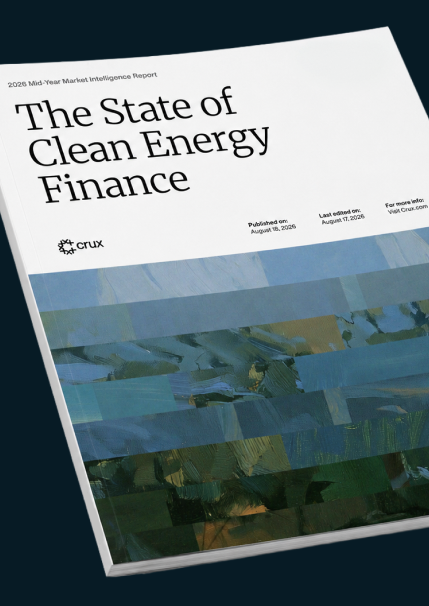
Quick guide to PFE definitions
Understand the differences between prohibited foreign entities, specified foreign entities, and foreign-influenced entities, as well as the material assistance cost ratio test.

What are the experts saying about PFE compliance?

"The bottleneck is always getting the first deal through the finish line for new issues. Once there is familiarity with the risk, the market responds quickly."

"PFE is a major threshold issue for tax insurance underwriters at this time — this is because it is not one that creates a partial loss, rather a project will be in or out and could be a total loss... We have heard about advisors willing to write it, but have yet to see anyone actually doing so. That is the chicken-and-egg problem we are in right now."

"Our general approach is a smell test — confirm that publicly available documents and at least some internal documentation do not show red flags. We are not just taking a counterparty's word for it, but we are realistic that we will never have all the documents."

"A signed certification is an important starting point — and often necessary if you are relying on the certification safe harbor — but it is not the end of the analysis. The standard is asking whether it was reasonable to rely on that certification — that is a process question, not a document question."

“What observers sometimes underestimate about the industry is the degree of expertise and professionalism that exists within it — by and large most participants are very sophisticated and very knowledgeable and see compliance as a core component of their overall responsibility as market participants. The responsibility of others is to ensure that the rules are clear and that they can be followed."

“I think the important signal from the notice is that the dominant framework across the market is tier-one supplier accountability.”

"What I have not seen enough discussion of is the recapture provision within §48E. The statutory language is broad and the provision looks onerous... The market has not fully grappled with the scope or what mitigation looks like. The best approach is to start raising awareness, and ensure clients can get out in front of it as early as possible."
Lessons from H1 2026: A growing market adapting to PFE risk in real time
Total tax monetization is on track to approach $70 billion by year-end 2026, up 11% year over year. While forthcoming PFE guidance should unlock more tax-oriented capital, the market adapted during the first half of the year. Preferred equity investments — which do not take an ownership position that exposes them to the PFE ownership test — will more than double in 2026. Tax credit buyers diversified into tax credit types and technologies with mixed or limited PFE exposure, such as clean fuels and battery storage.
.png)
What developers need to know about PFE requirements
Explore insights, regulatory updates, market data, and practical resources for understanding the new PFE regime.




The market is starting to price PFE risk into transactions
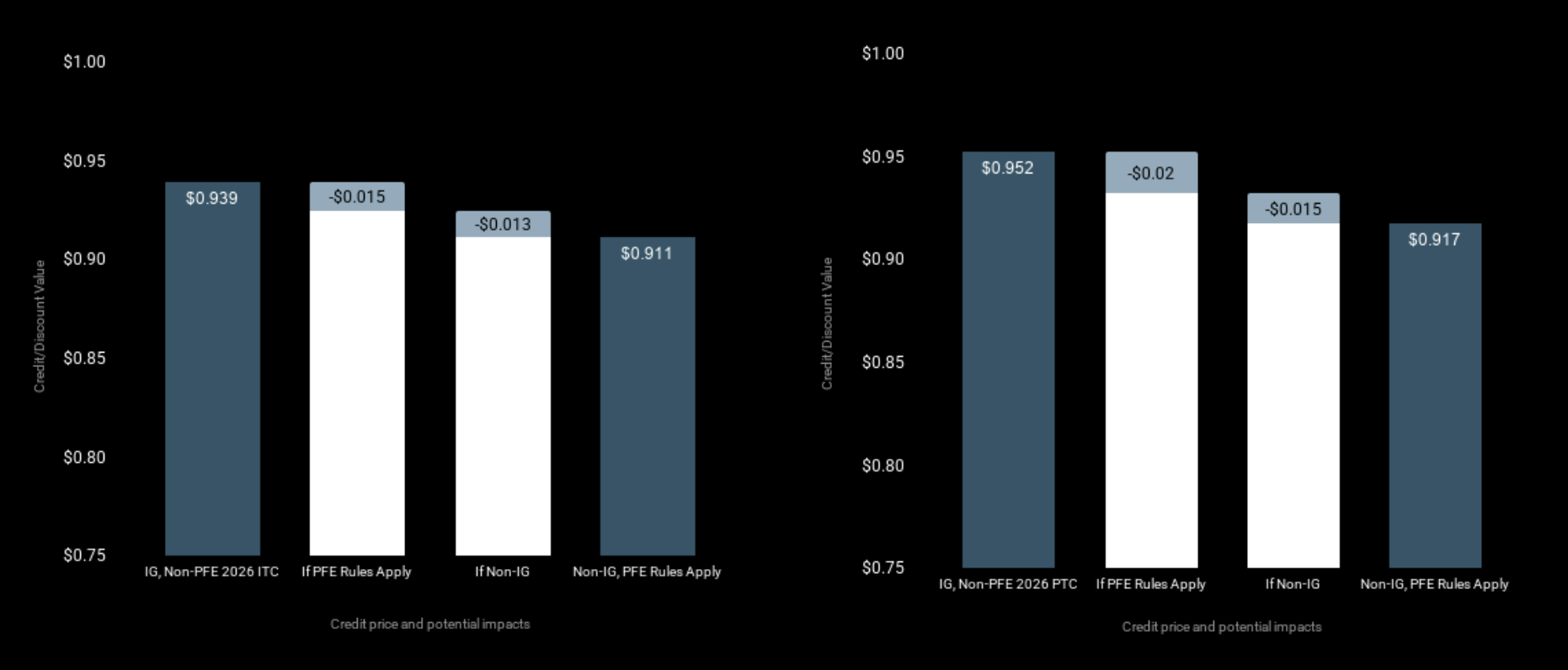
Historically, deal size and seller credit rating have driven tax credit pricing. In H1 2026, exposure to PFE rules emerged as the single biggest driver of tax credit pricing. While PFE-exposed tax credits are transacting, they’re doing so at a discount — roughly $0.015 for investment tax credits and $0.020 for production tax credits.
Resources for tax credit buyers and investors
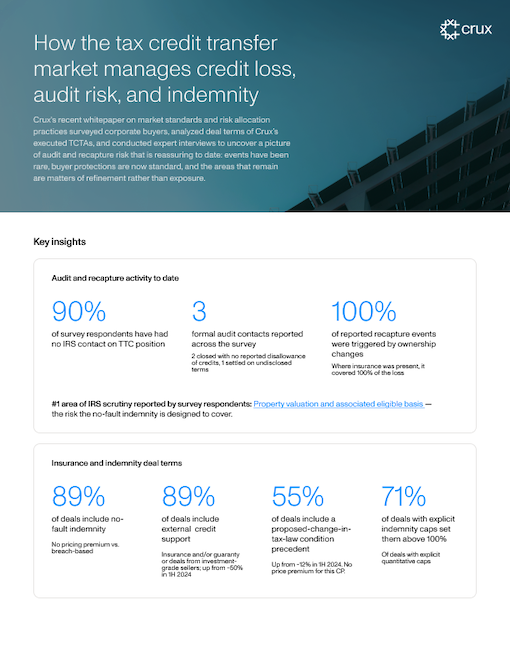
Learn more about diligence requirements, mitigating PFE risk, and compliance pathways so you can transact confidently.





How Crux supports PFE compliance
Crux helps developers and manufacturers, tax credit buyers and investors, lenders, and advisors navigate PFE requirements with market intelligence, clear diligence workflows, and expert support at every step:
- PFE market signals based on proprietary transaction data.
- PFE-specific diligence checklists.
- White-glove support to understand and underwrite transaction risks.
- Centralized platform that streamlines the diligence process.