Market update: What happened in the 2Q2026 tax credit market?

Share
.svg)

.svg)
.svg)

Want to explore more conversations like this?
View all blogs
Liquidity returned to the tax credit market in 2Q2026.
After a volatile 2025, buyers gained confidence in their projected tax liabilities and became more comfortable diligencing prohibited foreign entity (PFE) risk. That clarity brought more current-year credits to market and expanded the range of opportunities available to buyers.
Average prices moved lower as the market broadened beyond a limited group of large, investment-grade transactions — not because demand weakened. Deal activity accelerated.
"The pricing data only tells part of the picture," says Josh Price, Crux's Director of Intelligence & Research. "From tax credit prices alone, you could infer that the second quarter was worse than the first. It was actually meaningfully more active."
We spoke with Price about what moved pricing in 2Q2026, where debt capital is and is not available by technology, and what he is watching in the second half.
Key takeaways:
- Prohibited foreign entity (PFE) compliance risk is a primary driver of pricing in the transferable tax credit market: legacy §45/§48 credits with no PFE exposure price highest, while current-vintage §§ 45Y, 48E, and 45X credits (which require compliance with material assistance and effective control rules) price lower.
- Transferable tax credit prices fell in 2Q2026 because deal volume surged quarter over quarter as buyers gained confidence in PFE compliance and their tax liabilities. More, and smaller and/or lower-quality, deals pulled the average price down.
- The historical buyer preference for investment tax credits (ITCs) reversed in the second quarter. Legacy §45 and §45Y production tax credit (PTC) deal flow dropped sharply, but §45Z clean fuel and §45X advanced manufacturing PTCs filled much of the gap.
- Access to bridge loan financing varies sharply by technology: utility-scale solar and battery storage have the deepest lender pools, while fewer than 24% of surveyed lenders would provide bridge financing to a §45X deal, for example. That gap is expected to narrow as these credits mature.
Tax credit market dynamics
What factors drove tax credit pricing in Q2?
Josh Price: Tax credit prices did not move as one market in 2Q2026. They dispersed according to three questions: Does the credit carry PFE risk? How strong is the seller standing behind it? And how much liquidity is in the market?
Prohibited foreign entity risk
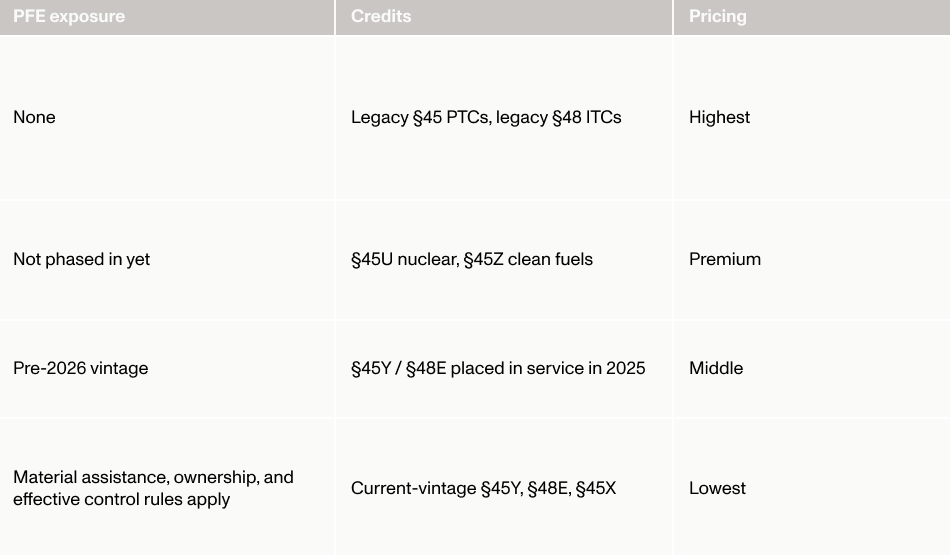
The pricing dispersion tracks PFE exposure almost cleanly, from credits with none to credits carrying the full weight of the material assistance, ownership, and effective control rules. Legacy §45 PTCs and §48 ITCs, which are not subject to PFE rules, continued to price at the top of the market. Going down the risk spectrum, you get to the §45U nuclear tax credit and the §45Z fuel production credit. The PFE provisions haven't phased in yet for them, so they’re pricing at a premium.
Moving down, you get older-vintage §45Y/§48E tech-neutral tax credits that entered service in 2025, before the 2026 implementation date for material assistance. And then continuing down, you have the current-vintage §§ 45Y, 48E, and 45X tax credits for advanced manufacturing that must comply with material assistance, ownership, and effective control rules and are pricing lower.
There are some puts and takes — if it's an investment-grade (IG) seller selling one of these credits, it could price higher.
PFE pricing ladder
Seller quality
Second, seller quality still matters a ton — particularly where a credit carries PFE exposure. An investment-grade seller with the balance sheet to support an indemnity can command a premium, even where insurance cannot cover the underlying PFE risk.
Market volume and liquidity
Last, on liquidity.As we moved into the second quarter, we saw a lot more deal flow as more current-year credits came to market. Deal volume in the first quarter was extremely limited as buyers were still figuring out their 2025 tax liability and navigating new PFE risk in Q1.
The pricing data only tells part of the picture. From tax credit prices alone, you could infer that the second quarter was worse than the first quarter. It was actually meaningfully more active in terms of deal flow as market participants got more comfortable with PFE and buyers grew confident in their tax liability through the rest of the year. That liquidity is the reason that pricing is down quarter over quarter — there were more transactions, with lower-quality sellers and smaller deals that impacted the overall mix.
"It was actually meaningfully more active in terms of deal flow as market participants got more comfortable with PFE and buyers grew confident in their tax liability through the rest of the year."
What kind of tax credits are buyers focused on?
Josh Price: Q2 is really where we saw the pivot from buyer interest in previous-year tax credits to current-year tax credits. Normally you know your tax liability for the year as you start the year, and you'll start picking at your current-year vintage credits. That really didn't happen until the second quarter. Going into 2026 with the post-One Big Beautiful Bill (OBBB) changes to tax liability, to R&E expenses, all these other impacts on buyers, it took a while for corporations to figure out what their 2025 tax liability would be. Once you figure out what your 2025 tax liability is, that's probably a decent way to model your 2026 liability. Consequently, we saw an uptick both in 2025 purchases and 2026 purchases in Q2.
What surprised you most about how the market moved in the second quarter?
Josh Price: The limited amount of PTCs that transacted is pretty interesting. Historically, ITCs have dominated the market, but the proportion has been around 55%/45%. The number of legacy §§ 45 and 45Y tax credits in the market has just kind of fallen off a cliff, possibly related to wind permitting. We've seen other PTCs, like §45Z and §45X, fill that gap, but it was interesting to see the limited amount of deal flow related to legacy §45 and §45Y.
Data centers are driving a lot of new electricity demand. How is that showing up in the deals and pricing that you're tracking?
Josh Price: Data center demand is not yet visible in transferable tax credit transactions in any direct way. The share of the market selling credits tied specifically to data center development remains small — a handful of battery storage deals, with most volume still coming from utility-scale solar developers and advanced manufacturers well upstream of the offtake.
Where it does show up is in the load growth driving project development in the first place, and in the state policy environment those projects now have to navigate.
The clean energy finance landscape
The data shows that debt financing is easier to come by for some technology types than others. What is driving that gap, and what do you think will happen to it as we move forward?
Josh Price: In the second quarter, we went out to about 50 different lenders, both private credit and banks across the lending spectrum, to figure out how they would price tax credit bridge loans based on specific customers. We used a utility-scale, 100-megawatt, committed bridge loan as a baseline. Then we varied it — by technology type, by committed vs. uncommitted, and by structure (tax equity bridge loan, transfer bridge loan, or pref equity bridge loan) — to see how each variable moved price.
We found that utility-scale solar and storage have the highest level of capital availability when it comes to tax credit bridge loans. Lenders are comfortable with ITCs and with those technologies.
At the other end of the spectrum, you have clean fuels, where just under 15% of lenders said they would provide bridge financing for a §45Z credit. Twenty-four percent of lenders said they would provide bridge financing to §45X manufacturing tax credits. A lot of the lenders are more familiar and comfortable with solar and with ITC dynamics, whereas §45Z is a brand new credit that just came into effect in 2025 and is still being implemented. The regulatory uncertainty and newness of the credits have made it harder to finance any bridge lending.
But we are seeing increased openness. We're into the second year of existence for the §45Z tax credit. There are still policies and regulations being implemented — the GREET model is getting updated, for instance. As those dominoes start to fall and developers demonstrate this is a trustworthy, mature technology — “I'm an ethanol plant. I've been operating since the 1980s” — I think that lenders will grow more comfortable.
State-level policies seem to be pulling in a lot of different directions depending on the state and the technology type. What can market participants take away from that state-level policy picture?
Josh Price: It's extremely volatile, not just at the federal level, but at the state level, too. To name some examples, there's been a long-time push at the state level to create new clean fuel programs. California is the longest-standing and largest market that provides incentives for clean fuel producers to sell into California. Washington and Oregon also have programs. New Mexico and Hawaii recently launched programs, bringing the total to five. New York and New Jersey have considered these programs for years. But with the higher-than-average gasoline and diesel prices over this year, it's been a lot tougher for state policymakers to prioritize transportation decarbonization over affordability. That's been a big tension we've seen on the clean fuel side.
That affordability issue has also been front and center on the power side and the electricity side. Different states are taking different approaches. We've seen Texas, for example, take a leading role in trying to integrate data centers into the grid while ensuring adequate cost protections and ensuring that they're not double-counting the data center customers in the load-growth forecast, and then creating new rules to integrate them quickly while supporting flexible operations so they're not adding to peak demand. PJM as a region is also following suir; they've had some approvals from the Federal Energy Regulatory Commission (FERC).
What could unlock in the second half of 2026
What sectors do you feel optimistic about heading into the second half of the year?
Josh Price: I think the §45U nuclear production tax credit. Nuclear generally is having a good time in terms of new investment and policy support, but specifically on §45U, we are expecting clarity from the US Department of the Treasury sometime this summer on the calculation of gross receipts. Basically, what's the value of that credit? How do you measure that? Right now most existing nuclear plant owners who are selling these credits are relying on spot prices, which seems to be the industry standard, but we don't have any exact direction from Treasury saying you can do that. Once we get those rules from Treasury, that should help buyers get more comfortable with that credit type.
I'd also say §45Z. It's had a great year. We are expecting additional regulations clarifying some of the carbon intensity calculations for renewable natural gas and a rule finalizing the regulations implementing §45Z. I think that'll all be done by the end of the year. These credits are already performing well, but the upcoming catalysts are all positive.
I would also be remiss not to note that we do expect PFE rules to come out either at the end of Q3 or in Q4, which should serve as an unlock for the whole market, particularly §48E and §45Y.
Is it accurate to say that PFE guidance is the thing you’ll be watching most closely for the rest of 2026?
Josh Price: That’s it. Any tea leaves on PFE notice or proposed rulemaking — when it's coming out, what the content could be — that's the main thing on everyone's mind. It's not so much what the rules are, but having rules that folks can underwrite to is critical. Right now it's a bit of a black box on the two critical pieces of how to define ownership when it comes to PFE rules and how to define effective control when it comes to various contracts. Clarity on those would be extremely meaningful for the market.
Get the full report
The complete quarterly market update — including technology-specific tax credit pricing information, policy analysis, and insights from market participants — is available exclusively to Crux clients and partners. Want to learn more about accessing Crux’s full library of market intelligence? Get in touch.
Further reading
Learn more about the popular §45Z tax credit with our guide to clean fuels tax credits.
Understand the differences between legacy §45 and §48 tax credits and the tech-neutral §45Y and §48E tax credits.
Check out our resource hub for the latest on prohibited foreign entity guidance.
Share