

What is recapture risk in tax credit transactions?

Share
.svg)

.svg)
.svg)
Want to explore more conversations like this?
View all blogs
Recapture risk is inherent in every investment tax credit (ITC) transaction, but its actual incidence has been very rare since transferable tax credits began transacting in 2023. In every case Crux observed where insurance was present at the time of a recapture event, insurance covered the loss, performing as designed.
The tax credit market has developed well-established tools — including robust indemnity provisions, tax credit insurance, and structured reporting covenants — to help buyers and investors manage recapture risk effectively. This article covers what actually triggers recapture and — leveraging Crux’s own deal terms data — how those protections are performing in practice.
Key takeaways
- Recapture events have been rare since transferable tax credits began transacting in 2023, and Crux’s data shows the market’s core protections — no-fault indemnity, recapture-prevention covenants, and tax credit insurance — are working as designed. In every recorded case where insurance was in place at the time of a recapture event, it covered the loss.
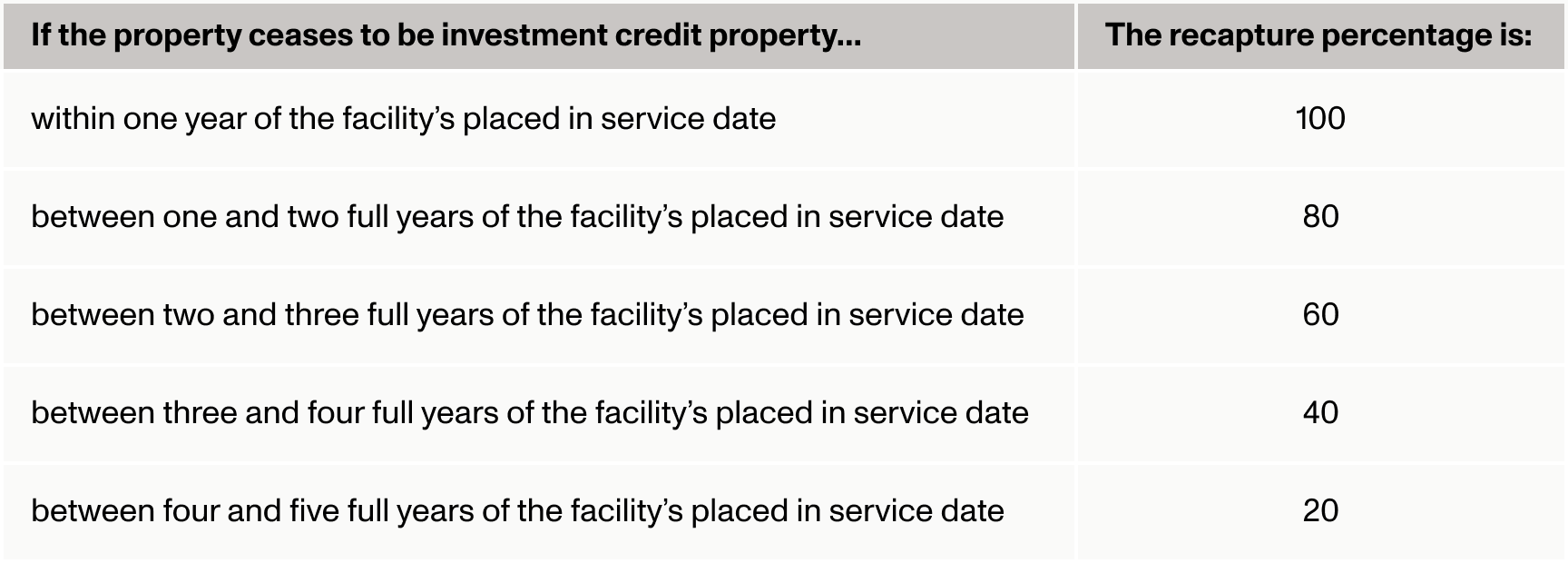
- Recapture risk represents the risk that the Internal Revenue Service (IRS) claws back a portion of an investment tax credit because the underlying property ceased to qualify as energy property within five years of being placed in service. The recapture amount decreases by 20% each year, reaching zero after year five.
- New rules under the One Big Beautiful Bill (OBBB) also introduce a 10-year recapture window tied to prohibited foreign entity payments, but these rules will not take effect until 2028 (for calendar-year taxpayers).
- Recapture liability typically falls on the taxpayer who claimed the credit, which means that the tax credit buyer typically will negotiate contractual protections such as indemnities or insurance to mitigate this risk.
- Due diligence of a project’s corporate structure and insurance policies, seller indemnities, tax credit insurance, and ongoing reporting agreements identify and manage recapture risk exposure during the five-year recapture period.
Download the infographic: Managing tax credit loss and audit risk →
What is recapture risk?
Investment tax credits, including both legacy credits under §48 and tech-neutral credits under §48E, are subject to a five-year recapture period if the facility earning the ITC ceases to be “investment credit property.” If, within five years of being placed in service, the underlying property ceases to be used for its qualifying purpose (such as generating electricity), the IRS can “recapture” a portion of the credit.
In the context of a tax credit transfer, the IRS claws the tax credit value back from the taxpayer who claimed it — in this case, the tax credit buyer or investor — by increasing their taxes to offset the claimed tax credit.
The amount of the original tax credit eligible for recapture declines by 20% each full year following the property’s placed-in-service date. If the eligible property experiences a disqualifying change between one full year and five full years after it is placed in service, the IRS could initiate a partial recapture of the tax credit based on the timeline shown in the table below.
Recapture percentage timeline
What causes a recapture event?
To trigger recapture, an ITC-eligible property must experience a disqualifying change during the five-year recapture period. Potential triggers include:
- Disposition of the property: The project owner sells, transfers, or otherwise disposes of the energy property, including outright sales as well as certain changes in ownership structure.
- Cessation of use as energy property: The property is no longer used for its qualifying purpose (for example, a facility is decommissioned or repurposed).
- Destruction without timely replacement: The property is destroyed by severe weather, equipment failure, or another casualty event.
- Non-compliance with GHG emissions rate requirements: For combustion and gasification (C&G) facility ITCs, the IRS may recapture the credit if a facility's greenhouse gas emissions rate exceeds specified levels.
- Failure to maintain prevailing wage and apprenticeship (PWA) compliance: Projects that claimed the PWA multiplier are subject to recapture of the increased credit amount if they fail to satisfy prevailing wage requirements during the five-year period following the placed-in-service date. This recapture applies only to the multiplier portion, not the base credit, and the project developer has a 180-day window to cure deficiencies after the IRS identifies a failure.
The few recapture events in Crux’s dataset were all triggered by an ownership change or project transfer. Anti-transfer covenants, which restrict the seller from disposing of or transferring the underlying project during the recapture period, guard against these triggers. Anti-transfer covenants appear in nearly half of ITC deals in Crux’s data.
New foreign entity recapture rules
The OBBB introduced additional recapture rules for the tech-neutral investment tax credits (§48E) if a project makes certain payments to companies deemed prohibited foreign entities (PFEs). For §48E ITCs claimed in tax years beginning after July 4, 2027 (i.e., 2028 for calendar-year taxpayers), the IRS may claw back 100% of the credit if the project makes effective control payments to a PFE within 10 years of being placed in service.
The IRS is expected to release further guidance detailing effective control payments and PFE definitions this year; clarity from this guidance will help market participants and insurers fully incorporate this risk into standard underwriting practices.
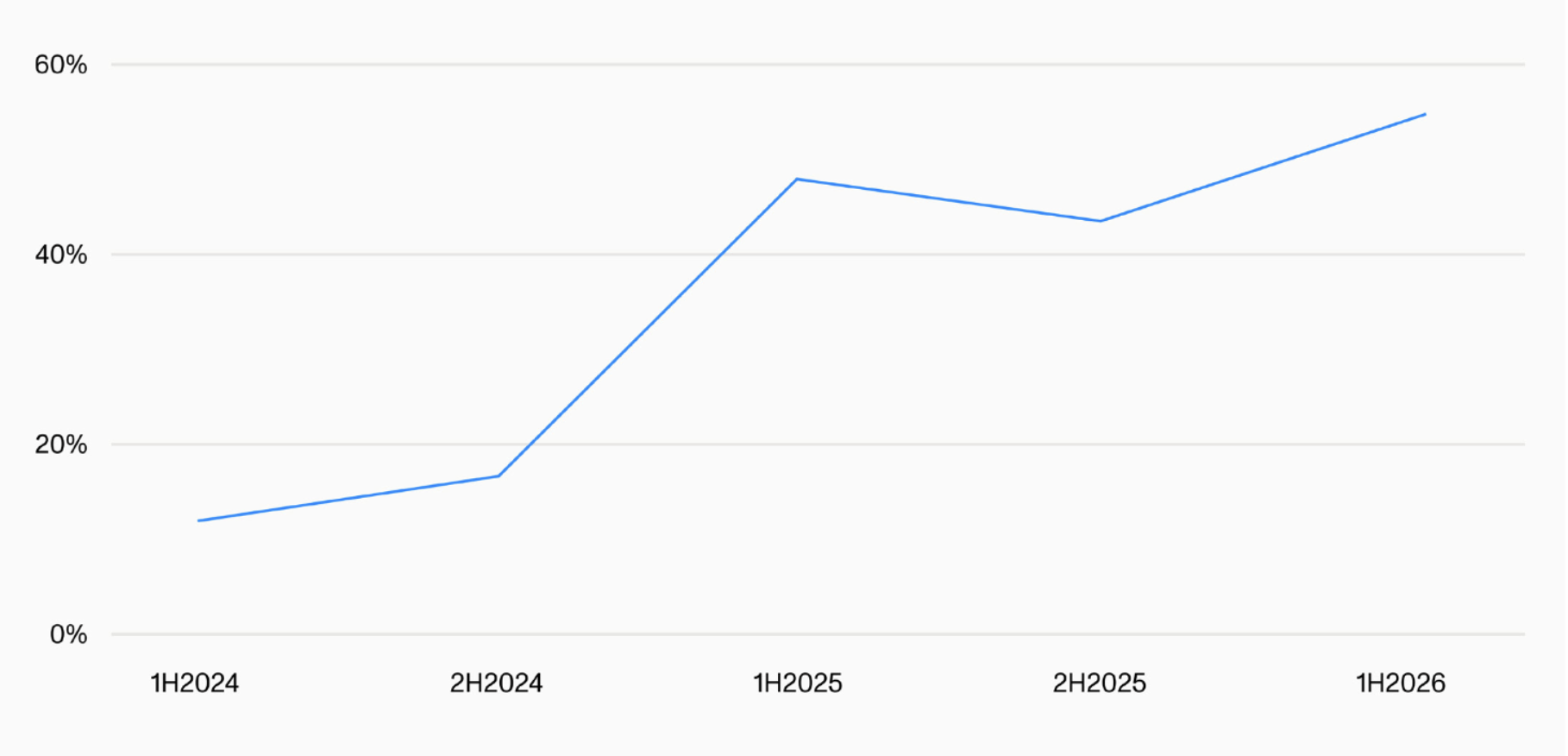
However, the market is already adjusting. Proposed-change-in-tax-law condition precedents — contract terms that let a buyer exit or renegotiate if legislation crosses a defined threshold before closing — have more than quadrupled in prevalence over the last 18 months, from roughly 12% of deals in the first half of 2024 to roughly 55% in the first half of 2026. The timing lines up directly with the legislative uncertainty introduced by the OBBB’s prohibited foreign entity rules, suggesting buyers are already contracting around this exposure well ahead of the 2028 effective date.
Prevalence of proposed-change-in-law provisions over time
How does recapture risk affect tax credit buyers and investors?
Liability for recapture often sits with the taxpayer that claims the tax credit, regardless of whether they own or operate the credit-generating facility. As an example, say that a buyer purchases a tax credit from a solar developer. A hail storm critically damages that developer’s solar project, stopping it from generating electricity. As a result, the solar project ceases to qualify as an investment credit property.
In this scenario, the tax credit buyer, not the developer, bears the increased tax liability recapturing the tax credit. That’s why contractual protections such as indemnities and tax credit insurance are critical to mitigating recapture risk (more below).
There are exceptions to this rule. For example, in the context of a credit that has been transferred, if a partner in the seller entity sells or gives up their ownership stake during the recapture period, that departing partner bears the recapture liability, not the tax credit buyer.
How the market already mitigates recapture risk
The market has largely standardized around how to diligence and mitigate recapture risk. In Crux’s deal-terms dataset:
- Every ITC deal includes some form of recapture-prevention covenant.
- Eighty-nine percent of deals include a no-fault indemnity, making the seller responsible for a credit loss regardless of fault.
- Ninety-three percent of ITC deals include a covenant requiring the seller to notify the buyer of a potential recapture event.
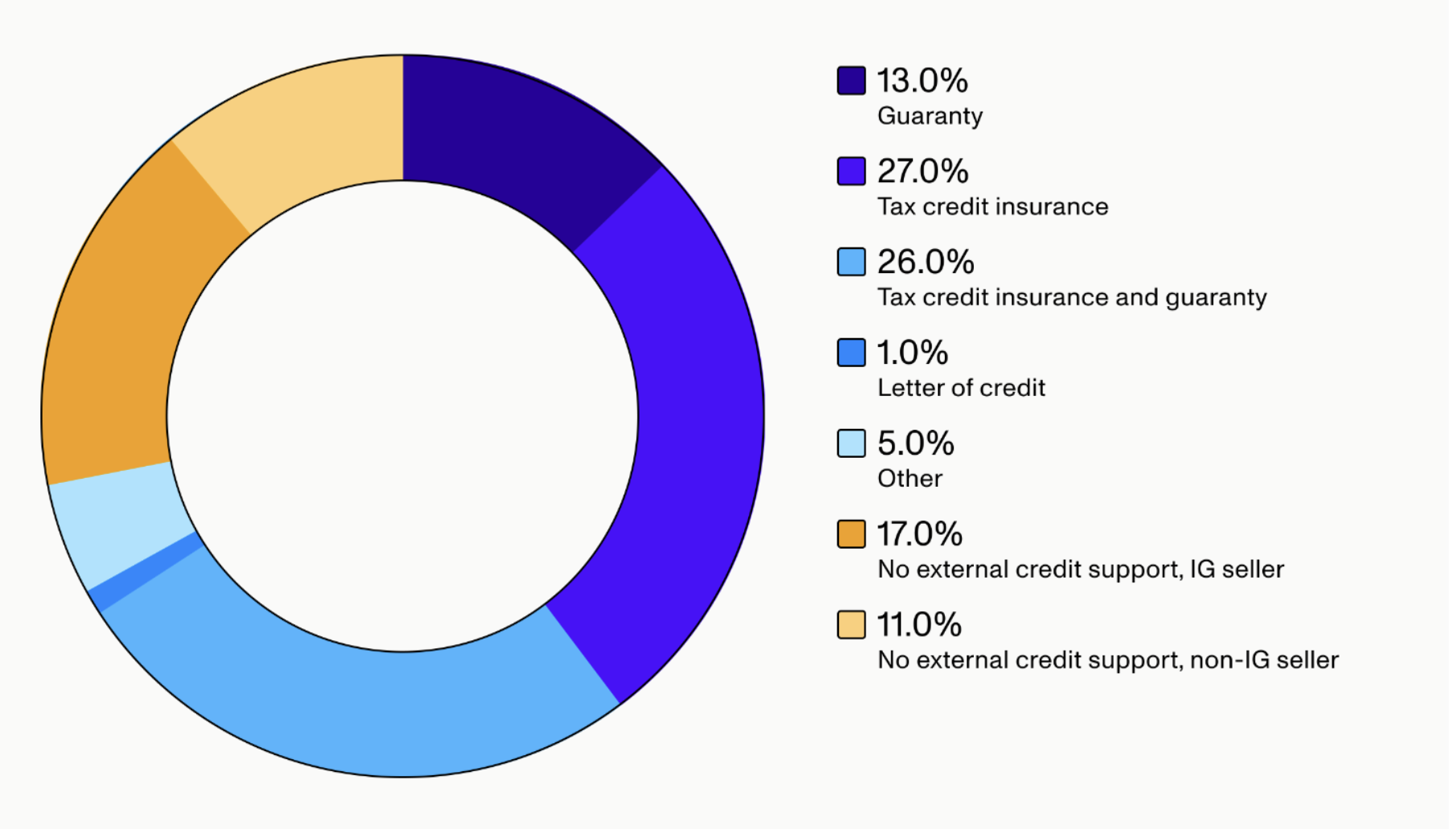
- External credit support — tax credit insurance, a seller guaranty, or both — has grown from roughly 50% of deals in early 2024 to roughly 82% today.
Tax credit buyers use the following diligence steps to confirm these protections are structured correctly for their deal.
Due diligence
Before transacting, buyers and their advisors should evaluate factors that could affect the project's ability to remain in service through the recapture period. Key areas of focus include:
Project viability and financing structure
Buyers, investors, and their advisors should analyze the project's debt structure, lender covenants, and overall capitalization to assess the risk of a forced disposition. A loan default or foreclosure, for example, could result in a change of ownership that triggers recapture.
Diligence should identify whether forbearance agreements are in place that would prevent a lender from foreclosing directly on the energy property during the recapture period. In many transactions, buyers require the seller to negotiate agreements with their lenders not to pursue a foreclosure that would result in an ITC recapture, reducing recapture risk significantly. Credits sourced from projects financed through tax equity flip structures often already have these protections in place, as tax equity investors often negotiate lender forbearance agreements to protect their credit allocation.
Property and casualty insurance review
Buyers, investors, and their advisors should also review the terms of the project's property and casualty insurance to ensure that it is sufficient to cover losses, including a potential recapture of the ITC, stemming from exposure to severe weather events such as hurricanes, wildfires, flooding, or seismic activity.
Counterparty strength and creditworthiness
The financial health, operating history, and creditworthiness of the project operator and sponsor are key considerations. A well-capitalized sponsor with a track record of operating similar projects may be less likely to voluntarily dispose of or abandon the asset during the recapture period, and a creditworthy seller is more likely to be able to fulfill indemnity obligations if a recapture event does occur.
Risk mitigation
Once a buyer or investor has assessed the project's risk profile, they have several contractual and insurance mechanisms available to mitigate recapture risk exposure. Approximately 72% of deals include some form of external credit support, rising to approximately 89% when including transactions where a well-capitalized seller signs the tax credit transfer agreement (TCTA) directly.
Breakdown of external credit support
Indemnities
No-fault indemnities, which protect against credit loss, are an expected baseline in tax credit transactions, with near-identical prevalence across ITC and production tax credit (PTC) transactions.
Buyers, investors, and their respective advisors should negotiate for clear indemnity provisions covering recapture events. In direct transfers, buyers often require sellers to fully indemnify them for any recapture liability, including associated penalties and interest, regardless of fault. Where the seller is a project-level entity with limited creditworthiness, buyers may also require a parent guarantee from the project sponsor.
Tax equity investors should similarly ensure that the partnership agreement includes indemnification from the developer or sponsor for recapture events, particularly those arising from voluntary dispositions or changes in use that the investor did not consent to.
Tax credit insurance
Many buyers and investors procure tax credit insurance policies that cover recapture risk under certain circumstances. Insurance provides a backstop if a seller's indemnity proves insufficient.
In every case where insurance was present at the time of a recapture event, insurance covered the loss, performing as designed.
Structural protections and post-execution reporting requirements
Tax equity investors typically benefit from built-in governance mechanisms, including consent rights over asset sales and change-of-control provisions, that reduce the likelihood of a surprise recapture event. Direct transfer buyers should confirm ongoing reporting covenants that require the seller to notify them of material events during the recapture period, including any change in ownership, use, or physical condition of the property.
Every ITC deal in the dataset also includes some form of recapture-prevention covenant. Standard TCTAs include two types:
- Transfer restriction covenants prohibit the seller from disposing of or transferring the underlying project during the recapture window without buyer consent.
- Compliance and audit-readiness covenants address a related but distinct set of risks: that the credit loses validity because the project fails to maintain eligibility conditions, or that documentation needed to defend the credit position is unavailable when the IRS comes looking. These covenants protect against both recapture and credit disallowance.
Learn more about navigating recapture risk
Recapture risk is inherent in every ITC transaction, but the data shows that the standard protections are working. Taken together, thorough due diligence and adequate risk management mechanisms ensure that even in the unlikely event of a recapture trigger, buyers and investors have clear paths to recover their economic position.
To learn more about how tax credit buyers are managing tax credit loss and audit risk, download the infographic about our findings.
Share