

Understanding the §45U tax credit for existing nuclear power plants (updated 2026)

Share
.svg)

.svg)
.svg)
Want to explore more conversations like this?
View all blogs
Originally published January 2026. Updated August 2026 to reflect prohibited foreign entity rules, Treasury’s pending guidance, and Crux’s 2026 Mid-Year Market Intelligence Report.
Major technology companies are turning to nuclear power to meet the massive electricity demands of AI computing and data center expansion. Amazon, Google, and Microsoft have all announced nuclear power purchase agreements in recent months, recognizing that nuclear power’s operational characteristics align well with data centers' need for reliable, 24/7 baseload power.
Despite nuclear power’s substantial contribution to the US electricity grid — about 19% of all power in the US and around half of all domestically produced zero-emission electricity comes from nuclear — existing nuclear power plants were not eligible for clean energy tax credits before the creation of the §45U zero-emission nuclear production tax credit in the Inflation Reduction Act (IRA) of 2022. Nuclear power also enjoys bipartisan support in Congress; the 2025 One Big Beautiful Bill (OBBB) preserved the §45U tax credit’s original 2032 phaseout date.
Nuclear tax credits priced at the top of the transferable tax credit market in the first half of 2026. Section 45U credits averaged $0.958 — against a market-wide average of $0.930 for production tax credits (PTCs) and $0.913 for investment tax credits (ITCs) — and made up 11.8% of transfer volume, after a near-standstill at the end of 2025. That rebound reflects a market increasingly shaped by timing and prohibited foreign entity (PFE) exposure. PFE rules now explain more variation in tax credit pricing than deal size or seller credit rating.
As data center electricity demand continues to climb and nuclear power seeks to meet this need, it is increasingly important for tax credit market participants to understand how the §45U tax credit is structured, how it has been transacting in the transferable tax credit market, and what tax credit investors should consider when evaluating these credits.
Key takeaways
- Section 45U is a production tax credit for existing nuclear facilities placed in service before August 16, 2022, worth up to $0.015/kWh with prevailing wage and apprenticeship (PWA) compliance and stepping down as a facility's revenues rise.
- Nuclear credits priced at the top of the H1 2026 market, averaging $0.958 against market-wide averages of $0.930 for PTCs and $0.913 for ITCs.
- Section 45U carries the PFE ownership provision today, but not effective control until tax years beginning after July 4, 2027, and no material assistance requirement at all.
- Every §45U transaction Crux observed in H1 2026 closed on an investment-grade seller indemnity. Crux has not observed tax credit insurance on a nuclear deal.
- The US Department of the Treasury has not specified how facilities should measure gross receipts — the input that sets the credit's value. Owners are relying on spot prices as
Value of the §45U production tax credit
The §45U PTC provides a base credit of $0.003 per kilowatt-hour (kWh) of electricity produced and sold between December 31, 2023, and the end of 2032. Qualified facilities that meet prevailing wage and apprenticeship (PWA) adder requirements receive a credit multiplier of five times the base credit, raising the credit value to $0.015/kWh of electricity produced.
There is some additional nuance to how the actual PTC is calculated. The §45U credit is a contract for differences and phases out at higher power prices. The credit calculation changes based on a facility’s “gross receipts,” which includes revenues from the sale of electricity along with any state, local, or federal zero-emission credit programs or subsidies other than the §45U credit itself.
If a facility’s gross receipts are at or below $0.025/kWh, the baseline credit is $0.003/kWh. If a facility generates gross receipts above $0.025/kWh, 16% of the gross receipts above that threshold is subtracted from the base credit value.
For example, say a facility brings in revenue from electricity sold at $0.030/kWh. To calculate the credit, the taxpayer must:
- Subtract $0.025 from its gross receipts ($0.030) to find its excess receipts ($0.030 – 0.025 = $0.005).
- Multiply its excess receipts by 0.16 to find the reduction value ($0.005 * 0.16 = $0.0008).
- Subtract the reduction value from the base credit value to find the net base credit ($0.003 – $0.0008 = $0.0022/kWh).
Importantly, facilities must utilize the net effective power price — inclusive of wholesale power, ancillary services, capacity payments, or other payments — to calculate their PTC entitlement based upon the receipts at the eligible facility.
PWA multipliers are incorporated after this calculation. In this example, the facility could claim up to $0.011/kWh assuming they meet PWA requirements ($0.0022 * 5 = $0.011).
The US Department of the Treasury has not specified how facilities should measure those gross receipts. Most nuclear plant owners selling §45U credits today rely on spot prices, which has become the industry standard, but no guidance confirms that approach. The Treasury is expected to address the gross receipts calculation in the second half of 2026. For buyers, it is the most consequential open item on the credit, because it determines the value of what they are buying.
Right now most existing nuclear plant owners who are selling these credits are relying on spot prices, which seems to be the industry standard, but we don't have any exact direction from Treasury saying you can do that.
— Josh Price, Director of Intelligence & Research at Crux
Which nuclear facilities qualify for §45U?
Only facilities placed in service before August 16, 2022 qualify, and they must sell power to an unrelated party to generate the credit.
Because the credit steps down as revenues rise, wholesale market conditions directly affect how many credits a facility generates. In 2024, a large share of §45U credits came from facilities in the PJM Interconnection. Rising PJM capacity prices lifted those operators’ revenues, which in turn reduced the volume of §45U credits they could claim.
How prohibited foreign entity rules apply to §45U
Congress applied some form of PFE restriction to §45Q, §45X, §45Y, §45Z, §45U, and §48E under the OBBB. The restrictions are not uniform, and those differences are now the largest single driver of tax credit pricing. In the first half of 2026, whether a credit was subject to PFE rules explained more of the variation in price than deal size or seller credit rating did.
Section 45U carries a narrower set of requirements than most major credits:
- Ownership applies. The provision reaches §45U for tax years beginning after July 4, 2025 — January 1, 2026 for calendar-year taxpayers.
- Effective control does not, yet. The harder of the two to diligence, it does not reach §45U until tax years beginning after July 4, 2027 — January 1, 2028 for calendar-year taxpayers.
- Material assistance never applies. Section 45U carries no material assistance requirement.
Section 45U’s PFE treatment is more limited than that of many major credits. It is subject to PFE ownership rules, but not the effective-control test until 2028, and it carries no material assistance requirement. Much of the credit supply also comes from publicly traded, investment-grade nuclear operators, making ownership diligence more routine. Those characteristics help explain §45U’s pricing premium at a time when PFE exposure accounts for more price variation than deal size or seller credit rating.
How §45U tax credits are transacting
Section 45U activity declined following the OBBB’s enactment in July 2025. Its share of spot-market volume fell from 5.2% in the first half of 2025 to 1.7% in the second half, as buyer activity slowed across the market.
Activity increased in 2026: §45U represented a minimal share of deals in the first quarter, then rose to 16.6% in the second, as buyers settled their 2025 tax positions and began sorting the market by PFE exposure. Nuclear accounted for 11.8% of transferable tax credit volume in the first half of 2026 — the fourth-largest share among tax code sections, behind §48 ITCs, multi-credit portfolios, and legacy §45 PTCs. Legacy §45 and §45U together made up 54% of all PTC volume.
Section 45U credits averaged $0.958 in the first half of 2026, above market-wide averages of $0.930 for PTCs and $0.913 for ITCs. Across the broader market, ITCs subject to PFE rules traded at an approximately $0.015 discount and PFE-exposed PTCs at an approximately $0.02 discount. §45U’s narrower current PFE exposure, seller credit profiles, and typically large transaction sizes distinguish it from many PFE-exposed credits and are relevant factors in how buyers assess pricing.
Section 45U and multi-credit portfolios, avg. deal size and credit price, H1 2026
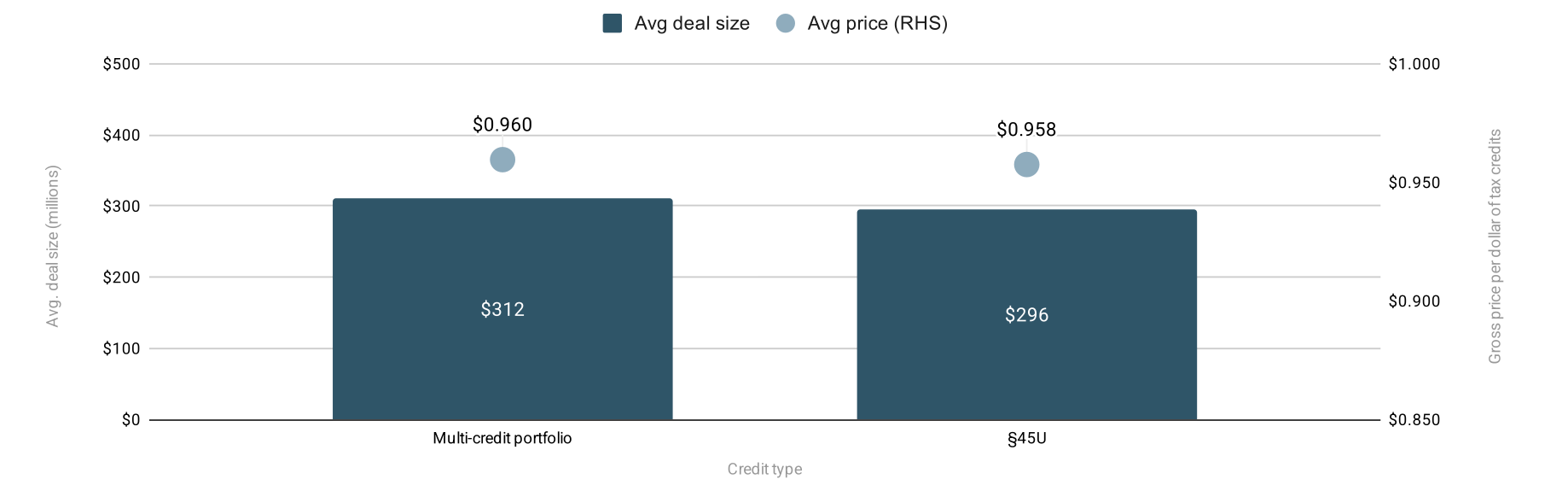
Across §45U transactions Crux observed, each closed with an investment-grade seller indemnity. Crux did not observe tax credit insurance on §45U deals; buyers instead relied on seller credit support, while PFE exposure was generally outside available insurance coverage.
Tax credits available for new nuclear construction
New nuclear power plants that begin construction by 2034 are eligible for the technology-neutral §45Y PTC or §48E investment tax credit (ITC). Established under the IRA, the technology-neutral tax credits apply to zero-emissions facilities placed in service after December 31, 2024. Repowered nuclear facilities are also eligible for the §45Y or §48E credit if they meet the 80/20 repowering test; 80% of the project’s value must come from new equipment.
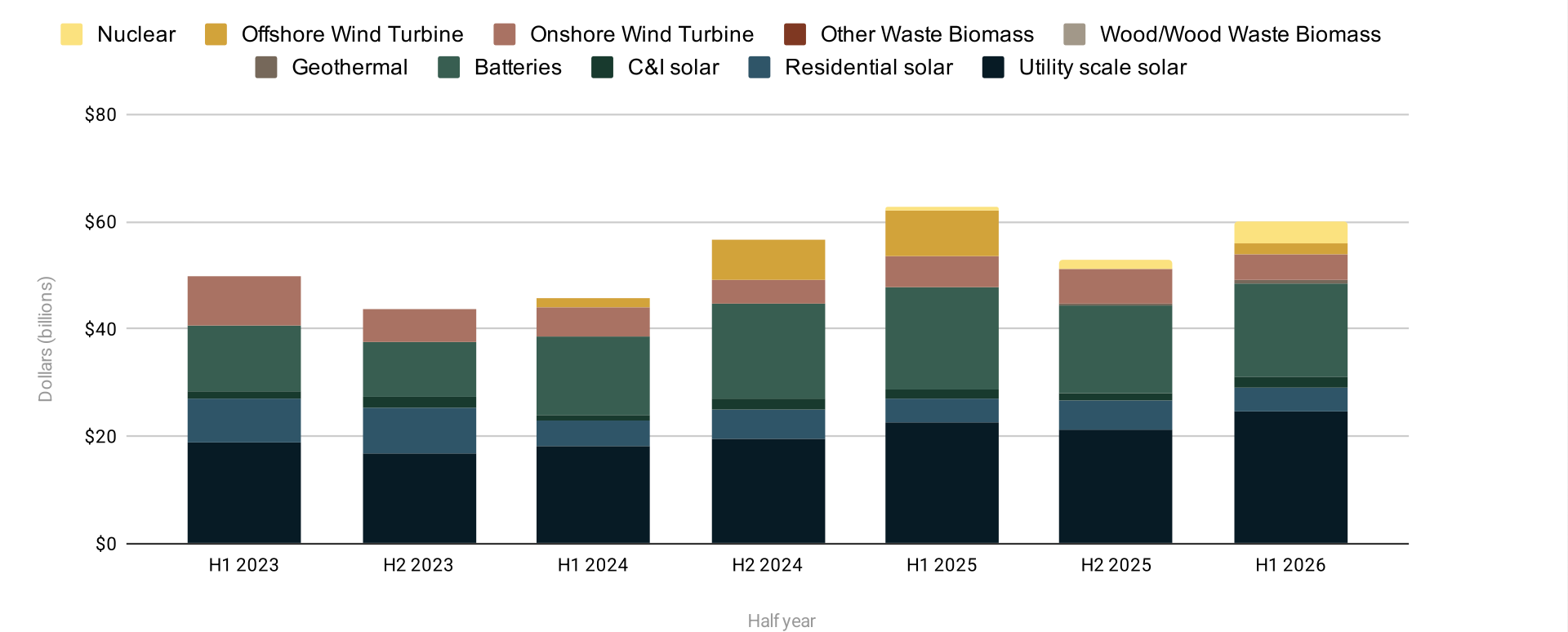
Driven by rising electricity demand and the availability of these incentives, a number of nuclear power plants are projected to enter service before the end of the decade. Support for nuclear technologies started to move from rhetoric to action in H1 2026, spurred by the DOE’s $17.5 billion conditional loan commitment to finance up to five projects with construction to begin by 2030. The funds will be made available to eligible utilities or energy companies, with the goal of deploying a total of 10 Westinghouse AP1000 reactors. Crux has yet to observe widespread sales of tax credits from new nuclear facilities, or other financing activities for such projects. New nuclear activity remains early, but it is developing against a broader shift in power-sector investment toward technologies that can meet rising load and provide firm capacity.
Estimated total power capex by technology, H1 2023 - H1 2026
New and repowered nuclear credits
Crux has not yet observed any §48E or §45Y credits transactions, most likely because new nuclear power facilities remain in the development phase, but expects that repowering projects will begin to transact soon.
When these credits do begin to transact, we expect due diligence to focus on eligibility risks such as:
- 80/20 repowering test qualification.
- Prevailing wage and apprenticeship qualification.
- PFE requirements.
- Proper cost segregation analysis.
- Parent guarantee and indemnification analysis.
Conclusion
Crux expects demand for §45U credits to stay strong. The supply of tax credits exempt from PFE rules is limited and shrinking, and Crux expects the premium those credits command to widen in the second half of 2026 as buyers avoiding PFE risk concentrate on a smaller pool. 68% of tax credit market participants named regulatory uncertainty as their leading concern heading into the second half of the year. Buyers who transact earlier in that cycle generally see wider selection and better pricing.
Treasury's guidance on the gross receipts calculation is another thing to watch. Clarity on how the credit is measured should bring more nuclear operators to market and give buyers a firmer basis for diligence.
Further reading
For a closer look at §45U pricing, PFE exposure, and broader market conditions in the second quarter of 2026, read our 2Q 2026 tax credit market update.
To learn more about tax credit pricing and volume across technologies in H1 2026, and Crux’s outlook for the second half of the year, download our 2026 Mid-Year Market Intelligence Report.
For Crux’s full collection of analysis on the prohibited foreign entity rules—updated as new guidance is released—visit our Prohibited Foreign Entity Rules resource hub.
For another perspective on how buyers evaluate production tax credits, read RNG for tax credit buyers.
Share