

§45Q carbon capture tax credits: What tax credit buyers need to know (2026)

Share
.svg)

.svg)
.svg)
Want to explore more conversations like this?
View all blogs
Section 45Q carbon capture tax credits give buyers access to a growing category of production tax credits with relatively limited prohibited foreign entity (PFE) exposure compared with many newer transferable credits. The tradeoff is that §45Q carries recapture risk, so buyers must understand how the underlying project measures, documents, and stores captured carbon dioxide.
For buyers, the key diligence question is whether the seller can support the tax credit claim with the required technical and tax documentation — and transfer the credit on a timeline that works for both parties. That is particularly relevant for carbon utilization projects, where the IRS requires lifecycle-analysis pre-approval before a taxpayer can claim the credit. An August 2026 Government Accountability Office report found that this process can delay claims and create uncertainty for taxpayers seeking to transfer credits. Buyers should therefore assess both the seller’s technical and tax documentation and whether the expected transfer timeline fits their tax-planning needs.
This guide breaks down what §45Q buyers need to know today, including which facilities qualify, what buyers should diligence before funding, and how recent policy changes affect credit value and eligibility.
Key takeaways
- For carbon capture equipment placed in service after July 4, 2025, the OBBB aligned §45Q credit values across secure geological storage, enhanced oil recovery (EOR), and utilization.
- Section 45Q carries lighter PFE requirements than §45X, §45Y, or §48E — an advantage in a market where PFE exposure now drives pricing.
- Recapture liability generally follows the tax credits to the buyer, which shapes indemnity and insurance terms. Exposure runs three years past the last year credits could have been claimed.
- Transfer volume remains limited relative to the roughly $1 billion in §45Q tax credits generated annually, because many credits are retained or direct-paid. Buyers should factor that limited supply into sourcing, pricing, and transaction timing.
What is the §45Q tax credit?
Section 45Q provides a per-ton tax credit for qualified carbon oxide that’s captured at a qualifying facility and then is either:
- Disposed of in secure geological storage.
- Used as a tertiary injectant in enhanced oil or natural gas recovery.
- Utilized in a qualifying manner, such as conversion into fuels, chemicals, or other products.
Congress substantially expanded the credit in the Bipartisan Budget Act of 2018 and again in the Inflation Reduction Act of 2022, which raised credit values, added a direct air capture tier with higher per-ton rates, and made the credit available for transfer to unrelated parties under §6418.
For buyers, the facility type and the ultimate use of captured carbon oxide are not just eligibility details: they determine the credit amount, the documentation required to support the claim, and the risks that need to be diligenced before funding.
What underlying projects should §45Q buyers understand?
Carbon capture projects across natural gas processing, ethanol and biofuels production, ammonia and fertilizer manufacturing, cement, steel, refining, helium production, power generation, and direct air capture (DAC) may qualify for §45Q. To generate credits, a project must meet the applicable annual capture threshold and other §45Q requirements, including rules governing the carbon capture equipment and the carbon oxide’s qualifying storage or use.
The facility type and the way captured carbon oxide is stored or used affect expected credit volume, the technical diligence required, and the documentation the seller needs to support the credit claim.
Annual capture thresholds by facility type:
- Direct air capture: At least 1,000 metric tons.
- Electricity generating facilities: At least 18,750 metric tons; the carbon capture equipment must also be designed to capture at least 75% of the unit’s baseline carbon oxide production.
- All other facilities: At least 12,500 metric tons.
What changed for §45Q in 2026?
Under the One Big Beautiful Bill (OBBB), the §45Q credit rates and eligibility rules for certain carbon capture projects changed. For qualified facilities that begin construction after December 31, 2024, the credit is generally $17 per metric ton for carbon oxide captured using equipment that meets prevailing wage and apprenticeship requirements, or $36 per metric ton for DAC. Those amounts are increased fivefold when the project meets the applicable wage and apprenticeship requirements. The OBBB also extended the construction-start deadline for §45Q projects and added prohibited foreign entity restrictions.
More recently, interim guidance from the Treasury and the IRS expanded and extended a temporary reporting safe harbor for projects that securely store carbon dioxide. The safe harbor applies when the Environmental Protection Agency’s (EPA) electronic reporting system is unavailable and gives eligible projects an alternative way to satisfy certain §45Q reporting and recapture requirements. To use it, a project must still comply with the applicable monitoring and reporting rules, maintain an EPA-approved monitoring plan where required, and obtain certification from an independent engineer or geologist.
For buyers, this does not eliminate diligence around secure storage or recapture. It does, however, provide a defined fallback process for evaluating whether a seller’s storage documentation supports the credit claim when EPA reporting is unavailable.
What to diligence in a §45Q transfer
Section 45Q diligence differs from solar or manufacturing tax credit diligence in four ways.
- Recapture
Section 45Q is the rare production tax credit subject to recapture. If stored carbon oxide leaks, the IRS claws back tax credits on a last-in-first-out basis for up to three prior tax years. In a transfer, that liability generally lands on the buyer, so buyers price indemnity and insurance terms accordingly. Exposure also outlasts the credit period, ending three years after the last year the tax credits could have been claimed.
- Secure storage documentation
Buyers should confirm that the project can document the volume of carbon oxide securely stored and whether that documentation satisfies §45Q requirements. Where a project relies on the Treasury and IRS reporting safe harbor, buyers should review the project’s monitoring plan, annual report, and independent-engineer or geologist certification as part of that diligence.
- Who claims the tax credit
Where more than one party touches the carbon oxide stream — a processor running the gas, an operator sequestering it — buyers should confirm which taxpayer is entitled to claim the §45Q tax credit. Only one taxpayer can claim the tax credit for each single process train. That taxpayer must own at least one component of the carbon capture equipment and be responsible for disposal or utilization. Buyers should confirm this treatment in a tax opinion rather than relying on an internal memo.
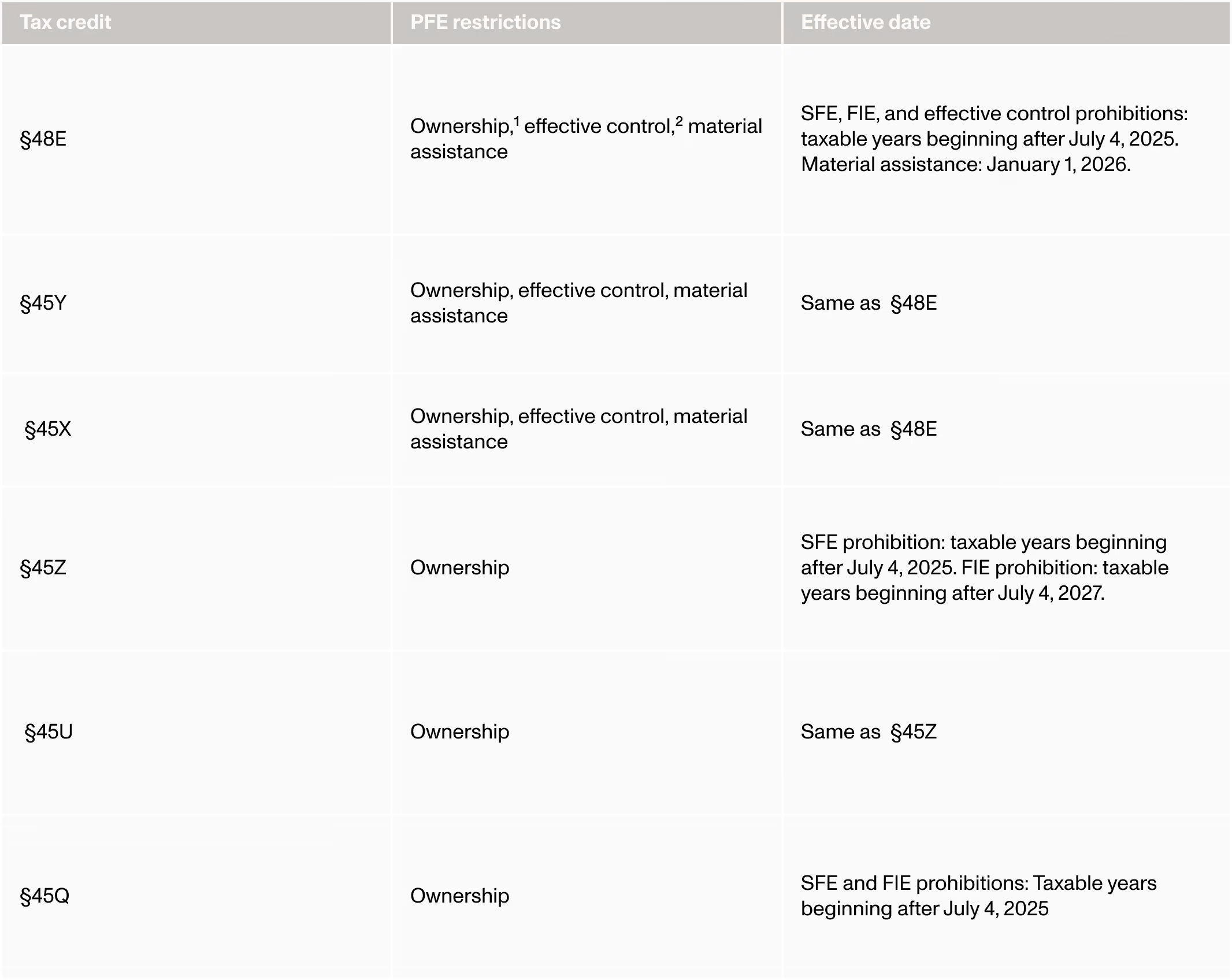
- Prohibited foreign entity rules: Section 45Q is subject to the PFE ownership and effective control tests, and exempt from the material assistance cost ratio testing that applies to §45X, §45Y, and §48E. The tests apply for tax years beginning after July 4, 2025, which for calendar-year taxpayers means January 1, 2026.
PFE requirements by tax code section
What the §45Q market looks like in 2026
Crux’s 2026 Mid-Year Market Intelligence Report puts production tax credits at an average price of $0.930 in the first half of 2026, with legacy §45 tax credits at $0.94–$0.96. PFE exposure has become a major driver of pricing, with tax credits carrying the least PFE exposure pricing at the top of the market.
Section 45Q is subject to the PFE ownership and effective-control tests but exempt from the material assistance cost ratio test that applies to §§45X, 45Y, and 48E. That narrower PFE exposure is an important part of the pricing and diligence conversation, though buyers should still evaluate the seller’s PFE status and supporting documentation.
Impact of IG and PFE status on ITC pricing
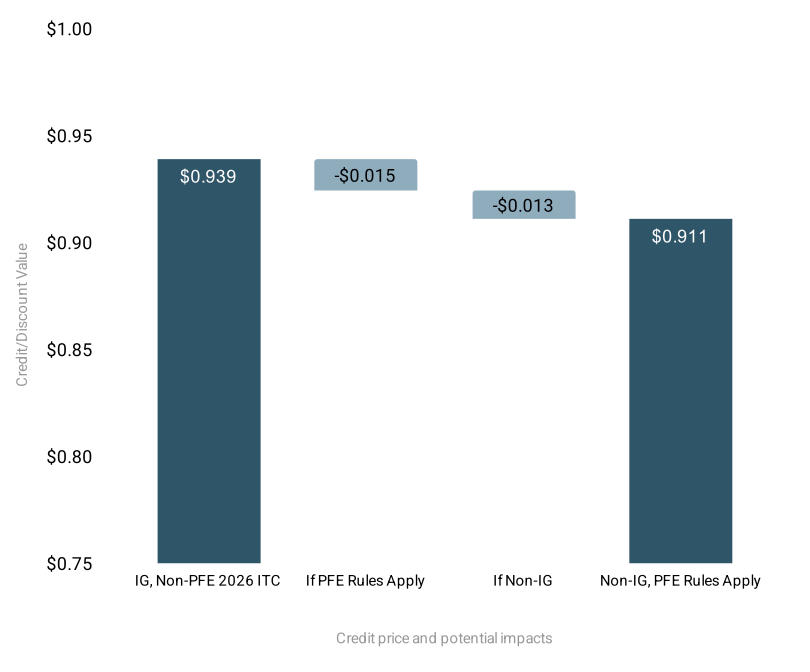
Crux has observed pricing for §45Q in the transfer market in the $0.85–0.92 range, depending on project size,sponsor creditworthiness, and other factors. Roughly $1 billion in §45Q tax credits are generated annually based on existing capacity, but most are likely retained by large companies with sufficient tax liability rather than transferred. As a result, buyers may need to spend more time sourcing §45Q opportunities and evaluating project-specific pricing than they would in more liquid credit categories.
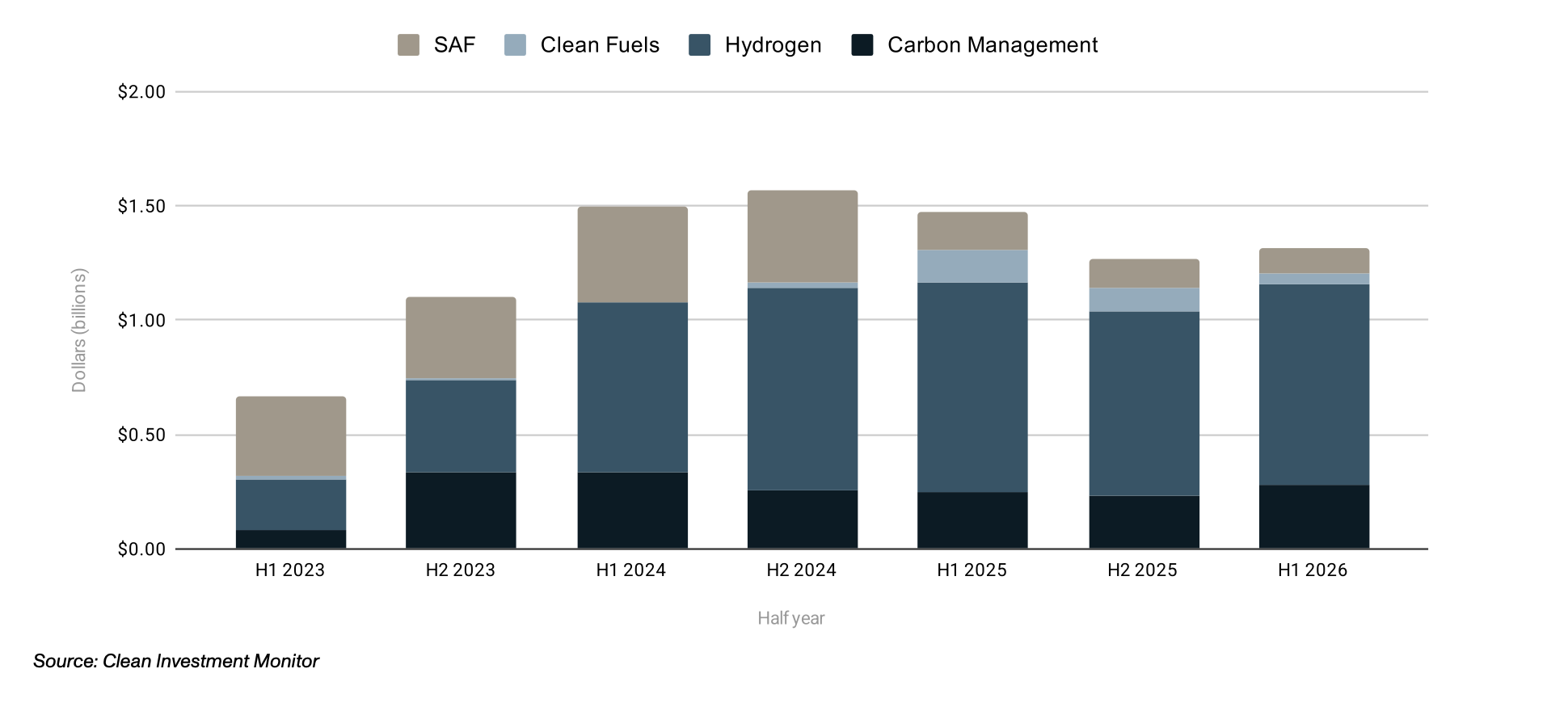
The release of Treasury's interim §45Q tax credit guidance acted as tailwind for the carbon-management segment by creating a workable solution for substantiating carbon sequestration volumes. Carbon management project financings grew 20% from the second half of 2025.
Clean fuels investment, H1 2023 - H1 2026
Buying §45Q tax credits with Crux
Crux helps tax credit buyers evaluate §45Q opportunities before funding, including credit eligibility, pricing, recapture protection, PFE status, and the technical documentation supporting the claim. Our $85 billion transaction dataset informs pricing benchmarks and structuring decisions across the transferable tax credit market, including segments where public price discovery remains limited.
If you are evaluating §45Q for the first time, talk to our team about current pricing, the documentation buyers typically require, and how parties are structuring recapture protection.
Further reading
For the full picture on tax credit pricing, volume, and insurance across the market in the first half of 2026, download The State of Clean Energy Finance: 2026 Mid-Year Market Intelligence Report.
For Crux's full analysis on prohibited foreign entity rules — updated as new guidance is released — visit our Prohibited Foreign Entity Rules resource hub.
To understand how PFE exposure is affecting tax credit pricing, diligence, and transaction terms in 2026, read Tax credits in the PFE era: What tax credit investors need to know in H2 2026.
Share