

What are the three prohibited foreign entity compliance tests?

Share
.svg)

.svg)
.svg)
Want to explore more conversations like this?
View all blogs
Since January 1, 2026, prohibited foreign entity (PFE) rules have governed whether clean energy projects and components can qualify for federal tax credits — and, by extension, whether those credits can be safely claimed, transferred, or financed. The framework is often grouped under the broader label foreign entity of concern (FEOC). FEOC is a term defined in the 2021 Infrastructure Investment and Jobs Act (IIJA). The Inflation Reduction Act (IRA) was the first to apply FEOC restrictions to a tax credit, through the §30D clean vehicle credit, and only as a battery supply chain sourcing test. The OBBB builds on that FEOC definition and substantially expands it — introducing the PFE framework, which adds two entity categories (specified foreign entities and foreign-influenced entities) and extends the restrictions from a single vehicle tax credit to six clean energy tax credits. Market participants still often refer to these provisions by the older FEOC label, but eligibility now turns on PFE status — which tests ownership and effective control in addition to supply chain sourcing.
Depending on the tax credit type, a taxpayer may need to clear three distinct tests to prove compliance with PFE requirements and qualify for tax credits:
- Ownership: Is the taxpayer a PFE because it is itself a specified foreign entity (SFE), or because it qualifies as a foreign-influenced entity (FIE) due to sufficient ownership, debt, or officer appointment rights held by an SFE?
- Effective control: Even without any ownership tie, has the taxpayer made a payment to an SFE under a contract or license that gives the SFE control over the project? That payment is the other route to FIE — and therefore PFE — status.
- Material assistance: Does the supply chain lean too heavily on PFEs? This is measured against statutory material assistance cost ratio (MACR) thresholds.
Developers, manufacturers, buyers, tax equity investors, and lenders therefore need to understand all three before capital is committed. This piece examines each test in turn, explains where regulatory guidance stands today, and discusses what developers, buyers, investors, and lenders should be doing in response.
Key takeaways:
- PFE rules, introduced by the OBBB and effective January 1, 2026, determine whether clean energy projects and components qualify for six federal tax credits: §§45Y, 48E, 45X, 45Q, 45U, and 45Z.
- PFE compliance is unusually consequential because the outcome is largely binary: a taxpayer or project complies, or the tax credit may be disallowed.
- PFE compliance is assessed through three tests: ownership (is the taxpayer owned or controlled by a prohibited foreign entity?), effective control (does a contract or license give a specified foreign entity control over the project?), and material assistance (do too many components and materials come from prohibited foreign entities?).
- Legacy §45 and §48 tax credits, for projects that began construction before 2025, are exempt from PFE and FEOC restrictions.
- IRS Notice 2026-15 (February 12, 2026) is the primary guidance to date and established three safe harbors for the material assistance test, but detailed rules for the ownership and effective control tests are still forthcoming in proposed regulations.
What are prohibited foreign entity rules?
The PFE rules created by the OBBB and signed into law on July 4, 2025, amended the clean energy tax credit statutes to deny tax credits to projects and manufacturers tied to prohibited foreign entities. Compliance is largely binary — a project either meets the requirements or forfeits the tax credit entirely — which is why the rules have quickly become one of the most consequential eligibility questions in the market.
PFE restrictions apply across several tax credit types, including the §45Y clean electricity production credit, the §48E clean electricity investment credit, the §45X advanced manufacturing production credit, the §45Q carbon capture credit, §45U zero-emission nuclear power production credit, and the §45Z clean fuel production credit. Specific restrictions and their effective dates vary by tax credit type. Legacy §§45 and 48 tax credits for projects that began construction before 2025 are generally outside the new framework.
Regulatory guidance so far has been limited. Notice 2026-15, released by the Treasury on February 12, 2026, is the only formal guidance issued to date, and it just addressed the material assistance test. Comprehensive proposed regulations covering all three tests are expected later in 2026.
What are the three PFE tests?
Ownership
The ownership test asks whether the taxpayer claiming the tax credit is itself a PFE. PFEs include SFEs and FIEs.
SFEs include businesses, entities, governments, or nationals of China, Russia, Iran, or North Korea, as well as entities designated as national security threats (for example, certain battery companies under the Uyghur Forced Labor Prevention Act). An entity is also an SFE if one or more of the previously mentioned SFEs directly or indirectly owns 50% or more of it, as determined by constructive ownership stock rules.
FIEs include entities that an SFE has influence over, determined by the following thresholds in the applicable tax year:
- Entity where one or more SFEs collectively hold ≥40% ownership or voting interest.
- Entity where a single SFE holds ≥25% ownership or voting interest.
- Entity where one or more SFEs were collectively issued ≥ 15% of the entity’s debt.
- Entity where an SFE has authority to appoint officers or directors.
If the taxpayer is an SFE or FIE, it cannot claim the applicable tax credit even if its operations are domestic. Tax credits also cannot be transferred to an SFE. The rules disqualifying tax credits due to FIE ownership took effect on January 1, 2026 for §§45Y, 48E, 45X, and 45Q tax credits, and will take effect on January 1, 2028 for §§45U and 45Z tax credits. Rules disqualifying tax credits due to SFE ownership took effect on January 1, 2026.
Additional operational rules related to ownership mechanics and tracing are expected in future Treasury and IRS guidance.
For more info: See our PFE definitions cheat sheet
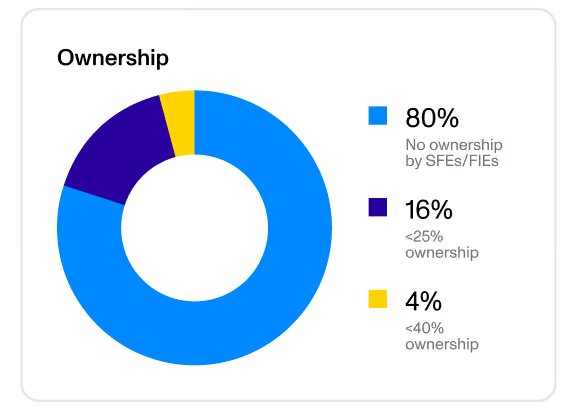
Even without complete guidance, the market has already started stress-testing this question against its own structures. In a late-2025 Crux survey of developers and manufacturers, 80% confirmed no prohibited foreign entity ownership. While fewer than 10% of surveyed companies reported that SFE/FIE owners can appoint officers or directors, those companies reported a variety of mitigation measures already underway, including working with entities to resolve governance issues or liquidating ownership by the SFE/FIE.
Percent of companies reporting ownership by SFEs/FIEs (late-2025, pre–Notice 2026-15)
Effective control
Distinct from the ownership test is the effective control test, which applies to a taxpayer’s contractual relationships. A taxpayer with no foreign ownership can still be disqualified from receiving §§45Y, 48E, and 45X tax credits if it makes payments to an SFE under a contract or licensing agreement that gives the SFE control over a project, facility, or eligible-component production.
The Internal Revenue Service (IRS) is expected to publish additional guidance defining "effective control" later in 2026. In the interim, the statute identifies specific contractual rights that may constitute effective control, such as:
- Contracts allowing an SFE to dictate production levels, output, or facility operations.
- Licensing agreements that either (i) give an SFE the right to specify sources of components, direct facility operations, limit IP usage, receive royalties for more than 10 years, or provide services for more than two years, or (ii) were entered into after July 4, 2025.
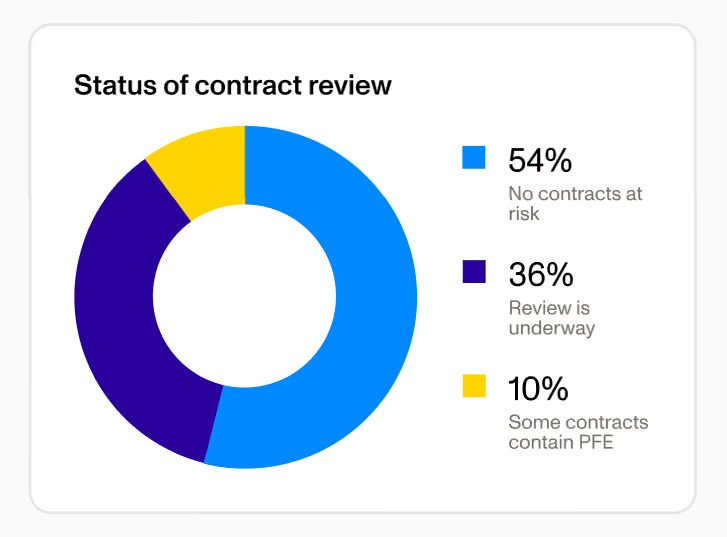
In the same Crux survey, 54% of companies reported no effective control payments to PFEs following contract reviews. Among the companies that did report effective control payments to PFEs in certain contracts, roughly 80% indicated that they were already revising contract terms to exclude effective control payments.
Percent of companies reporting payments to SFEs/FIEs (late-2025, pre–Notice 2026-15)
Material assistance
Taxpayers claiming §§45Y, 48E, and 45X tax credits must also demonstrate that a sufficient share of total manufactured product costs attributable to PFEs remains below statutory material assistance cost ratio (MACR) thresholds. These thresholds vary by tax credit type, technology, and year, and generally tighten annually through 2030. MACR thresholds can be calculated using the following formula:
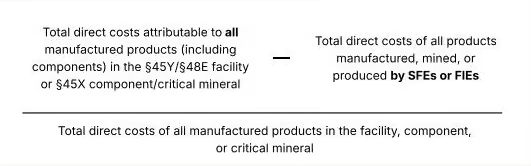
Notice 2026-15 addressed two core compliance questions regarding material assistance: “how far up the supply chain must a taxpayer trace PFE-attributable costs?”, and “how should those costs be calculated and documented?”. It established three safe harbor pathways for calculating the MACR, rules for how components may be tracked and averaged across facilities, and special treatment for interconnection property under §48E.
Interim safe harbor pathways
Notice 2026-15 established three pathways through which taxpayers can calculate the MACR without independently verifying upstream costs at every level of the supply chain:
- Identification safe harbor: Taxpayers can treat the manufactured products and manufactured product components (for §45Y/§48E) or constituent materials (for §45X) identified in the 2023–2025 domestic content safe harbor tables as the "exclusive and exhaustive" list for MACR calculation purposes — items not listed are disregarded entirely. Taxpayers are not required to trace subcomponents or raw materials beyond what the tables specify. Technologies without existing safe harbor tables — such as nuclear, fuel cells, and geothermal — and facilities using the incremental production rule cannot use this pathway.
- Cost-percentage safe harbor: Taxpayers may use percentages assigned in those tables as proxies for direct costs rather than calculate actual costs independently.
- Certification safe harbor: Taxpayers may rely on supplier certifications addressing the share of direct material costs not produced or manufactured by a PFE, unless they know or have reason to know a certification is inaccurate. Certifications must be signed under penalties of perjury, retained by both the supplier and taxpayer for at least six years, and attached to the relevant tax forms. Taxpayers can use this pathway with or without the identification safe harbor, making it available for unlisted technologies and components.
Tracking and averaging
Notice 2026-15 provides taxpayers with multiple compliant methods for tracking components across facilities, including individual tracking, de minimis assignment-based tracking, and cost averaging for certain energy storage and §45X components. For buyers, the key diligence question is whether the seller has selected a defensible tracking methodology and can produce supporting documentation.
Interconnection property
For §48E projects, interconnection property is subject to its own distinct MACR calculation, separate from the qualified facility. If interconnection property fails PFE compliance, the taxpayer may still claim §48E tax credits for the underlying facility — but cannot include interconnection property expenditures in the qualified investment. If the facility itself fails PFE compliance, no tax credit is available, and the interconnection property cannot be claimed independently.
Of the three tests, material assistance demands the most extensive documentation because compliance depends on tracing component costs through multiple tiers of the supply chain. Supply chain mapping was among the steps more than 90% of developers had already begun before guidance was issued. Notice 2026-15 then made that work more tractable than feared: for technologies with domestic content safe harbor tables — solar, wind, and storage — the calculation covers only listed components, and compliance turns on Tier 1 supplier certifications rather than tracing every material to its origin.
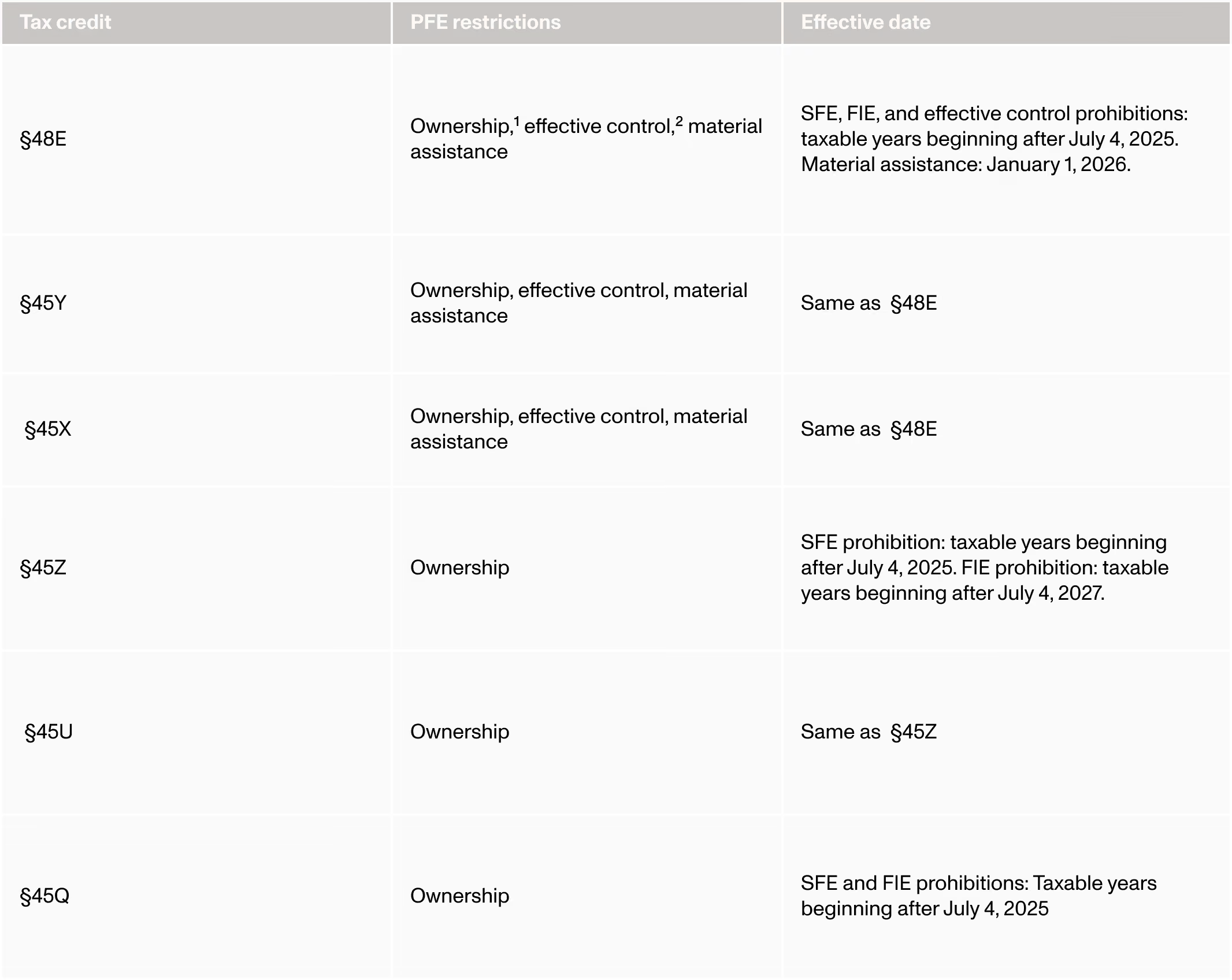
What tests apply to each tax credit type?
Which tests apply, and when, depends on the tax credit. As a rule of thumb, the two entity-level tests — ownership and effective control — apply most broadly, while material assistance is the narrowest. The table below breaks down the specifics, including effective dates, by tax credit.
What’s coming next?
Guidance remains incomplete in two distinct ways — one procedural, one substantive.
The procedural gap concerns the type of guidance issued so far. Notice 2026-15 is interim guidance — a temporary framework that taxpayers can rely on today, but one that the Treasury can revise and that lacks the durability of formal regulations. Treasury and the IRS have said they expect to issue additional guidance later in 2026, beginning with proposed regulations and ultimately followed by final regulations that will settle the framework. . Until then, the market is operating on a stopgap that could still change.
The second gap is substantive. Notice 2026-15 addressed only the material assistance test — the MACR calculation and its safe harbors — and left the ownership and effective control tests almost entirely to future rulemaking. That means two of the three tests still lack detailed rules, which remains a significant source of diligence uncertainty today.
As legacy §§45 and 48 tax credits are exhausted, tech-neutral §45Y and §48E tax credits — which carry the PFE rules — will make up a growing share of the market. That growth is uneven, however. OBBB placed an accelerated sunset on wind and solar, which must have begun construction by July 4, 2026 or be placed in service by the end of 2027 to claim §45Y or §48E — years ahead of the phase-out for other technologies. As a result, the tech-neutral pipeline is increasingly weighted toward storage and other technologies, alongside the large volume of wind and solar already safe-harbored ahead of that deadline. That transition is still unfolding: as of mid-2026, investor appetite for the most PFE-exposed tech-neutral tax credits, while improving, remained selective as buyers awaited the ownership and effective control guidance still to come. That makes the ability to evaluate all three tests a prerequisite for transacting in the tax credits that will define future supply, whether or not final guidance has landed.
Further reading
For Crux's full collection of analysis on the prohibited foreign entity rules — updated as new guidance is released — visit our Prohibited Foreign Entity Rules resource hub.
To see how developers and manufacturers are approaching compliance in practice, read our FEOC readiness survey report, the source of the market data cited throughout this article.
To understand the first round of regulatory guidance in more detail, see our breakdown of initial Treasury guidance on prohibited foreign entity rules.
For broader market pricing and volume trends across tech-neutral and legacy tax credits, download our 2025 market intelligence report.
1 Ownership test — disqualifies the taxpayer if it is itself a PFE: an SFE, or FIE by formal control — an SFE owning ≥25% (or SFEs owning ≥40% in aggregate), holding ≥15% of the entity’s debt, or holding authority to appoint an officer or director.
2 Effective control test — the second route to FIE status: a payment to an SFE under a contract or license giving it control over the facility, storage, or eligible-component production. Applies to §§45Y, 48E, and 45X only.
Share