

Unpacking the new 45ZCF-GREET update for clean fuels

Share
.svg)

.svg)
.svg)

Want to explore more conversations like this?
View all blogs
On September 8, 2026, the US Department of Energy (DOE) released a revision of 45ZCF-GREET, the lifecycle emissions model that sets carbon intensity (CI) scores — and credit values — under the §45Z clean fuel production credit.
The update adds pathways for several renewable natural gas (RNG) feedstocks and allows for farm-specific, negative emission rates for dairy and swine manure feedstock omitted from the June 2026 model update. The US Department of the Treasury and the Internal Revenue Service (IRS) also released Notice 2026-53 with guidance on the model's new manure-specific inputs.
Key takeaways for clean fuel producers and tax credit market participants:
- Increased eligible supply from new feedstocks. Adding organic waste — including food scraps, corn stover, grain stillage, and mixed high-moisture organic wastes — as eligible feedstocks under the updated GREET model is a major win for producers who previously had no established pathway to generate §45Z credits, expanding the pool of eligible RNG supply.
- Potential upsized credit values for dairy and swine producers who can prove on-farm practices. Producers able to substantiate their prior manure-management practices (e.g., uncovered lagoon, deep pit) in the updated model may see meaningfully improved CI scores. Using the sample assumptions from the updated model, dairy manure RNG would receive a -75 CI, equivalent to ~$2.60/gallon, or ~$20/MMBtu,representing an improvement on the ~-35 CI under the prior model.
- Updated GREET model and revised guidance should expand buyer pool. Clear rules for calculating the carbon intensity for newly eligible feedstocks such as organic waste will help lower the diligence bar and make §45Z tax credits accessible to a wider set of buyers.
- Regenerative agriculture integration should benefit crop-based fuel producers sourcing from eligible farms. The model now incorporates the US Department of Agriculture’s (USDA) Feedstock Carbon Intensity Calculator (FD-CIC) directly, so CI benefits from low-carbon farming practices flow straight into a producer's emissions rate when their feedstock comes from farms using those practices.
- Continued momentum in the §45Z tax credit market. Crux estimates an upside case of $3 billion or more in §45Z tax credits available for 2026.
For more on recent regulatory changes to §45Z, download our ebook →
What is the §45Z clean fuels tax credit?
The §45Z clean fuel production credit is a technology-neutral federal tax incentive, enacted under the Inflation Reduction Act (IRA). Unlike previous technology-specific fuel credits, §45Z is a performance-based incentive based on the fuel’s greenhouse gas emissions. Available for fuel produced and sold from 2025 onward, the credit pays a base rate of $0.20 per gallon. For facilities that comply with prevailing wage and apprenticeship (PWA) requirements, that rises to $1.00 per gallon. The credit rate is scaled by an emissions factor tied to the fuel's lifecycle carbon intensity as modeled under Treasury's 45ZCF-GREET framework.
The lower a fuel's CI, the larger the credit, up to a cap of 1.0x the applicable amount for most feedstocks. Fuel derived from livestock manure is exempt from that cap, letting negative-CI dairy and swine digester pathways earn a proportionally larger credit.
The One Big Beautiful Bill (OBBB), enacted in July 2025, extended §45Z two years through 2029 and reshaped it in several ways that took effect for fuel produced after December 31, 2025:
- Eliminated the separate, higher credit rate ($0.35/$1.75 per gallon) for sustainable aviation fuel (SAF), putting SAF on the same $0.20/$1.00 base as every other transportation fuel.
- Restricted feedstocks to those produced in the US, Canada, or Mexico and layered in new foreign-entity-of-concern (FEOC) ownership restrictions on eligible facilities.
- Removed indirect land use change (ILUC) penalties from the emissions calculation, opening the door for crop-based feedstocks like corn and soy to score better.
- Codified the general prohibition on negative emissions rates while carving out an exception only for animal manure–derived fuel.
This release is the latest in a series of updates clarifying federal guidance around the §45Z tax credit.
Crux’s July 2026 clean fuel policy catalyst calendar

What this update changes for RNG producers
New pathways for food waste and organic residuals
The January 2025 table recognized only three feedstocks for the RNG pathway: wastewater sludge, animal manure, and landfill gas. Without approved pathways, fuel producers cannot generate §45Z tax credits.
RNG producers digesting food waste, corn stover, grain stillage, or mixed high-moisture organic wastes had no established pathway and would have needed a provisional emissions rate (PER), a slower, facility-specific process.
The September 2026 model adds all four as established feedstocks, giving those producers a direct route to generate tax credits in 2026 without going through the underdeveloped PER process.
Negative-emission pathways for dairy and swine manure
The September update addresses the requirement in the OBBB to account for negative emission rates from manure feedstocks. Dedicated dairy and swine manure pathways now calculate emissions using each farm's practices rather than a national-average baseline. Poultry and beef manure are not yet included; Treasury and the IRS are encouraging producers of those fuels to wait for a future update rather than file a PER.
This is a big policy win for dairy and swine manure RNG producers. Dairy and swine operations — the segments most likely to have stored manure in lagoons or deep pits, the highest-emitting practices on the list — can move from the national-average baseline to a farm-specific one, receiving a more favorable CI. That, in turn, translates into more §45Z credits.
The farm-specific model inputs aren’t available for new farms beginning operations after September 8, 2026. While guidance on new farms is still to come, Treasury and the IRS flagged that a new farm, with no prior practices to reference, could otherwise claim the highest-emitting hypothetical baseline to maximize tax credit value. RNG producers must also substantiate their farm-specific practices, or the model won't include avoided emissions for that portion of their manure inputs.
Other model changes worth flagging
- FD-CIC now built into the model. The update incorporates the USDA's Feedstock Carbon Intensity Calculator directly for CI adjustments tied to regenerative agricultural practices, providing upside for crop-based fuels sourcing eligible feedstocks.
- New inputs for integrated natural gas CHP facilities. Certain pathways add inputs for facilities running integrated combined heat and power (CHP) systems, with guidance on accounting for purchased environmental attribute credits (EACs), creating additional flexibility for fuel producers to lower their CIs via onsite generation.
A recent tailwind from the RFS market
The favorable GREET model update and IRS guidance come just over a week after another major win for clean fuel producers. On August 31, 2026, the Environmental Protection Agency (EPA) issued its SRE Decisions Action, ruling on 34 pending small refinery exemption (SRE) petitions from 29 refineries for the 2025 compliance year: 18 full exemptions, 11 partial exemptions, three denials, and two ineligibility determinations. The decision exempts 1.76 billion renewable identification numbers (RINs) for 2025 and reissues one partial exemption for a 2024-year petition originally decided August 3.
For RNG producers, §45Z credits and RINs are two separate revenue streams generated by the same fuel, so swings in RIN prices reshape the underlying project economics that tax credit buyers are underwriting when they price a §45Z deal.
The EPA committed to reallocate 100% of that volume into the 2026 and 2027 Renewable Volume Obligations (RVOs), with the rule expected before the end of October 2026. It also extended the 2025 compliance deadline by 30 days, to October 1, 2026, to let the market absorb the additional RINs.
The scale of the exemptions had already driven volatility ahead of the announcement: D6 (ethanol) RIN prices fell to roughly $1.75 in the weeks before the decision, down from a July high near $2.50, as the market priced in how large the relief might be. The reallocation commitment offsets that: the EPA's Set 2 rule had built only 990 million RINs of 2025 exemptions into the 2026–2027 RVOs, so the actual 1.76 billion total is roughly 770 million RINs above that projection. However, with the EPA expected to reallocate the entire incremental volume, demand for RINs will remain stable.
What this means for the tax credit market
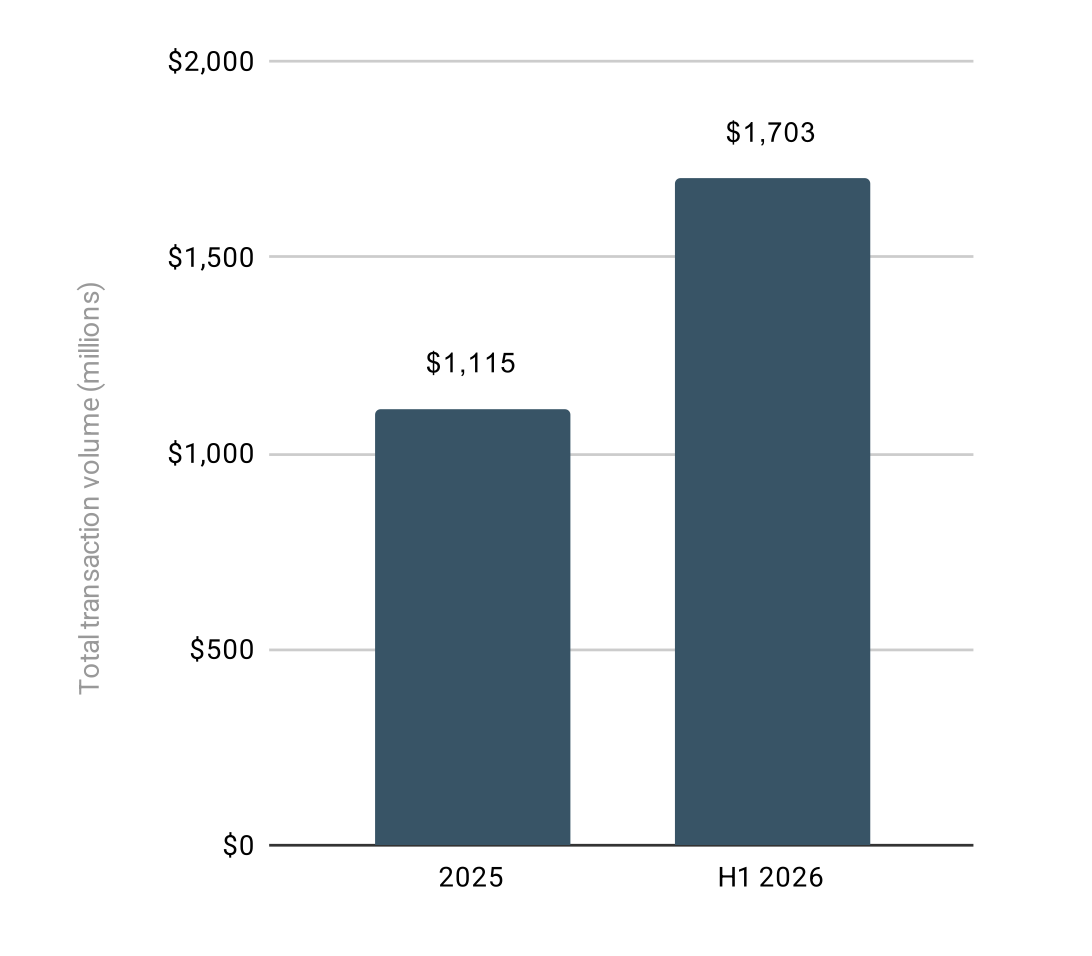
Crux expects this update to drive continued momentum in the §45Z tax credit market, which has grown exponentially. We observed more than $1.7 billion in §45Z transactions in the first half of 2026, up from $1.1 billion for all of 2025. Crux estimates an upside case of $3 billion or more in §45Z tax credits available for 2026.
Total clean fuels transaction volume, 2025 and H1 2026
Both the model update and Notice 2026-53 take effect September 8, 2026. RNG producers digesting food waste, corn stover, grain stillage, or mixed organic wastes should confirm which pathway now applies. Manure RNG producers should gather documentation on farm-specific management history.
Tax credit buyers evaluating RNG deals should take a closer look at newly eligible organic waste projects and update assumptions on the potential size of tax credits generated from dairy and swine RNG projects.
By year end, Crux expects Treasury will issue final rules implementing the §45Z tax credit, and the DOE will update the 45ZCF-GREET model to incorporate beef- and poultry-specific pathways for RNG producers. We’ll continue to monitor for updates — subscribe to our newsletter to keep up with the latest policy developments.
Further reading
Dive deeper into the §45Z tax credit, including qualification, how to mitigate transaction risks, and how recent legislative changes have affected the tax credit, in our comprehensive guide.
Understand the rising popularity of §45Z tax credits and other trends affecting the tax credit market in our mid-year market intelligence report.
Learn more about the June update to the 45ZCF-GREET model update and what it means for clean fuels producers.
Share