

What final 2026–2027 RFS volumes mean for RNG, renewable diesel, SAF, and ethanol producers

Share
.svg)

.svg)
.svg)

Want to explore more conversations like this?
View all blogs
On March 26, the Environmental Protection Agency (EPA) released its final rule establishing renewable volume obligations (RVOs) under the renewable fuel standard (RFS) for 2026 and 2027, finalizing higher volumes than proposed in June 2025 despite rising consumer fuel prices stemming from the Iran war.
For clean fuel producers and developers, the final rule is broadly supportive across fuel types:
- Renewable diesel (RD): The primary beneficiary of the final volumes relative to the proposal, with significantly higher biomass-based diesel (BBD) volumes than EPA initially proposed.
- Renewable natural gas (RNG): Higher cellulosic volumes provide a supportive demand signal, despite EPA's more conservative assumptions for cellulosic fuel growth.
- Ethanol: The conventional fuel mandate remains at 15 billion gallons in both years, creating an incentive for continued E15 adoption to help close the gap between the mandate and projected ethanol consumption.
- Clean fuels overall: EPA's treatment of small refinery exemptions (SREs) increases effective RIN demand above the proposed volumes.
Crux views EPA’s decision to increase the volumes as further evidence of the current administration’s support for the clean fuel sector. It also provides a positive signal for outstanding policy decisions that could affect clean fuel economics, including final rules from the US Department of the Treasury on the §45Z production tax credit, upcoming updates to carbon intensity models and on-farm conservation rules for feedstocks, and E15 negotiations in Congress.
The favorable RFS decision came shortly after EPA waived summertime limits on E15 sales. Together, these actions signal that the administration views supportive biofuel policies as a solution to fuel price inflation, not a driver.
The RFS program creates a critical source of demand for clean fuel producers by requiring refiners to either blend physical volumes of biofuel or purchase associated credits, called renewable identification numbers (RINs), based on a percentage of their gasoline and diesel throughput.
Compared with the proposed volumes, EPA increased the mandates for most clean fuel categories in both 2026 and 2027:
- Cellulosic: Up 4.6% in 2026 and 5.1% in 2027
- Biomass-based diesel (BBD): Up 24.4% in 2026 and 19.3% in 2027
- Advanced fuel: Up 20.0% in 2026 and 16.0% in 2027
- Conventional ethanol: Unchanged at 15 billion gallons in both years
When accounting for reallocated SREs, the mandate increases even further — by roughly 1 billion RINs in both 2026 and 2027 across all categories besides cellulosic.
Changes from proposed to final volumes, 2026–2027
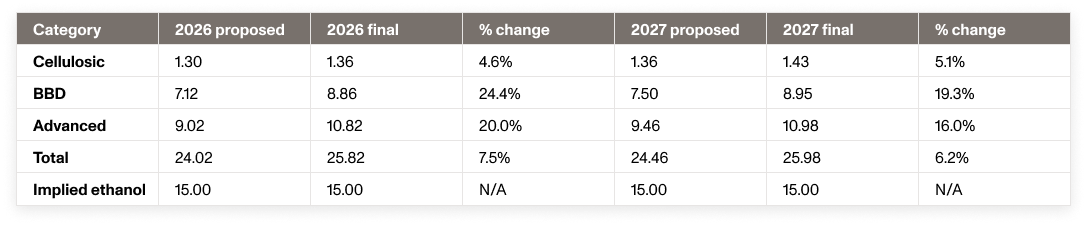
The increase in effective RIN demand reflects EPA's decision to reallocate 70% of volumes exempted through small refinery exemptions (SREs) from 2023–2025 into the 2026–2027 RVOs and percentage standards.
Percentage standards determine how much biofuel refiners must blend or procure based on their throughput and are calculated using volumetric RVO quotas divided by projected gasoline and diesel consumption, meaning actual RIN demand fluctuates with overall fuel consumption. Rather than removing exempted gallons from the denominator, EPA added exempted gallons to the numerator when calculating the 2026–2027 percentage standards.
The 70% reallocation is a meaningful win for clean fuel producers and a continuation of the policy EPA originally established in 2019. Going forward, Crux expects EPA to fold projected SREs directly into percentage standards, absent litigation, or other policy developments requiring further adjustments.
Changes in 2026 percentage standards in final rule compared to proposed and supplemental rules

Changes in 2027 percentage standards in final rule compared to proposed and supplemental rules

Implications by fuel type
The final volumes have different implications across renewable diesel and SAF, RNG, and ethanol markets.
Renewable diesel and SAF
The final volumes are particularly favorable for renewable diesel and SAF producers. The BBD volumes exceed the Clean Fuels Alliance's request for at least a 5.25 billion-gallon mandate for 2026, equivalent to 8.4 billion RINs on a 1.6 ethanol-gallon equivalency basis. Beyond the growth in the BBD mandate, renewable diesel gallons will also be necessary to close the roughly 600 million-gallon gap between the 15 billion-gallon D6 mandate and EPA's projected 14.4 billion gallons of ethanol consumption.
Renewable natural gas
For RNG producers, the final volumes are broadly supportive but reflect a more conservative outlook for cellulosic fuel growth. EPA assumes 9% annual growth from 2025–2027, compared with the 30% annual growth assumption used for the 2023–2025 volumes. Final volumes remain below industry's request for 1.50 billion gallons in 2026 and 1.86 billion gallons in 2027, with EPA taking a more conservative approach given the need to waive the cellulosic mandate retroactively for 2025.
Ethanol
For ethanol producers, the 15 billion-gallon conventional fuel mandate keeps implied demand steady. With EPA projecting approximately 14.4 billion gallons of ethanol consumption, the roughly 600 million-gallon gap creates an incentive for additional ethanol blending, including continued E15 adoption, or other D6-qualifying fuels.
On-demand webinar: Crux's experts break down financing for clean fuels projects in 2026 —>
What else changed in the final RFS rule?
Beyond the higher renewable fuel volumes and EPA's treatment of SREs, the final rule included several other policy changes that affect clean fuel producers and developers.
Imported fuels and feedstocks
EPA dropped its proposal to award only half the RINs to imported renewable fuels and domestically produced fuels using foreign feedstocks for 2026 and 2027. That would penalize used cooking oil and tallow imported from abroad while creating a structural advantage for producers sourcing domestic soybean oil, animal fats, and corn ethanol feedstocks. However, the agency indicated that it intends for the policy to take effect in 2028, a strong signal of its future direction. That said, implementing the policy in 2028 would require a new rulemaking process as part of a future RVO.
Elimination of eRINs
EPA finalized the elimination of renewable electricity as a qualifying fuel under the RFS. eRINs were drafted in 2022 as a pathway for electricity generated from biogas to earn RFS credits but were never implemented. As a result, their elimination has no near-term impact on RNG, renewable diesel, SAF, or ethanol producers.
Equivalence values for RD, SAF, and naphtha
EPA had proposed standardizing renewable diesel and SAF equivalence values at 1.6 RINs per gallon; the final rule set both at 1.5 instead, while keeping the naphtha multiplier at 1.4 and delaying the change until January 1, 2027.
The change narrows the RIN-generation advantage renewable diesel has historically held over biodiesel and ethanol, modestly improving the competitive economics of corn-based fuels relative to HEFA-derived products.
Ethanol-to-jet pathway
EPA did not finalize a new standard pathway for renewable jet fuel produced from corn ethanol, despite pressure from the ethanol industry. Such a pathway would open a new SAF demand channel for ethanol producers and could significantly expand the addressable market for domestic ethanol.
What to watch next
With the 2026–2027 RFS volumes finalized, four outstanding policy developments could further shape clean fuel economics and §45Z tax credit values:
- DOE GREET model update: The GREET model used to calculate carbon intensity under §45Z will be updated to reflect changes mandated by the One Big Beautiful Bill, including removing indirect land use change from crop-based fuel emission rates and differentiating the carbon intensity of manure-based feedstocks for RNG.
- USDA feedstock guidance: USDA guidance will determine which on-farm conservation practices, such as cover crops, reduced tillage, and advanced fertilizer, generate verifiable carbon-intensity reductions under §45Z and how much additional tax credit value flows to the agricultural supply chain.
- Treasury final rule for §45Z: Treasury's February 2026 proposed rule addressed key outstanding questions including intermediary sales, safe harbors for determining fuel emissions rates, and substantiation of qualified sales. Crux expects the final rule to track closely with those provisions.
- Legislative E15 negotiations: Congress is considering legislation that would permanently authorize year-round E15 sales nationwide, removing the summertime blend wall that has historically constrained ethanol demand. EPA's recent waiver provides near-term relief, but a statutory fix would offer more durable market access for ethanol producers.
Given the administration's demonstrated support for domestic biofuel production, Crux expects these developments to be broadly favorable for producers. Greater policy certainty would also narrow the range of outcomes investors must underwrite, supporting liquidity and pricing in the clean fuel tax credit transfer market and accelerating capital formation across the sector.
Crux will continue to track how these developments affect clean fuel producers, developers, and investors. To learn more about the regulatory and policy intelligence we provide clients and partners through policy memos, briefings, and custom research, get in touch with us.
Share