
What's changed with the §45V clean hydrogen production tax credit [updated 2026]

Share
.svg)

.svg)
.svg)
Want to explore more conversations like this?
View all blogs
Originally published December 2023. Updated August 2026 to reflect final Treasury guidance, the One Big Beautiful Bill (OBBB), and current market conditions.
Final US Department of the Treasury rules and the One Big Beautiful Bill (OBBB) significantly reshaped the §45V clean hydrogen production tax credit since Treasury released draft guidance in December 2023. Back then, many of the industry’s questions centered on the "three pillars" of additionality, deliverability, and temporal matching, and how strictly they'd be enforced. In 2026, much of that regulatory uncertainty has been resolved — but the tax credit's timeline and, for some projects, the economics of pursuing it have changed substantially.
This update walks through what's changed in the final rules and the OBBB, why developers are increasingly weighing §45V against alternatives like investment tax credits (ITCs) and §45Q, and what the current landscape means for projects still evaluating the tax credit.
Key takeaways
- Treasury and the Internal Revenue Service (IRS) released final §45V regulations on January 3, 2025, keeping the "three pillars" framework but easing several requirements.
- The OBBB, signed July 4, 2025, moved the §45V begin-construction deadline from January 1, 2033 to January 1, 2028.
- Section 45V remains exempt from the prohibited foreign entity (PFE) restrictions that apply to most other clean energy tax credits under OBBB.
- Developers are increasingly weighing §45V against ITCs and §45Q due to the tax credit's production-linked structure and variation in tax credit value based on lifecycle emissions.
- Several states offer stackable Low Carbon Fuel Standard (LCFS) incentives alongside §45V.
What is the §45V clean hydrogen production tax credit?
Section 45V is a production tax credit (PTC) for clean hydrogen production, established under the Inflation Reduction Act. Eligible facilities generate tax credits for each kilogram of qualified clean hydrogen produced domestically and sold or used, over the first 10 years of a facility's operation.
How much tax credit a project generates depends on the lifecycle greenhouse gas (GHG) emissions associated with its hydrogen production process, calculated using 45VH2-GREET, the hydrogen-specific version of Argonne National Laboratory's Greenhouse gases, Regulated Emissions, and Energy use in Technologies model. To qualify, hydrogen must be produced with lifecycle emissions of no more than 4 kilograms of carbon dioxide equivalent (CO2e) per kilogram of hydrogen. From there, §45V has four emissions tiers, with lower-emissions hydrogen earning a larger tax credit. The statutory tax credit ranges from $0.60 to $3.00 per kilogram for projects that meet prevailing wage and apprenticeship (PWA) requirements, with those amounts adjusted annually for inflation.
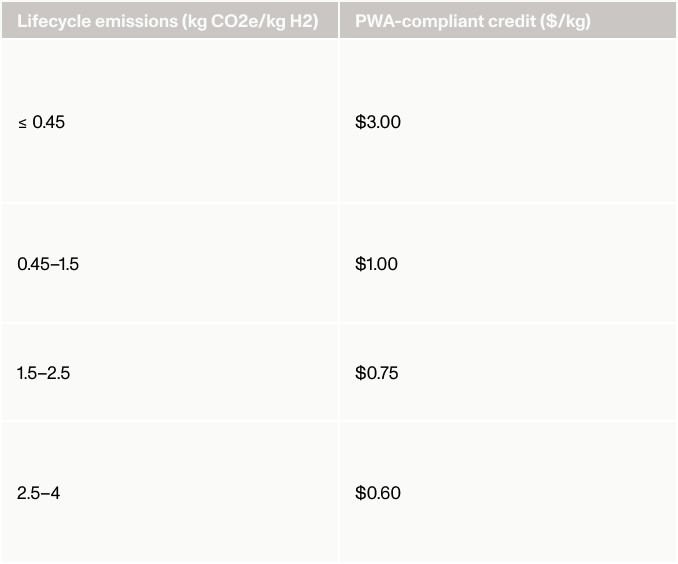
For hydrogen produced using electricity, determining that emissions rate is where the three pillars come in:
- Additionality: The clean electricity used to power hydrogen production generally must come from new or additional generation sources, rather than drawing on the existing grid.
- Deliverability: The electricity used must be deliverable to the hydrogen facility, generally requiring the generation and production to sit within the same region.
- Temporal matching: Electricity generation must be time-matched to hydrogen production. Under the final rules, annual matching applies until hourly matching requirements begin in 2030.
Together, these requirements are intended to ensure that the electricity attributed to hydrogen production reasonably reflects the emissions of the generation being claimed, rather than shifting existing electricity away from other grid users and increasing emissions elsewhere.
One requirement §45V projects don't have to navigate is PFE provisions. PFE rules, introduced under the OBBB, restrict certain clean energy and manufacturing tax credits based on a project's ownership, supply chain, and contractual ties to specified foreign entities. Congress applied some form of PFE restriction to §45Q, §45X, §45Y, §45Z, §45U, and §48E, but left §45V out. That distinction hasn't changed and remains a point of relative simplicity for hydrogen projects compared to other tax credit categories.
The hydrogen market is relatively small compared with power and manufacturing, but investment continues to move forward. Crux's 2026 Mid-Year Market Intelligence Report found that hydrogen investment increased 9% in the first half of 2026 and represented 66% of total investment in the clean fuels sector. Against that backdrop, developers evaluating §45V now have greater clarity on how the tax credit works, but a much shorter window in which to qualify — putting more emphasis on whether a project can meet the new construction deadline and whether §45V is the most attractive incentive available.
What changed in the final Treasury rules and the OBBB?
Treasury and the IRS released final §45V regulations on January 3, 2025, roughly 13 months after the December 2023 guidance. The final rules kept the three-pillar framework intact but added flexibility that eased several concerns:
- Energy attribute certificate (EAC) matching: Treasury pushed hourly matching requirements to 2030, giving producers more time to build compliant sourcing before the strictest temporal-matching rules apply.
- GREET model treatment: The final rules give producers the option to lock in the version of the GREET model available when construction begins for the remaining years of the 10-year credit period, rather than having to rely on future annual model updates.
- Additionality flexibility: Several carve-outs were added, including for existing nuclear generation, that widened the pool of qualifying electricity sources.
Then, the OBBB, signed July 4, 2025, brought up the §45V begin-construction deadline from January 1, 2033 to January 1, 2028. Separately, the US Department of Energy (DOE) announced in October 2025 that it was canceling roughly $7.5 billion in federal funding across more than 200 clean energy and infrastructure projects, including approximately $2.2 billion committed to the ARCHES (California) and Pacific Northwest hydrogen hubs. These hubs have appealed the decision, and the status of several other DOE-backed hubs remains unresolved as of August 2026. As grant funding becomes less certain, the economics and financeability of §45V — and alternatives like §45Q and the ITC — become even more important to project viability.
Why developers are weighing §45V against ITCs
The shortened construction window adds pressure to a decision that project sponsors were already facing: whether §45V's structure fits their project or if there are other available alternatives.
Section 45V is a production tax credit, paid over the hydrogen facility's first 10 years of operation based on actual volumes produced. That structure creates two practical considerations for sponsors:
- Timing of value realization: The ITC delivers its full tax credit value in the year a project is placed in service. Section 45V pays out over a decade, tied to production — a structure that can be harder to finance against, particularly for projects seeking to monetize the tax credit early through a transfer.
- Valuation tied to lifecycle emissions: Unlike an ITC with a fixed value based on qualifying investment, §45V's per-kilogram value depends on a facility's lifecycle emissions intensity as calculated using 45VH2-GREET. Projects with lower emissions qualify for higher credit tiers, which can make the value of a §45V credit stream more project-specific for buyers and sponsors underwriting a forward transaction
How does §45V compare to §45Q and §45Z?
For larger industrial hydrogen-adjacent projects — ammonia, methanol, and similar large-scale facilities — §45Q, the tax credit for carbon capture and sequestration, has also emerged as an alternative worth considering. Sponsors can't claim both §45V and §45Q for the same production, and we're hearing that several large projects that could have qualified for either have opted for §45Q, citing more established transaction precedent and a more straightforward buyer market.
There is also a connection between §45V and §45Z, the clean fuel production credit. Some of the emissions-accounting concepts Treasury developed through the §45V rulemaking process have informed its approach to §45Z, particularly around how producers substantiate lower-emissions electricity and feedstocks. For sponsors tracking both tax credits, §45V offers useful context for understanding how Treasury is approaching lifecycle emissions across newer production tax credits.
What state incentives can developers stack with §45V?
Federal tax credits aren't the only monetization path available to hydrogen producers. Several states offer LCFS or similar programs that generate tradable credits based on a fuel's carbon intensity:
- California, Oregon, and Washington operate LCFS-style programs.
- New Mexico has already enacted a clean fuel standard (2024), with implementing rules due by July 2026 — making it the fourth state with a program.
- New York's proposed standard passed the Senate in 2025 but stalled in the Assembly; New Jersey's version remains in committee.
- California's treatment of renewable natural gas (RNG) used as hydrogen feedstock has generally remained more favorable than the state's broader book-and-claim rules for other RNG end uses, though producers should confirm current requirements directly with the California Air Resources Board given the pace of rule changes.
For producers selling into these markets, LCFS-type credits can meaningfully supplement federal tax credit value and are worth factoring into a project's overall capital stack.
What this means for developers evaluating §45V today
For projects that do qualify and are moving forward, the January 1, 2028, begin-construction deadline is now the operative constraint. Developers still deciding on §45V should build their timelines around that date, with enough runway for permitting, financing, and construction start.
For projects pursuing the credit, the choice between direct pay and transfer remains a live decision:
- Direct pay is available for the first five years of production, providing full refundability without requiring a buyer. We're hearing that some sponsors are using this window deliberately, planning to transition to the transfer market once the project has an operating track record that reduces perceived risk for buyers.
- Transfer requires finding a buyer willing to underwrite the tax credit, which — particularly for smaller or pre-production positions — remains a more bespoke, relationship-driven process than transfers of more established tax credit types. Sponsors increasingly use insurance to address recapture risk and give buyers more certainty around the value they're purchasing — a pattern we're seeing echoed in how tax credit insurance is applied across other credit categories as well.
Sponsors evaluating §45V today are best served by starting structuring conversations early, given the compressed timeline and the number of variables — construction deadline, credit election, monetization path — that now need to be resolved in parallel.
Where Crux fits
Crux advises hydrogen developers and sponsors on structuring and monetizing tax credits across the full capital stack, including §45V, §45Q, ITCs, and complementary state programs. Our team draws on direct transaction experience — backed by an $85 billion transaction dataset that informs every deal and structuring decision — to help clients evaluate which tax credit or combination of tax credits fits their project and to execute transfers with buyers when that's the right path.
If you're evaluating §45V for a project ahead of the 2028 construction deadline, talk to our team about structuring options.
Further reading
For more on how §45V's EAC framework is shaping other tax credits, see our breakdown of the newly proposed §45Z regulations.
To understand how §45V compares to other production tax credits developers can elect instead, see our guide to §48E and §45Y tech-neutral tax credits.
For the full picture of how the One Big Beautiful Bill reshaped federal energy tax credits beyond §45V, see our breakdown of the OBBB's impact on energy and manufacturing tax credits.
Share