

Understanding the base erosion and anti-abuse tax (BEAT) and transferable tax credits

Share
.svg)

.svg)
.svg)
Want to explore more conversations like this?
View all blogs
Congress created the base erosion and anti-abuse tax (BEAT) in the Tax Cuts and Jobs Act of 2017 to limit the tax benefit of deductible payments to foreign related parties. A corporation calculates its regular federal income tax and a separate BEAT amount. If the BEAT amount is higher, it pays the difference as an additional tax. Because some credits lower federal income tax without reducing BEAT liability, a buyer may not be able to utilize the full amount of credits from a transfer or investments that their regular tax bill would suggest. This piece explains who is subject to BEAT, why credit type matters, and how corporate tax teams can evaluate BEAT.
Key takeaways
- Who is subject to BEAT? A narrow group of corporations whose aggregated groups meet both tests: at least $500 million in average annual gross receipts and a base erosion percentage of at least 3% (2% for certain bank and securities-dealer groups). Most buyers without material cross-border, related-party payments are outside its scope.
- How can a credit purchase affect BEAT? A purchased credit can reduce regular federal income tax; however, purchased credits may not fully offset the BEAT and could increase U.S. federal income taxes.
- Which transferable credits receive BEAT protection? Legacy §§45 and 48 credits may preserve up to 80% of their current-year federal tax benefit, subject to the buyer’s full BEAT calculation. Commonly transferred credits, like §§45X, 45Y, 48E, 45Q, 45V, and 45Z receive no corresponding BEAT offset and may increase federal income taxes.
How does BEAT interact with the federal corporate tax?
The One Big Beautiful Bill Act (OBBB) set the general BEAT rate at 10.5% for tax years beginning after 2025 and preserved a partial offset for certain general business credits. This means that BEAT imposes an additional tax on applicable taxpayers when 10.5% of modified taxable income (MTI) exceeds regular tax liability after prescribed credit adjustments. MTI generally adds back deductions and other tax benefits associated with payments to foreign related parties.
For tax credit buyers, the practical question is how much cushion remains between the corporation’s regular tax and its BEAT calculation. Because a purchased credit lowers regular federal income tax without receiving a corresponding offset under BEAT, it can lead to BEAT for a taxpayer that otherwise would not be subject to BEAT. As a result, a corporation may have less tax credit capacity than its regular tax bill alone suggests.
BEAT should also be modeled alongside the corporate alternative minimum tax (CAMT) which imposes a 15% minimum tax on the adjusted financial statement income of certain large corporations. CAMT applies to the extent tentative minimum tax exceeds the sum of regular income tax and BEAT. Corporations potentially subject to both should evaluate them together before sizing a transferable tax credit purchase.
Who is subject to BEAT?
BEAT generally applies only when a corporation’s aggregated group meets both tests:
- Gross receipts test: average annual gross receipts of at least $500 million over the three preceding taxable years. For foreign corporations, only gross receipts effectively connected with a U.S. trade or business count.
- Base erosion percentage test: a base erosion percentage of 3% or higher for the taxable year, or 2% if the taxpayer is a member of an affiliated group that includes a bank or registered securities dealer. The base erosion percentage is, roughly, the taxpayer’s base erosion tax benefits for the year divided by its total allowable deductions.
A corporation that does not meet either test in the year it applies purchased tax credits has no BEAT exposure. A group sitting near the 3% line is in a different position: it should model both the threshold and the Base Erosion Minimum Tax Amount (BEMTA) consequence before committing to a tax credit purchase program. For corporations with potential BEAT liability, different transferable tax credits carry different BEMTA consequences.
BEAT is not a universal constraint for all potential tax credit buyers and investors. Most buyers without material cross-border, related-party payments that give rise to a domestic deduction are outside its scope. The buyers most likely to be affected are multinational groups with material deductible payments — interest, royalties, or certain service fees — to foreign affiliates. For these multinational groups, BEAT is an important element in credit-capacity modeling.
Note that Congress is aware of the interaction between the BEAT and domestic credits, and members have introduced legislation to fix the issue. For example, S. 1605, the International Competition for American Jobs Act of 2025, would allow all domestic tax credits to offset BEAT.
How are transferable tax credits treated under BEAT?
For a buyer in a BEAT position, tax credit value depends on whether the credit receives an offset in the BEAT calculation. Among commonly transferred credits, legacy §45 production tax credits (PTCs) and §48 investment tax credits (ITCs) qualify as “applicable §38 credits.” BEAT can preserve up to 80% of these credits’ value, subject to the buyer’s full BEAT calculation.
BEAT offset treatment by tax credit
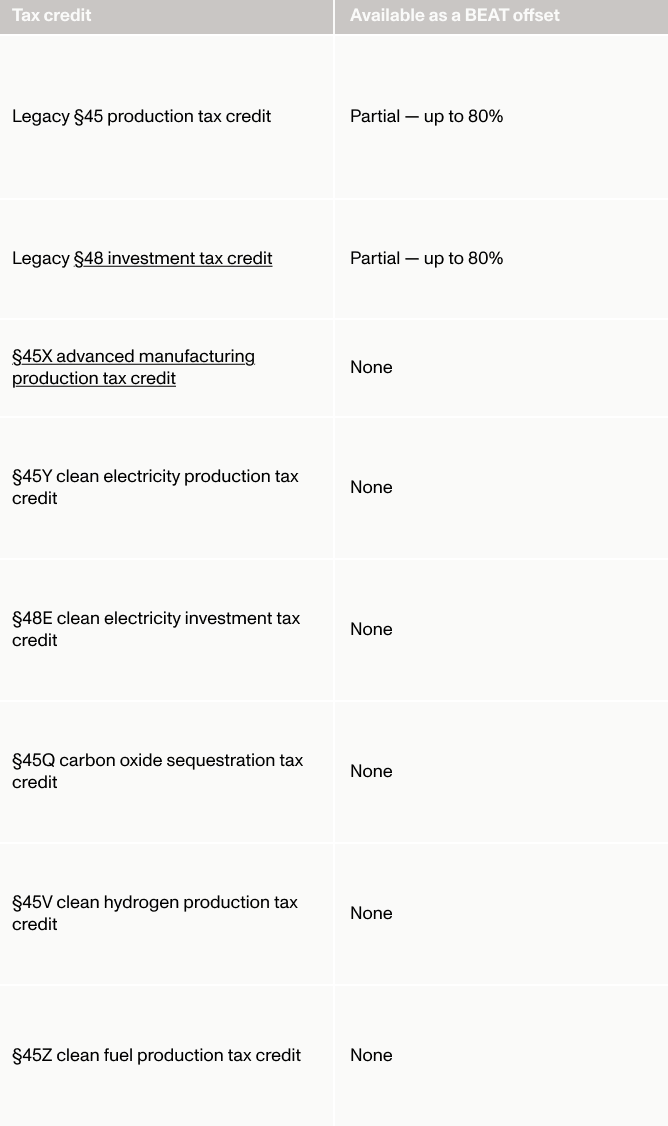
For example, a corporation in a BEAT position purchases $10 million of tax credits and has the full 80% offset available. A qualifying legacy §45 or §48 credit would reduce regular tax by $10 million while increasing BEAT by about $2 million, leaving the buyer with roughly $8 million of current-year federal tax benefit before accounting for the purchase price and other tax effects.
Transferable credits outside that definition receive no corresponding BEAT offset. For a corporation firmly in a BEAT position, purchasing $10 million of one of these credits could reduce regular tax by $10 million while increasing BEAT by the same amount, eliminating its current-year tax benefit.
Legacy credits remain available in the transfer market. Qualifying §45 facilities can generate credits throughout their 10-year production periods, and projects that began construction before 2025 may continue to qualify under §48.
What does this mean for tax credit buyers?
For most corporate buyers, BEAT does not affect a transferable tax credit purchase. For buyers that meet both BEAT test thresholds, regular tax liability alone overstates usable tax credit capacity. Tax teams should model the after-tax result in the year the tax credit would be used — across regular tax, BEAT, CAMT, and, where relevant, Pillar Two — before committing to a tax credit type or purchase size. BEAT does not make transferable tax credits unworkable, but it does narrow the amount of tax credit investments, which tax credits work, and at what price.
Further reading
To see how corporate taxpayers are participating in the transferable tax credit market, read our benchmarking report on corporate taxpayer participation.
To understand the other minimum tax regimes bearing on tax credit capacity, see our analysis of the corporate alternative minimum tax and how Pillar Two affects transferable tax credits.
For broader market pricing and volume trends across legacy and tech-neutral tax credits, download our 2025 market intelligence report.
Share