
How the domestic content safe harbor works for clean energy projects

Share
.svg)

.svg)
.svg)
Want to explore more conversations like this?
View all blogs
Clean energy projects that meet IRS requirements for domestic content sourcing can qualify for a bonus on the value of certain production tax credits (PTCs) and investment tax credits (ITCs), including the tech-neutral §45Y and §48E credits. But demonstrating that a project meets the domestic content requirements can be complex, particularly when developers need cost information from manufacturers and suppliers.
The IRS's elective safe harbor offers a simpler pathway for certain projects to demonstrate that they qualify for the domestic content bonus. Notice 2025-08, published in January 2025, updated the safe harbor for solar PV, land-based wind, and battery energy storage systems (BESS), including revised component classifications and cost percentages.
This guide explains the two paths to qualify for the domestic content bonus, how the elective safe harbor works, and what developers need to know when applying the IRS's assigned cost percentages.
Key takeaways
- Two requirements apply: Projects must satisfy separate domestic content requirements for structural steel and iron components and manufactured products and components (MPCs).
- The safe harbor simplifies the calculation: Eligible projects can use IRS-assigned cost percentages rather than independently calculating certain manufactured product costs.
- Thresholds depend on when construction begins: For projects other than offshore wind, the adjusted percentage is 50% for projects beginning construction in 2026 and 55% thereafter.
- Notice 2025-08 updated the safe harbor: The notice revised classifications and cost percentages and created separate tables for ground-mounted and rooftop solar PV projects.
Two paths to qualify for the DC bonus
To qualify for the DC bonus, a project must meet two sets of criteria: one for manufactured products and one for steel and iron.
Structural steel and iron components — materials that are integral to the project structure — must be sourced entirely in the US.
Manufactured products and components (MPC) must meet the adjusted percentage rule based on the MPC costs. If the share of domestically produced and sourced components relative to total MPC costs is equal to or greater than the required adjusted percentage, then the project can qualify for the DC bonus adder. The adjusted percentage rule increases from 40% for projects beginning construction prior to 2025 (or 20% for offshore wind projects) to 55%, according to the following schedule:
- For all projects except for offshore wind: 40% for projects beginning construction before 2025; 45% in 2025, 50% in 2026, and 55% thereafter.
- For offshore wind projects, 20% for projects beginning construction prior to 2025, 27.5% in 2025, 35% in 2026; 45% in 2027; and 55% thereafter.
How does domestic content affect §45Y and §48E? Read Crux's guide to tech-neutral tax credits.
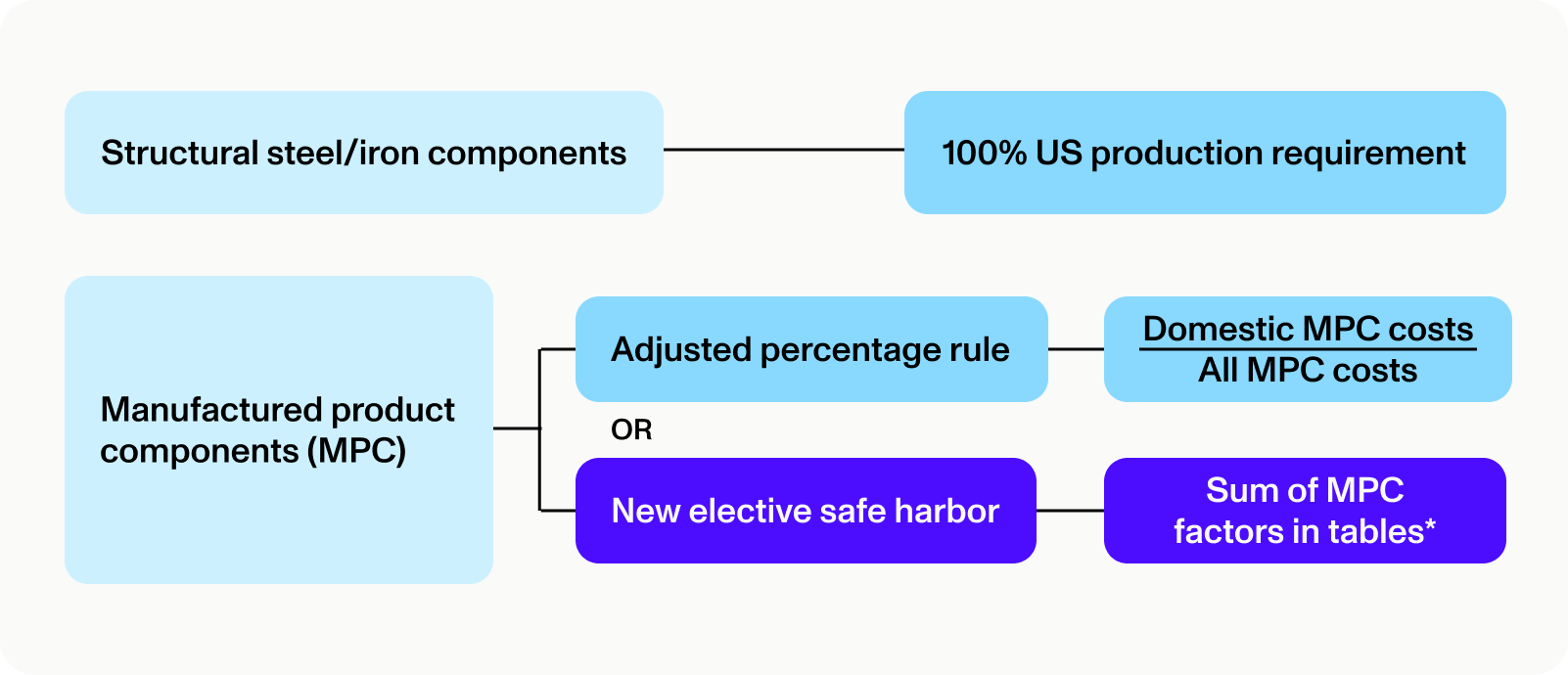
Aggregating data to qualify for the adjusted percentage rule threshold has been a challenge for some projects, and so the elective safe harbor is meant to offer a simpler pathway for projects to demonstrate that they qualify for the DC bonus. The figure below illustrates how the new safe harbor fits into the overall DC bonus qualification rubric.
Qualification for the domestic content bonus
Using the safe harbor
The safe harbor allows projects to substitute the IRS’ calculated factors for MPCs in lieu of independently calculating the MPC manufactured cost. Projects still have an obligation to purchase domestically produced materials, and would discount the MPC factor proportionally if not all of the supplied product came from a US manufacturer.
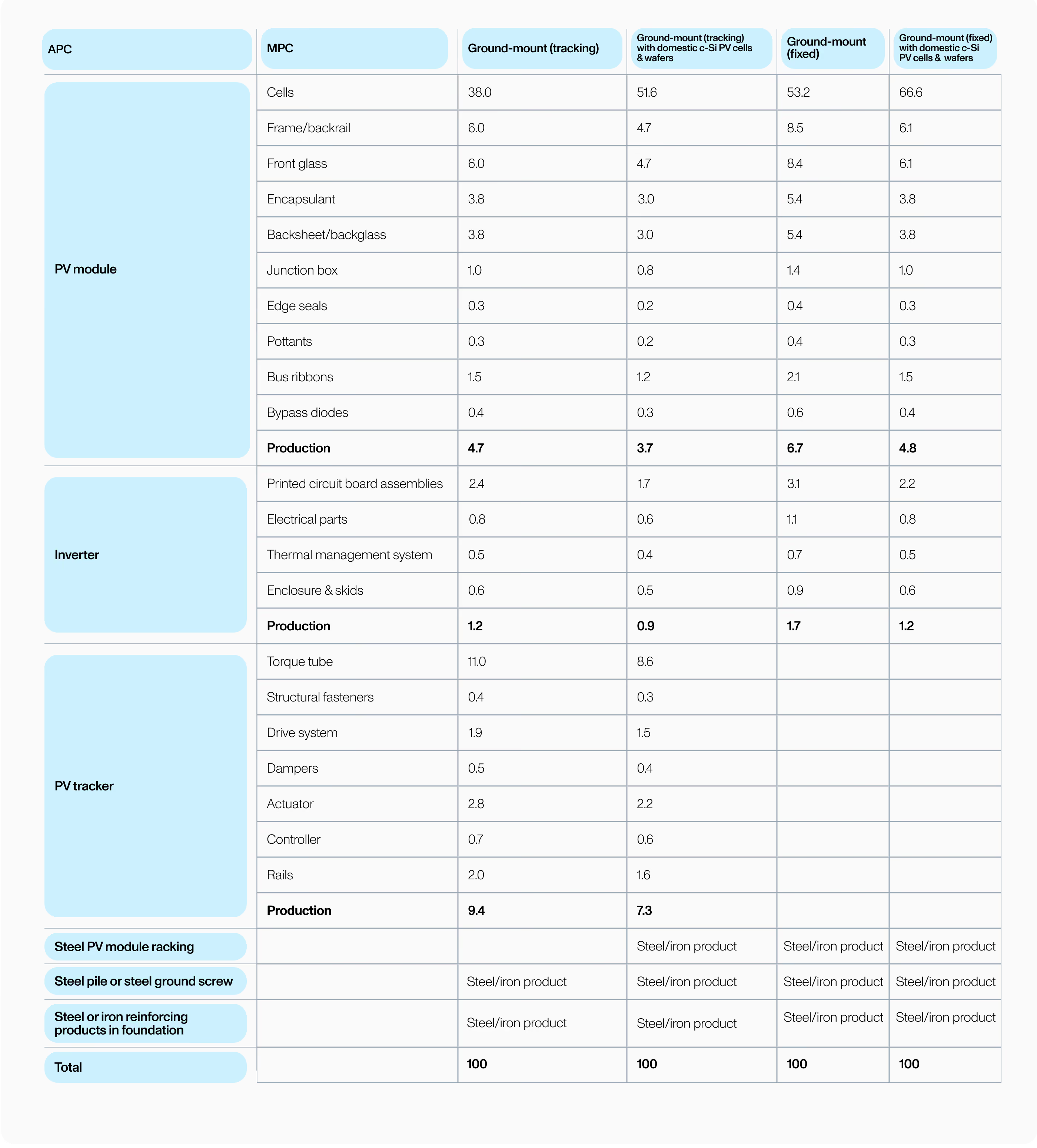
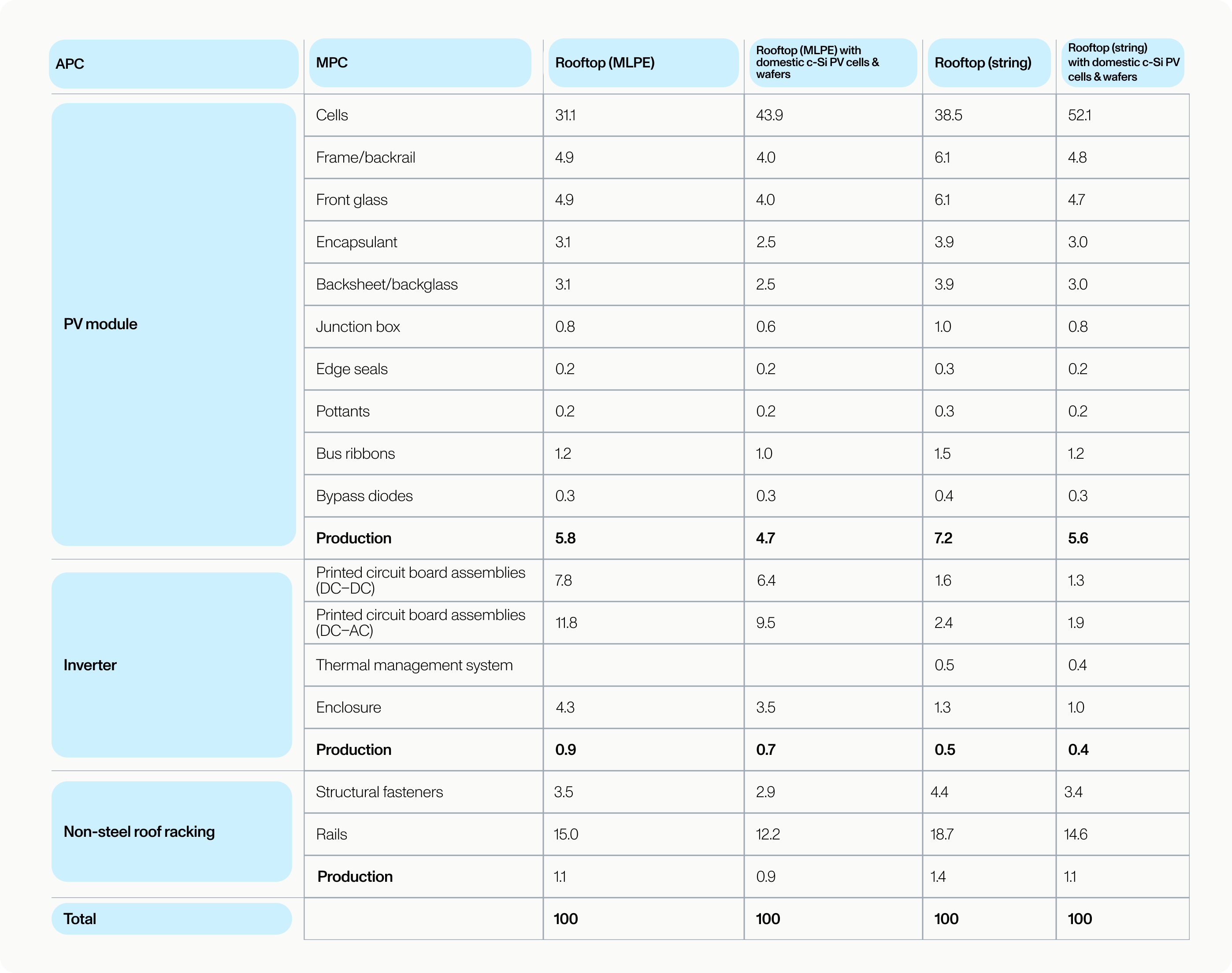
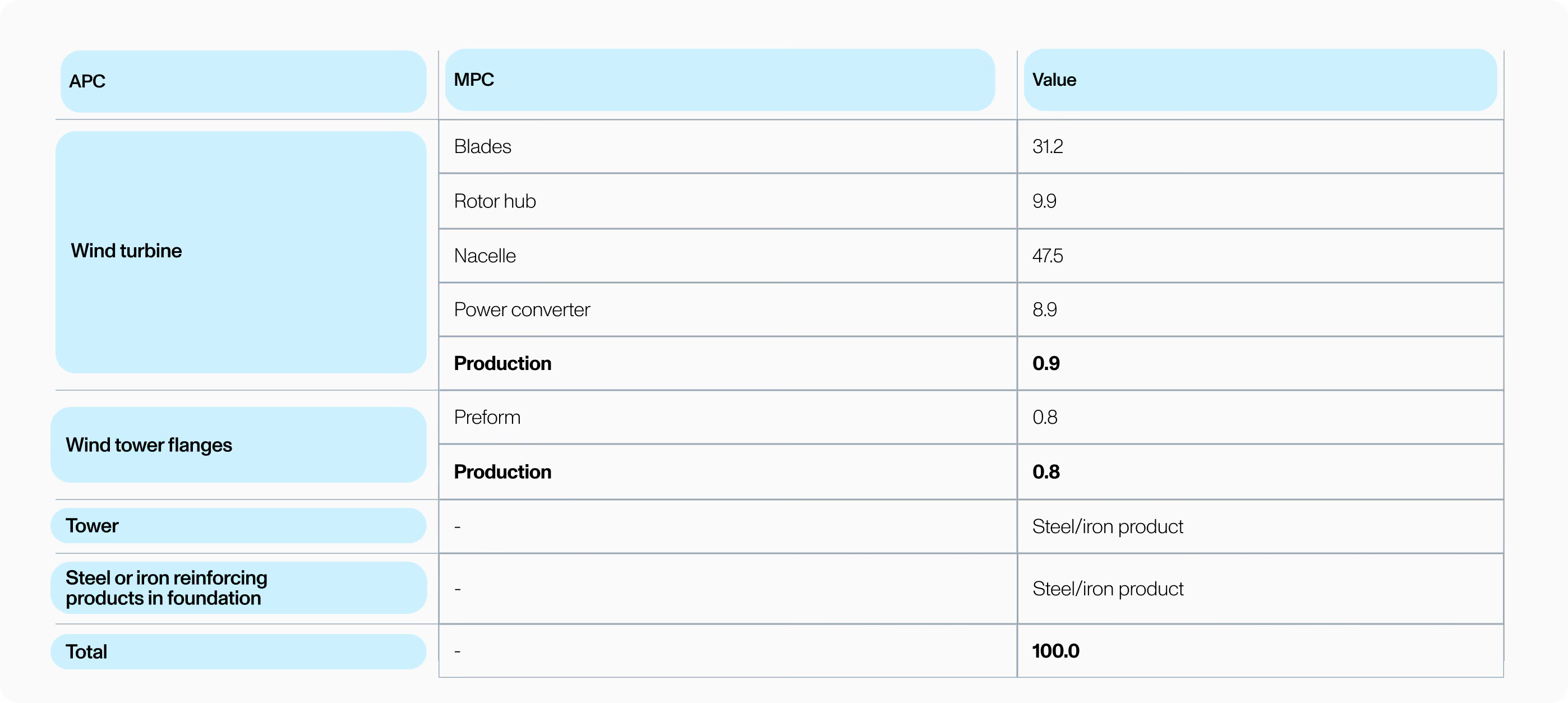
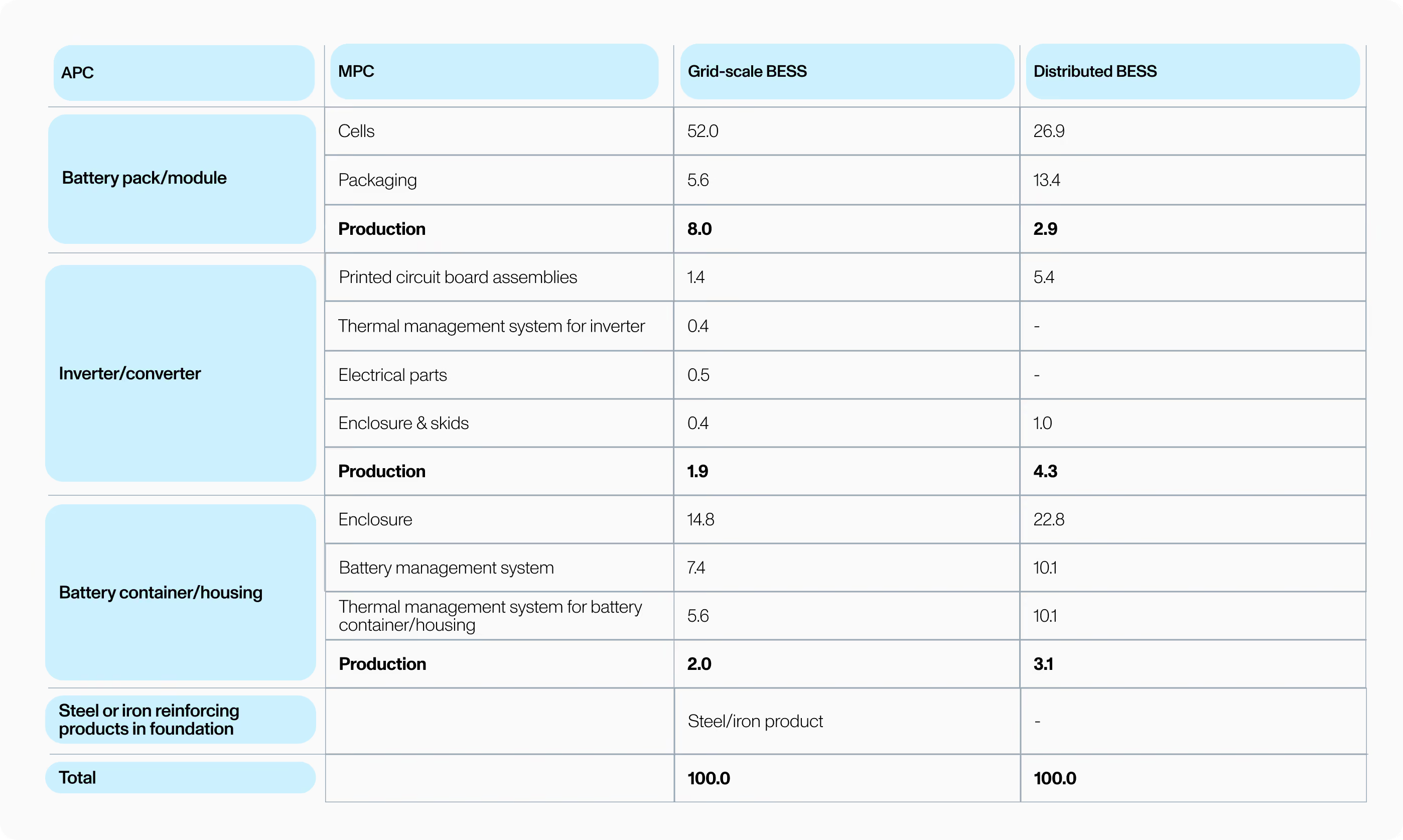
The IRS published tables containing MPC factors for different solar PV installations, onshore wind, and BESS. To determine whether a project meets the requirements of the DC bonus, a project developer would first need to determine that all structural steel and iron was produced by a US manufacturer. Then, using the factors in the IRS tables, it could determine whether its share of MPCs meets the applicable adjusted percentage threshold based on when the project begins construction.
For each technology type, the tables include a list of MPCs as well as applicable project components (APCs) and the associated factors. For each MPC, developers should determine whether:
- The project uses the component; if not, then the factor is effectively zero for calculating the domestic content percentage.
- The component is manufactured in the US, meaning that it is “substantially transformed” into a different product that is “functionally different from that which would result from mere assembly.” If a portion of the MPC supply comes from the US, the project should multiply the factor by the share of US manufactured supply.
For all MPCs that satisfy the above criteria, the project will sum up the factors in the appropriate table to arrive at the domestic content percentage. If that value meets or exceeds the applicable adjusted percentage threshold, then the project can satisfy the manufactured products requirement for the DC bonus. If all of the components in a given APC category are manufactured in the US, the IRS provides an additional “production” factor that is additive to the domestic content percentage calculation.
IRS Notice 2025-08 updated table for solar PV ground-mount
Updated table for solar PV rooftop
Updated table for land-based wind
Updated table for battery energy storage system (BESS)
Examples using the 40% adjusted percentage threshold
- For a grid-scale battery project that uses US-made cells, packaging, and battery container/housing, the qualifying DC percentage would be: 38+3.3+15.8+6.5 = 63.6%.
- For a utility-scale tracking solar PV system with US-made cells and torque tubes, the qualifying DC percentage would be: 36.9+9.7 = 46.6%
- For an onshore wind facility that uses US-made nacelles and hubs, the DC percentage would be: 47.5+9.9 = 57.4%.
At a 40% adjusted percentage threshold, all of these examples would satisfy the manufactured products requirement. Projects must also demonstrate that the applicable structural steel and iron requirements are met to qualify for the DC bonus. Projects beginning construction in later years are subject to the higher adjusted percentage thresholds outlined above.
Updates in the January 2025 notice
The First Updated Elective Safe Harbor notice renamed and clarified several APCs and MPCs including in the May 2024 notice to better reflect component functions and/or the manufacturing process and supply chain. Some tables also include updated cost percentages.
The biggest change is to the solar PV table. Notice 2025-08 splits the original Table 1 for Solar PV into two tables: one for ground-mount photovoltaic systems and one for rooftop photovoltaic systems. Each of the two tables also contain additional columns for PV systems with domestic c-Si PV cells and domestic wafers. These columns came in response to comments the IRS received highlighting the expected cost premium of utilizing domestically produced c-SI PV cells made with domestically produced silicon wafers.
The notice also clarifies that a qualified facility or energy project placed in service after December 31, 2022 (for projects claiming the legacy PTC or ITC) or December 31, 2024 (for projects claiming the tech-neutral §45Y or §48E) and that meets the 80/20 Rule can use the classifications and cost percentages in the First Updated Elective Safe Harbor notice or Table 1 in Notice 2024-41 to qualify for the DC bonus credit amount. According to the 80/20 Rule, retrofitted facilities can be treated as new facilities provided 80% of their components are new; fair market value for the reused equipment cannot exceed 20%.
The updated safe harbor may allow more projects to demonstrate that they qualify for the DC bonus and take advantage of the opportunity to transfer these credits. Planning to transfer your tax credits? Read Crux's updated guide to transferable tax credits.
Share