
Inside Lowercarbon’s apolitical approach to cleantech investing
.png)
Follow on


Share
.svg)

.svg)
.svg)
About the episode
Have feedback on Critical Capital? Fill out our listener survey to let us know what topics and guests you’d like to hear next!
For decades, clean energy technology was framed as a moral imperative; a necessary strategy for saving the planet. Today, it’s just good business.
Thanks to rapid breakthroughs in generation and storage, the unit economics of cleantech have reached price parity with — and in some cases even undercut — fossil alternatives. But despite the incentives, this shift away from fossil fuels continues to hit roadblocks. Broken project finance stacks, risk-averse underwriters, and political gridlock have all slowed down innovation and deployment.
In this episode of Critical Capital, host Alfred Johnson sits down with two champions of the capital-centric, apolitical approach to climate investing: Lowercarbon Capital’s Chris Sacca (co-founder and managing partner) and Caie Kelley (general partner). Built on the heels of Sacca’s Lowercase Capital, a powerhouse tech fund in the 2010s, Lowercarbon has quickly emerged as one of the most dominant forces in cleantech. Today, they manage over $2 billion in assets across the sector.
During this in-studio conversation recorded at New York Climate Week, Alfred, Chris, and Caie unpack why the industry is ditching the word "climate," how technical-minded founders can bridge the gap from lab-scale science and prototypes to deployment, and how to rebuild the capital stack needed to help this new era of cleantech reach its full potential.
Critical Capital is a co-production of Crux and Latitude Studios. Learn more about how Crux is financing the future of energy.
Episode transcript
Chris Sacca: One of the big banks who I'd worked with in the past and made a bunch of money for, we were talking about investing in Lowercarbon, and they said, "We don't invest in climate funds." And so just for shits and giggles, I was like, "Okay, okay, I get it. But what about our energy fund?" "Oh dude, we'd love to see that." "What about our advanced manufacturing stuff?" "Absolutely." "What about our resilience stuff?" And like, "Yeah, yeah, yeah. That's all in our wheelhouse." I'm like, "Fuck you guys, it's the same fund."
Alfred Johnson: For much of the history of clean energy to this point, decarbonization has been cast as the clear objective, the moral imperative, the solution to saving the planet. But the sector finds itself in a different cultural climate today. Thanks to huge advances in technology, the incentives for decarbonization have shifted. To put it another way, the unit economics finally check out. From Antora's thermal batteries to Base Power's revolutionary home energy solution, cutting-edge technologies have made it possible for clean solutions to reach parity or even offer lower prices than traditional alternatives.
But cleantech, it's still getting bogged down by entrenched partisan attitudes, and it's not just political headwinds that have complicated deployment. Cleantech today faces a broken project finance stack and lenders who can't underwrite new technologies. Success, then, may come from an approach that's much more focused on dreaming really big and setting a new definition of what's possible.
Caie Kelley: I think there's something interesting happening in this environment right now, which is super politically divided, but also you have huge exits with SpaceX and amazing talent coming out of the space for the first time, where people have, I would say, infinite opportunity to do whatever they want to do. And that's an interesting environment for entrepreneurship in general. And that's where I think we're finding a lot of really interesting opportunity to back founders. And that is also a magnet for great talent.
Alfred Johnson: This is Critical Capital.
In today's episode, I sit down with two guests at once: the Lowercarbon Capital dream team of Chris Sacca, co-founder and managing partner, and Caie Kelley, general partner. Lowercarbon comes on the heels of Chris Sacca's Lowercase Capital, one of the most influential and successful tech funds of the 2010s.
Since launching in 2020, Lowercarbon has emerged as one of the most successful funds in the space. Today, it has $2 billion of assets under management, and they've invested in companies like Antora and Base, who I mentioned earlier, as well as Commonwealth Fusion Systems and Crusoe. They're also an investor in Crux.
I sat down with Chris and Caie in New York in person during Climate Week to dig into their approach to financing and their assessment of cleantech as a whole. We unpack a lot of factors influencing their investment strategy: things like how the AI boom is shaping global energy demand, and how new companies are blending equity and project finance to fund today's physical energy economy.
We also talk messaging, like why a firm named Lowercarbon has changed the way that they talk about climate, and the significance of reshoring manufacturing jobs to the US.
As you may have guessed from the opening of the show, there's a fair amount of colorful language in this episode. So if your five-year-old is already a regular listener of Critical Capital, this might be one that you want to skip.
And one more thing: We're already getting towards the end of our first season of this show, and we want to hear from you. If you have feedback on Critical Capital, please fill out our listener survey in the show notes and let us know what topics and guests you'd like to hear from next.
So now, let's get into it.
Chris Sacca, Caie Kelley, welcome to Critical Capital.
Chris Sacca: Oh, stoked to be here, man.
Caie Kelley: Thanks for having us.
Alfred Johnson: So this is a particular privilege for me because, Chris, across two companies, you've invested in every round of capital that I've ever raised, and were around the table at the very beginning of Crux — led our seed, led our B. And Caie, you sit as a board observer, and I've been so grateful to have your advice and your counsel along the way. I think we are in a really interesting and profound time in infrastructure investment and climate.
And Caie, I wanted to start with you. You are focused on the companies that are growing and scaling in this moment where AI is transforming the landscape around clean energy investment and climate tech. How are you seeing those themes start to intersect?
Caie Kelley: I think it's a generally very good question, and one of the things we talk about a lot is that there's been so much demand from hyperscalers to bring more power onto the grid, and that has been an enormous accelerant for companies in our portfolio like Crux and a lot of our power businesses. But something that we think about a lot at Lowercarbon is that before all of this big AI wave, there was still enormous demand for energy from a huge variety of sources. One of the big things we talk about internally is that air conditioning is a much bigger driver of demand than AI or data centers or anything else.
And so people needing to live and exist in comfortable environments is a trend that existed well before any of the waves we're seeing today. I think the waves we're seeing today are calling into more interesting forms of infrastructure and capital financing and making people be more creative around how do we build those quickly, but I don't think that it's tied to any particular demand structure there.
Alfred Johnson: So Chris, we're sitting here at Climate Week, and right down the road from where we are is the Javits Center, where a lot of the main stuff is happening. Over the last two days, people have been presenting, and there have been a lot of protesters there who have been talking about the intersection of AI and the stuff that people are building in clean energy. How do you see the way in which activism and the climate movement is intersecting with the capital investments that are happening in the space? And how do you reconcile that as one of the leading investors in the space?
Chris Sacca: Well, look, we all know that the core solution to climate change is to throw more soup on more paintings. That's going to solve it all. And if more people can glue themselves to the floor of the US Open, this will all be over.
Yeah, I have a chip on my shoulder about how Climate Week was originally started as a protest week, right? It was meant to overlap with UN Week and with Clinton Global Initiative. We are, though, now very much past the point of raising awareness. And so it's exhausting because the reality is those of us who are actually trying to build solutions at scale, we find the people we run into most as the obstacles to getting stuff done are the activists.
And it's not just the protesters in puka necklaces — it's actually more the well-funded environmentalists who just sue at every point, who take advantage of NEPA and CEQA and everything else to just stop actual progress in the space. It is frustrating because we should be on the same team right now. But that's the biggest movement we're up against right now: the obstructionists. And so I'm excited because we are at a time now where these businesses make sense as businesses.
That was at the founding of Lowercarbon: that forever, addressing the climate crisis needed to be either philanthropic or you needed some kind of regulatory capture to basically mandate that this stuff would happen. And now we're at the point where the unit economics — the core business offerings of these things — have reached price parity or even advantage pricing over the regular traditional offering. Literally, digging up and burning old dinosaur bones is expensive. Moving that stuff around is expensive. Often takes wars, as you'll read the headlines today, to secure those supplies. And then that shit tends to blow up every now and then.
So anytime you can decarbonize a process, it's not just good for the environment, but more importantly, for our work, it's an opportunity to profit. And so what's been fun is finding that our work is increasingly bipartisan when we don't say the word climate. So we basically have an internal rule: don't fucking talk about the climate. One of the big banks who I'd worked with in the past and made a bunch of money for, we were talking about investing in Lowercarbon, and they said, "We don't invest in climate funds." And so just for shits and giggles, I was like, "Okay, okay, I get it. But what about our energy fund?" "Oh dude, we'd love to see that." "What about our advanced manufacturing stuff?" "Absolutely." "What about our resilience stuff?" And like, "Yeah, yeah, yeah. That's all in our wheelhouse." I'm like, "Fuck you guys, it's the same fund."
But we just do a horrible job of branding it, right? And so I think — your opening question when you talk to Caie about the demand curve for electricity right now — that's not going away. Whether it's AI, whether it's a global burgeoning middle class, whether it's just survivability and the need for cooling indoor spaces, that demand curve is going to continue to accelerate, and we could debate how steeply and how soon. But that needs to be met by new sources of generation, new sources of transmission, new paths to efficiency.
And that should not be a partisan discussion. And so we do our best to try and keep politics out of it, and this week is one of those times where I get reminded: these two sides are going to entrench and they're going to scream at each other, and hopefully we have a growing middle that's actually just getting shit done.
Alfred Johnson: Chris, I remember the story of the first fund raise in 2021, and the particular context — you went out and raised $800 million, and it was that summer in San Francisco when the skies were orange. And you raised it in four days or something at 2x the hard cap or something like that. And I know that as one of the most successful venture capitalists in the history of the world, there were a lot of things that you could have chosen to invest in, but the thing that you found most meaningful was the climate aspect of all this.
So how do you reconcile that with the places where you're seeing the investment opportunities today? Is it a one-for-one? And what I'm really trying to get my head around is: Why, when you say the statement that we all should be on the same side, which I agree with, do you think that if they were listening to this, they should be on the side of a lot more investment in all of these categories?
Chris Sacca: I'll take that in a couple ways. To answer the latter part of that, if you're running as a political candidate right now and you say that the core of my platform is climate and developing clean energy — we have some data that show that out of 25 issues that voters were polled on, on what will actually determine how they pull the lever in the polling place, those are ranked number 23 and 24 out of 25.
So what are the top issues? It's the economy, and it's cost of living and cost of energy. And so if you were going to run this as a candidate, you would never mention climate. You would say, "Hey, guess what? You're struggling check-to-check trying to manage your energy prices and your home heating prices and cooling prices and the cost of food right now. We are building things that bring those costs down. And you're worried about job security in the face of AI and economic instability — you're worried about your job. Well, we actually build companies that bring jobs back to the United States, that give good, high-paying jobs, particularly through the gut of the country, down through the Midwest and the South. That's where we operate.
"And, in the back of your mind, you're also worried about maybe having to send your kids off to fight in some forever wars on the other side of the planet. And so we are decoupling our economy from dependency upon autocratic regimes around the world." So that is a winning message as a candidate, and that's exactly what we fucking do at work every day. And so I find we can reach a lot of common ground, but we just have to skip past that first layer of culture war nomenclature bullshit and just get down to jobs.
We'll see the stuff where a member of Congress, or even maybe a Speaker of the House, will vote against climate work, and then show right up to the ribbon cutting for the facility we built in their district, where we might be one of the largest employers. I'm not calling anyone out in particular, but it's fucking amazing.
And so instead of fighting and calling out that hypocrisy, if we all agree, what is the end goal? The end goal is to build massive, massive solutions to this stuff. Real businesses that don't depend on regulatory changes or philanthropy to have multiple gigawatt- and gigaton-scale impact on the planet. If that's the goal, then we need to cut past a bunch of this other bullshit and just get it done.
Alfred Johnson: Totally agreed. So Caie, how do you see this playing out with the founders? They have to figure out how to navigate this really rapidly changing macro environment, rapidly changing geopolitical world, prices and components being higher and less accessible, and they have to figure out how to navigate politics while building these novel technologies. How do they handle all that? How do you advise them?
Caie Kelley: I think the point that Chris made is the right one, which is that we just try to stick with a practical solution that genuinely makes sense in any environment. At the same time, I think there's something interesting happening in this environment right now, which is super politically divided, but also you have huge exits with SpaceX and amazing talent coming out of the space for the first time, where people have, I would say, infinite opportunity to do whatever they want to do.
And that's an interesting environment for entrepreneurship in general. And I think in that environment, when you have enormous choice, you want to do something with purpose that you can genuinely say, if this company does really well, I can look my friends and my family in the eye and I can say that this is a good thing for the world.
And so I think you're also increasingly finding people who come out of OpenAI or Anthropic or SpaceX or Anduril or any of these big pools of talent, looking for a place to bring that into something real. And that's where I think we're finding a lot of really interesting opportunity to back founders.
And that is also a magnet for great talent. People who have a lot of options because they're very, very talented, but they want to come to a place like a Rainmaker or like a Crux or like an Antora where they can say, "I'm going to take that technical understanding and I'm going to offer something that makes sense because it is the best solution for offering or bringing power to the grid, or making drought-stricken areas less dry, or any of those types of opportunities."
Chris Sacca: Yeah. Antora makes solar 24/7 cheaper than gas, right? What is a cooler way to be proud of your work, and yet still get to be a hardcore engineer with a bunch of ownership in a company that's going to the moon and generating — I can't say their revenue numbers because I always forget what I'm allowed to say out loud, but a shit ton of money — doing well.
Antora currently operates the biggest battery in the world. We spent our whole lives saying "ex-China," right? So the biggest thing except for in China. And so this is literally the biggest battery in the world. It's just badass. And the customer who paid for it doesn't really care about their Scope 3 emissions. But when they opened this battery up, it shut down the adjacent coal plant as a result. And so those guys show up to work fired up and proud.
Alfred Johnson: Yeah, so Caie, let's pick up there, because those companies — companies like Antora and Base and Crusoe, and the ones that are building in the real economy — have to raise astronomical amounts of capital, right? It looks way different from the software companies of the last era. They're building finance within their companies that need to scale to the billions very rapidly. How do you see that influencing the shape of these businesses?
Caie Kelley: It's a really good question, and I think the short answer is that you expect that those companies, as they become very obvious and they take down most of their existing science risk — and it really becomes, sometimes they say, a pretty easy math equation because you can hold the product in your hands, you can understand the unit economics, you can go through the supply chain, you can understand any of those dependencies — that is a very financeable asset. But it's not one form of capital that ends up being the solution.
So I think the biggest misnomer in that space is that when you go out to raise your next round, you're going to have a mixture of equity and you're going to have some debt. And that debt isn't going to be one single sleeve of debt; it's going to be some tax credits, it's going to be project financing, it's going to be a development capital facility above a project facility. I didn't expect Permira and private equity to ever be particularly helpful in the world of venture, and it wasn't in enterprise SaaS, but these businesses end up really relying on different sleeves of capital in order to continue to grow.
The difference, though, is the demand is much more obvious, and you have purchase agreements and you're not taking as much market risk. And so you can really understand the shape of: if you can provide power at a price that's 10 times cheaper than what has ever been provided before, there is going to be a market for that. And you can finance that; you're just going to use a mixture of equity and different types of debt.
Chris Sacca: We've got these companies now where we always felt capable of evaluating them as science and technical projects, but now they're getting so big and they're real businesses. If you compare it to round after round of money raised for a Twitter or an Uber — in the case of Uber, it is just one round after another to do more customer acquisition, right? So it's CAC costs and, "Hey, what's our latest analysis on if we discount this ride to zero, are we going to be able to get them to become a rider for life?" And so you are just chasing, ultimately, one day maybe turning it around and actually having some positive cash flow in a company like that, right?
Same with Twitter. We did have revenue starting very early in the company, but that was a money-losing company for a long time. How do we grow? How do we pay for distribution and installs and marketing and that kind of stuff, all along the way?
And so these companies are real companies that get to hundreds of millions of dollars of revenue in unprecedented speed, right? I think the only companies growing faster are the frontier models themselves. Otherwise, we have some of the fastest growing companies in the world right now.
And what's funny is, they take a couple years of no revenue at all because that's that science and technical risk. "Hey, when they meet us, we have this idea, or we have a little prototype, and we think we can do this thing." And so we model out, okay, what is — and, by the way, another part of this, it's like cheating, because when you're building Twitter, there is no analog for a 140-character microblogging service, or however you wanted to describe it, right? You don't actually know the demand curve for that thing. It's a brand-new user behavior. Even with Uber, you are trying to find, is it going to replace the taxi medallions? Is it going to grow the market beyond that? We had a lot of internal debates, but there isn't a great marker by which to go ahead and build a model for the company.
With this stuff, it's crazy because almost everything we make is a substitute good for something that exists in the market. So if we're making clean steel, we know what the steel market looks like. And not just the size of the steel market — we know what people pay for steel, how they want it delivered, what size it is, what kind of tensile strength, what kind of certifications it needs. And as a result, it's really easy for us to go in and model, okay, here's how you're going to make it. It costs too much today. What can we do to improve the cost of that, and are we going to get it down to where the buyer, even if they're an oil company, might just buy it because it's the right steel?
One of my favorite companies that I'm sure a lot of your audience knows is Solugen. So Solugen is one of these screaming winners that makes industrial chemicals using enzymes instead of oil, right? So these guys, because they don't use oil as an input, they're not subject to the fluctuations in energy pricing at all. But their customers come to them, and they have three questions: Is it this chemical? Yep, that's the exact chemical formula, there's objectively no dispute about this. Is it cheaper? Yeah, it's cheaper. And wait, we can order the shit from down the street in Houston instead of waiting for it to come on a boat that might be stuck in a closed strait right now under a double blockade? Well then fuck it, I'll buy it.
And those customers are heavy industry; some of them are oil and gas, though. The Scope 3 emissions never come up in the conversation. And that's a company doing a nine-figure run rate with 60% margins. Margins that you don't see even in software.
Alfred Johnson: Yeah, I think it's really interesting because you came from software, right? You invested in these companies like Twitter and Uber and Twilio at the very beginning of these things, and then you came into this space that is effectively large-scale industrial energy manufacturing investment. What are the things that you brought in as a software investor that you think were the correct priors? What are the things that you had to update as you encountered this new space?
Chris Sacca: So what I was saying: We have more information now. There's fewer dashed lines. Which is why we probably wouldn't have had Caie as a partner — shit, I would have hired Caie anywhere if I'd met her back then, but we probably wouldn't have had Caie as a partner at Lowercase because we just didn't have the data that would have fed into the level of analysis and business improvement and strategy that a mind like Caie brings to the table for us. And so that's just something we never really had to do.
It's funny because the work we do now is less creative. We use less imagination than we used to in those other businesses, right? We would have long debates into the night of what do you put in the little Twitter box to get people to type? What should the next Instagram filter be? There was a lot of creativity because there were so many unknowns.
Now in these businesses, it's drier work. There's so much less doubt about it, and that's why it feels very obvious to me at some turns, and we trade on this arbitrage between the hangover that this is somehow not an investable space — and when we went to start Lowercarbon, mentors of mine, household names that you know, came to me and were like, "Don't do it, man. This is where capital and souls go to die. Do not touch this space."
Alfred Johnson: Because they were looking at cleantech 1.0.
Chris Sacca: Yeah. Yeah, and to be clear, Doerr turned a billion into three billion — nobody gives them credit for that — but Solyndra had cast this pall over the whole industry. But the reality is when we actually started digging in, we had the benefit of fresh eyes. We were able to look at actual numbers.
We have the world's only dedicated fusion fund. So fusion forever has been like, "Ah, it's 30 years off and always will be." And so without those kind of priors, we were able to go into the labs, and our partner Clay [Dumas] was truly the visionary within our fund, and he's just like, "Look, I actually just saw the data, and it's going exponential, and it's accelerated by machine learning and AI because they used to take a year and a half to run one fusion experiment in an accelerator, and now they can run a thousand of those in high fidelity in a week, choose the best — the ones that would have never made it through risk committee because they might have melted all the equipment — run those." And so we're at a point where net energy has been produced on the planet with fusion already.
And so that's turned out to be a good trade; now we have a second fusion fund as a result. So a lot of this has been a willingness to override either any priors or biases we might already have, or to look past the ones that the market is trying to condition us to. And that's what's funny. So a lot of these companies are called climate companies, and so they trade at much lower prices. But we just come in and we're like, "Well shit, this is an energy company."
Caie brought us into a company that was doing $600 million in sales, and we paid $600 million to invest in it. It was branded under climate and we're like, "Holy shit, this is not that." And so I actually think one of the bigger challenges is actually helping these entrepreneurs understand their own businesses better.
And so we had this really cool thing happen in the 2005 era where, with the advent of basically open source software and AJAX and the web tools — shit, I sound really old — when internet connections used to cost tens of thousands of dollars, but with the advent of internet available in the coffee shop, you had a new wave of the Y Combinator–type entrepreneur who could build something and show it to you without having to write a 60-page business plan first, and without having to raise a million dollars to go ahead and buy a Sun Microsystems environment or Oracle environment — this is how old I am, and that's how shit used to get built.
And so when we did that, we actually empowered a whole new layer of builders into the software economy at the time, who didn't have all the polish and storytelling — they hadn't done all the group projects at Harvard Business School — but they could actually just build shit and see if users wanted it. We've seen the same phenomenon happen in this space now. So if you want a massive compute cluster, you don't have to raise hundreds of millions of dollars to get access to it; you can just buy cycles on it.
And so some of our teams that aren't — they're not frontier models, but they're doing some modeling, or they're doing some accelerative calculations — are able to just get some cycles on some of these clouds and use it for tens of thousands of dollars. They're able to get some shared bioreactor space if they're working in chemicals and stuff like that, that would have normally been, "Well, here's a quarter billion dollars to set up this physical plant."
And so, in fact, the Solugen guys go and buy a lot of their parts at Home Depot. When they want to test a new chemical, they use PVC pipe and plywood and regular plumbing fittings. It's amazing.
Alfred Johnson: Yeah, let's go back to the finance piece of it because it's the limitation in all this. We need to build trillions of dollars of scale of this stuff, but it comes through these fragmented markets, right? Broken and fragmented markets. And Caie, if you were to think about what we actually need to get to the scale that we want to on building all this infrastructure, and developing the capital and financial products to do it, what are the things that you think need to be true? What are the things that founders need to take into account very early in their journey?
Caie Kelley: There's some new capital products, but I think it's also about making it more obvious what these companies are already building and the stages that they're already at. And what I mean by that is, when you go out to raise a growth round and you've de-risked most of your core science risk, you need to learn to tell a story to your investors, which is that we are at what we call the "add water" stage, where we say, if we give you $1 of capital, you understand enough about your sales and marketing, your demand, your supply chain, your volume, that you can pump out 10x the revenue or those overall costs. That's an equation that most capital markets can understand.
And one of the historical challenges is that these very engineering-heavy, super technical, not-prone-to-over-promising founders would rather try to stick with what they know for sure to be true, and not necessarily tell that capital story of, again, if you take this amount of capital in, we know exactly how to translate that into performance or revenue for our customers.
I think the other element — and Chris talks about this — is that we know the demand for these different products, but one of the things we're beginning to see in this market is we know the demand for the product at the cost it is today. So an average consumer pays 10 to 15 cents per kilowatt hour on electricity, but if you could offer — Panthalassa, for example, we'll say on podcast that they can get to 2 cents in the next 4 years...
Alfred Johnson: And they do data centers, node compute in the ocean...
Caie Kelley: Right, they put data centers in the middle of the ocean. They have a node that self-propels into the middle of the ocean, bounces up and down, uses wave energy to generate electricity in some of the most volatile parts of the ocean.
But the important part is the demand for that would be incredibly different. If you're talking about consumer electricity that is 5 times cheaper than what anyone experiences today, that is actually an unknown scale of market. And so we know that the demand for electricity that NextEra, a $156 billion market cap standalone for existing market energy costs today — but I think something that's exciting, and a lot of these engineers are learning to tell the story of, is that if you could actually offer something 5 times cheaper than anything we've experienced before, you're looking at a materially larger market for all of the rest of the things that the economy runs on. And I think that's where it starts to get people excited when we think about growth investing and raising different pools of capital.
And then financial investors think about the world incredibly differently than venture capitalists, and you know this very well. A private market equity analyst is not excited about the idea of a series of unknowns, and so it's a lot about taking down each individual pool of risk and making it obvious of, "We understand that there's no single point of failure in the way that we continue to scale, and that will allow for an underwriter at a later stage, or a much more risk-averse underwriter, to get excited about what that person is building."
Chris Sacca: I think there's a bigger problem in the finance stack right now, which is that in order to address these problems, we need to move faster and we need to move bigger — John Doerr's speed and scale. And what's funny is just yesterday, spending time with a bunch of our founders — I always like to pose the question to them, "What would you do if you had another billion dollars, or another $5 billion?" And they always immediately have an answer. "Well, we could just have this bigger plant and ship out 18 times more of these things at half the cost."
And it's amazing when you ask them — I was talking to one of our companies yesterday, "Why are we building two levels of demonstration plant again when we know the technology works?" And they're like, "Well, because that's what the banks require." They want to see a small-scale demonstration, and then another demonstration. Even within the hyperscalers, which are supposed to be the most innovative companies, even some of the people down in the layers of that company are like, "Well, I need to be able to show a pilot project before I can make a contract for the bigger thing."
And what I'm starting to see is just a bunch of cover-your-ass bullshit, and a bunch of job protection, avoid-the-career-limiting-move bullshit that is standing in the way of the speed at which we could operate this stuff.
So when you talk to a company like — yesterday, our company Arbor — at a time when gas turbines are 5 to 7 years backlogged right now, and part of it's because the way a gas turbine works, there's one specific element you can use to build these blades so they don't melt under all the heat. And so these guys have figured out how to do a supercritical process using a turbine that they 3D print. It literally fits in your back pocket as the 1 megawatt turbine, but the 25 megawatt turbine blade is about this big. And so they're able to 3D print these things, build them almost instantaneously, literally they run it cheaper than natural gas, but the byproduct of this stuff is clean water. Fucking crazy. I had to learn about supercritical shit from the beginning; it was just unbelievable.
Alfred Johnson: He holds the thing up, it's like the size of a coffee lid, and it produces a megawatt of energy, going to 25.
Chris Sacca: Right. So when you see his roadmap, though, and it's X megawatts today to X gigawatts 5 years from now, I'm like, we are going to need a lot more gigawatts of what you're doing before then, and I'm like, why is it going to take so long? And you talk to the team there and they're like, "It's because we have to do this demo plant first for this customer, and then we have to do another demo plant of another size that's not going to materially impact anything."
I was like, "Well, what would it take to just get to the real plant? We know it fucking works." We have no fear whatsoever. And they're like, "Well, it would take our lender being like, 'Yeah, that makes sense.' And it would take somebody at the hyperscaler being like, 'Yeah, I'm willing to bet my job on that.'"
And so, look, it's my bias as a venture capitalist — we're in the risk business, where I try and see these things, do a little risk analysis, and then evaluate that against everybody else's risk analysis and be like, "Oh, they're underpricing this," right?
So that's what I am seeing right now as the biggest opportunity for the capital stack. And the parallel thing is we had a meeting with one of the world's biggest banks yesterday, and they were looking at our projects, we were blowing their minds with some of the numbers on these things, and then they're like, "Well, so we're capital constrained within our climate unit. We have some capital to go ahead and push net zero solutions, but we're constrained there."
I was like, "Bless your net zero unit. But tell me what project the rest of the bank is financing that compares favorably to anything we're doing here."
Talk about Shreya over in India, SolarSquare.
Caie Kelley: Yeah, so Shreya is putting rooftop on Indian residential households. She and her co-founder Neeraj founded the business during COVID. They were staying at her parents' house, they realized that across the street there were frequent power outages, that there was an opportunity to start a local mom-and-pop business. She had previously built and sold a company in the consumer space, and then she ended up growing that business in the time that we've been investors from the seed until now. They're — we can say this, actually — the largest residential solar rooftop installer in India. Over $140 million of run rate, hundreds of thousands of homes in, and over 20 cities in India.
So unbelievable scale. Reminds me again of this idea of: so underappreciated still how big these markets are, so underappreciated how much progress we've made on technology, such that today the question really is scale. I sometimes say there's beautiful times to be investors in different stages, but growth is, I think, the best, most exciting time at the moment, because you just have all these projects and businesses that we get to be a part of where you can say there really is not a remaining science or technical risk, we really understand the supply chains, what we need to do is make 100 of these units, and we do need to raise the right type of capital to do that.
Alfred Johnson: Yeah, it's interesting on something like Shreya's business, where it is no longer a technical challenge. That is established; it is solved. And so it is a distribution challenge and it's a financing challenge.
And to go back to your point, the capital stack is so hard for these guys to compose. It's actually broken — it's the most broken part of this process — where if we're going to deploy trillions of dollars into infrastructure and you need to raise it across successive capital raises from lots of different people all checking the boxes and making sure that they align to the particular requirements of the bank, we're not going to do it. The thing that I think we need is a holistically new way of thinking about financial services for this space.
Chris Sacca: Yeah, there's no doubt. It's funny because when we do get to a single decision-maker type situation, we're able to cut through all this bullshit and just get some stuff done. So the State of New Mexico is a big partner of ours, and it's a wonderful place, and they have taken the bounty that has been bestowed upon them by having natural gas resources and the royalties they charge on that, and they've used it to — literally, it's a utopia. They fund universal child care in that state with natural gas royalties.
Alfred Johnson: Yeah, the Investment Council fund has gone from $10 to $80 billion in the last six years, right?
Chris Sacca: It's amazing. They have universal two- and four-year college in that state. It's incredible.
But they also are using that money to go ahead and fund the transformation to electrifying the economy, because they know that gas wells don't produce forever, and that some days you can just wake up and there's 50% less gas flowing through that well — it's hard to predict. And so they're not counting on it.
And they're doing so, though, by creating jobs in that state. And so what's funny is when we sit down with them — and it's always over some good chiles in Santa Fe — when we sit down with those guys, they are able to see the direct linkage between the types of technologies that we are building, the types of plants we are building, the jobs that are being created in their district, the energy prices coming down for their constituents, the amount of opportunities being generated for the graduates from their colleges there, and they see that virtuous cycle, and it is a no-brainer for them to actually make the investment decisions to help these plants and these facilities get built. And they'll bring in the land commissioner, who will help find a place to put it. It's just amazing when you see everyone working on the same team and saving years of cycles.
And so we started working with the State of New Mexico last year, and we've already moved multiple companies to that state. There'll be more — I lose track of which announcements we haven't made yet — more that are on their way. We've already created jobs in that state, and there are thousands more that'll be announced really soon.
It's just remarkable when you actually get somebody who, instead of just looking with tunnel vision to one layer of the stack, is accountable for the entire system.
And I'd say one big distinction as you think about ways to evolve the finance stack here is that so many of the companies that we're working on are verticalized, where what they're building is their factory, right? That's just different. Silicon Valley used to outsource everything to China. And so, we'll design it — your phone still says, "Designed in California" — but the reality is everything was built overseas.
Those jobs are coming back, and that stuff is being built here now. And so the capital raises for our companies aren't just buying a bunch of GPUs; the capital raises literally go towards building their version of the Gigafactory here in the US. And that's been amazing because, again, that is a traditionally financeable thing. It's an understandable thing that you can visit and that you can feel and touch, and where there are great financial models — there are spreadsheets in every single one of the major financial institutions that help you understand the economics of a factory, right? And that help you understand the economics of: if we can go from X units to 5X units and the cost comes down by 30% along the way, here's what that means in terms of contribution to the bottom line. These aren't hard financial problems.
Alfred Johnson: They're not, but it's still broken. When you look at the way that we built manufacturing at scale in the past, it's either been the government that has facilitated large investments in big projects like this, or it's been the largest balance sheets in the country — people like Ford and Raytheon and GM investing in massive facilities.
In the kinds of companies that you guys invest in, a lot of which we partner with to raise financing, they're new, right? Definitionally, they started 5 years ago, and now they've raised hundreds to billions of venture, and then they need to raise tens of billions of other kinds of project capital. And they go to the bank, and the unit economics are good, right, but it's still a new company without a credit rating and without an established track record of building that Gigafactory, and so they're still having an impossible time getting to the level of financing that they need to go as fast as they need to go.
Chris Sacca: Yeah. And you're starting to see this gap filled by people — Palmer Luckey's bank is now a lender to some of our companies, right?
Caie Kelley: I think that's the right summary, which is that I think he, because of all the building that he's doing at Anduril, has seen so much of the issue with not being particularly creative about how you underwrite these signals of demand and otherwise. And so I think Anduril's been an enormous partner for so many of our businesses, particularly as they get to that 10 to 100 unit scale.
I think you're also touching on an interesting point, though: The way that we build when we bring these industries back to the US is going to fundamentally need to be different, because the US has different constraints than a country like China, both in terms of the government support, but also in terms of the labor and the skill sets. And so I think one of the things that we're beginning to see that's really interesting is we have a lot of businesses in our portfolio that reflect US-focused dynamics.
We don't have as many electricians; we have a different dynamic around labor and cost of labor in general. We, at the same time, have way more creativity around software. We have way more access to foundational model AI that can change the way that we design and distribute, and so I think we have very unique American advantages, and we also have very different dynamics than China. And so the companies that we end up building here, to me, don't look at all like a Chinese copycat. It's not trying to re-industrialize for the sake of it — it is actively a business that recognizes what we do great here and then builds for those particular dynamics, and Base is a really good example of that.
Alfred Johnson: Yeah, I think competing against Chinese state capitalism, and the amount of progress that they have made in a very short period of time, the amount that they develop, is an extraordinarily hard thing to do, right? How do you do that in the context of a democracy without the same level of tools? And I think your frame there of leaning into our strengths is really interesting. What do you think it would look like for us to have even more muscular policy that actually enhances those strengths and allows us to compete even better?
Chris Sacca: I don't even let myself think about policy because I'm pretty convinced we're in a post-policy phase. Nothing's actually going to fucking happen again, so...
Alfred Johnson: I'll take the other side of that.
Chris Sacca: I hope you do. I have chosen, for my own mental health, to just write Washington out of the equation in terms of these solutions. One of the rules we have at Lowercarbon is we will not invest in a business that is dependent upon anyone's permission in any layer of the stack. I've seen this go so wrong so many times where you're waiting on a regime — even one that should be aligned with you and shares your values — but you're waiting on a bureaucracy to approve what you're doing, right?
That was the challenge with Climate 1.0: When they raised those funds, they then had to go hire Al Gore and Colin Powell to go push through regulation and subsidy and to get permission to launch stuff. I want to take on all the risk. We are going to evaluate the science, and it is going to be between us and the customer to make this thing work. It is going to be up to us to make the decisions and the prioritization and the execution to offer the customer something that they want, without making them feel bad or guilty — guilt and shame only go so far.
So that's the business I want to be in. And so if I'm counting on Washington for anything, for me, I've lost the plot, and I don't have the agency I want to have.
Alfred Johnson: Yeah, I definitely don't have the agency, and Washington is a place that changes its mind every ten minutes, and so I agree with the level of skepticism. I think the thing that is complicated and salient about the place that we operate is that we need to do it for the national interest, right?
We need to drive electricity prices down, have way more demand that we can meet, have a lot more access to the components and supply chains that will allow us to be secure in the next phase. And when I think about other segments of the economy that operate on the national interest, I think about things like defense, right? Where the government is the most important stakeholder in that market. And so I think if the government's really serious about things like critical minerals and other things in the US, they will do more policy here, and that is a thing that I anticipate will happen given the political...
Chris Sacca: I hope they do. And look, when the IRA passed and free money started falling out of the sky for our companies, I have no allergy to money, right? I am a capitalist through and through; I will take that. When somebody puts an export or an import restriction on something and it benefits our companies, blessed, that's amazing, and so we'll take it if it helps us from eroding a sector and allowing to ensure some job security here in the country. I get it. I am a patriot through and through.
But we've been doing the critical minerals work even without those kinds of rules. We were early to that, and we were up against China. We were bidding for assets both domestically and mostly abroad where it would be us versus China — a little startup from Oakland versus China, in the form of Lilac — and so China would bid 4x what it was worth to them just to try and secure the asset away from us, even though they could not produce that thing profitably. The state was just like, "Well, I need to sequester this thing away from an American company."
And you know what? Luckily our guys just out-innovated them. They extract lithium 10,000 times faster than conventional methods, and they do so using 99% less land and water.
And so I completely believe that the decoupling is a real thing; we need to be very aware of it and protect ourselves. You've heard me say from the beginning, a lot of the work we do is rooted in — I grew up in the Rust Belt, I've seen what happened when jobs went away. We need to restore that sense of control that humans have over their own destiny here in America. At the root of all our political problems is people feeling like they don't have those levers of control anymore, and maybe they blame the wrong folks for it, but that's at the root of it all.
But the reality is I can't afford to let our business depend upon any of that ever.
Alfred Johnson: When I went out to raise our seed round, I went to the Series A investors that I thought could be really good fits to follow whoever did the seed. It was always going to be you guys — I had picked you already. We had a lot of offers on it, we were in a really favorable position, and so we went to people like Andreessen, who ended up leading our A, and were like, "Who would you want to invest behind?" And every single one of them said Chris and the Lowercarbon team.
And so it has been a remarkable wind at our backs. We're so grateful to have you in our boardroom, Caie, and I'm grateful that you joined us. So Chris Sacca, Caie Kelley, thanks for coming on Critical Capital.
Chris Sacca: Oh, thank you, man.
Caie Kelley: Thank you.
Alfred Johnson: Chris Sacca is the co-founder and managing partner at Lowercarbon Capital. Caie Kelley is a general partner at the fund.
Critical Capital is co-produced by Crux and Latitude Studios. Our production team includes Max Savage Levenson, Jenna Herzog, Anne Bailey, Stephen Lacey, and Sean Marquand. Matthew Filler mixes the show. Additional production by Emily Hughes and the excellent team at Crux, the capital platform for the clean economy.
You can find Critical Capital on Spotify, Apple, or wherever you get your podcasts.
And as I mentioned at the top of the show, we're already getting close to the end of our first season of Critical Capital, and we'd love to hear from you. If you have feedback for us, positive or not, please fill out our listener survey in the show notes, and let us know what topics and guests you'd like to hear from next.
I'm Alfred Johnson. Thanks for listening.
Want to explore more conversations like this?
Browse all episodes
Hosted by
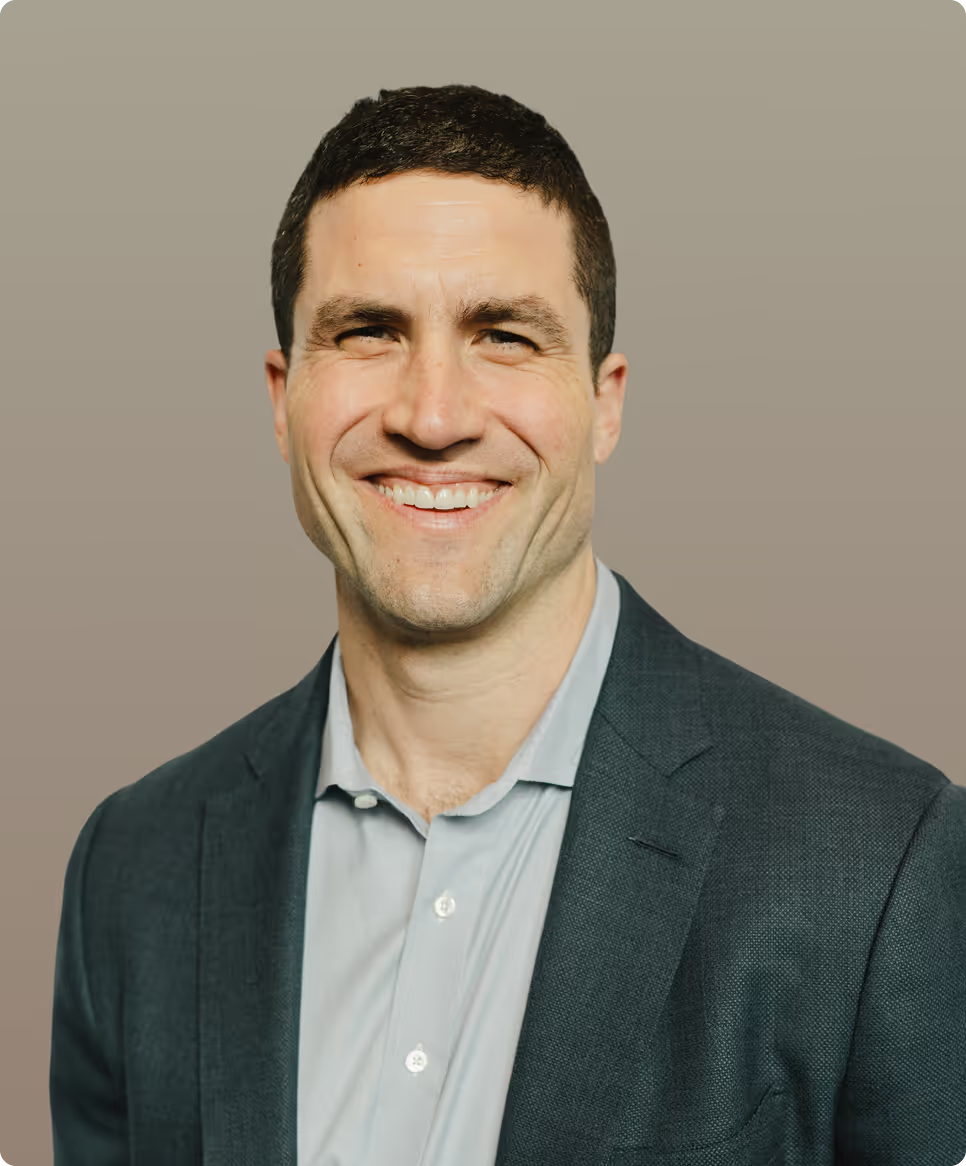
Alfred Johnson is co-founder and CEO of Crux, the capital platform for the clean economy. Before founding Crux, Alfred served as Deputy Chief of Staff to Secretary Janet Yellen at the US Department of the Treasury. Earlier in his career, Alfred was Vice President in Financial Markets Advisory at BlackRock, Senior Advisor for Financial Markets at the US Treasury, and Special Assistant to the White House Chief of Staff.
.svg)
.svg)
Share
.png)