

Understanding renewable energy project finance from start to finish
Share
.svg)

.svg)
.svg)
Want to explore more conversations like this?
View all blogs
Renewable energy projects require different types of capital as they move from early development through construction and operations. For developers and sponsors, understanding when to raise debt, tax equity, or other forms of capital — and what lenders expect at each stage — is essential to building a financeable project.
Project finance can be complex. Capital needs change throughout the project lifecycle, and financing options vary depending on project size, technology, risk profile, and the track record of the parties involved. There is no one-size-fits-all solution. Each deal requires careful planning and flexibility to secure the type and amount of funding needed.
This guide covers renewable energy project finance from start to finish, including the major sources of capital, when they are used throughout the project lifecycle, what lenders look for, and practical tips for securing financing.
The capital stack at a glance
Each lifecycle stage calls for different sources of capital. Understanding how they work together is essential to building a bankable project. The main types include:
- Debt: Development, construction, term, and bridge loans. The borrower repays principal and interest over time.
- Tax equity: Funding from investors in exchange for clean energy tax credit benefits, depreciation, or a share of project cash flows.
- Transferable tax credits: One-time sale of clean energy tax credits to a third party.
Together, these form a layered capital stack for a project. Debt provides upfront liquidity and is repaid over time using project revenues. Tax equity and credit transfers monetize tax benefits, reducing the need for more expensive capital. While debt is used throughout construction and operations, tax equity typically commits during the construction phase — tax credit eligibility requires investors to join before the project hits its commercial operation date (COD). Transferable tax credits are generally executed post-COD as a one-time sale.
Project finance across the development lifecycle
Knowing what type of financing is needed at each stage helps teams plan ahead and approach lenders with greater clarity. The core stages are:
- Development
- Construction and testing
- Operation
Stages of the project finance lifecycle
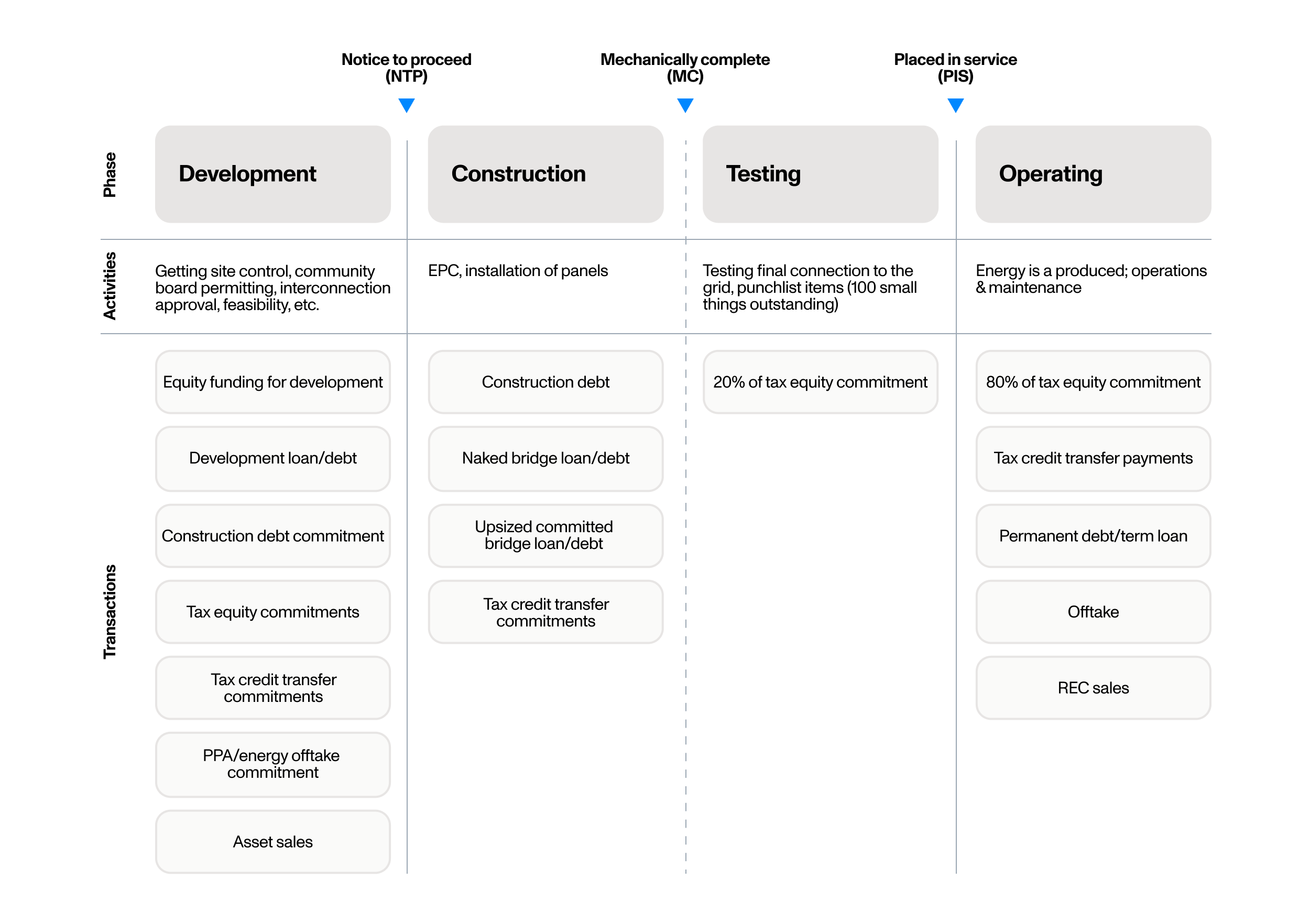
Development (pre-NTP)
Before notice to proceed (NTP), developers raise early capital to advance the project and make it financeable. This often includes securing land, permits, interconnection, and equipment — frequently before revenue or creditworthiness is established.
In light of recent legislative changes, equipment financing has become a crucial component of early-stage development funding. For solar and wind projects in particular, using debt financing to purchase qualified equipment and begin physical work helps developers meet Internal Revenue Service (IRS) requirements and preserve eligibility to monetize their clean energy tax credits.
Construction and testing
Once a project reaches NTP, construction can begin. Capital needs grow as teams procure equipment and labor. Financial scrutiny also increases as lenders assess risk, so it is important to demonstrate the ability to deliver on time and on budget.
Construction loans are the primary financing tool at this stage. These loans typically cover the majority of construction costs and are structured around interconnection, revenue contracts, permitting, and detailed engineering, procurement, and construction (EPC) contracts. Tax equity is also raised during the construction stage, as the tax equity partner must own an interest in the project prior to COD in order to qualify for tax credit benefits.
As construction nears mechanical completion — the point at which all major equipment is installed and the project is physically built — testing begins. This includes final inspections, grid connection, and ensuring the system is ready for operation. Because this stage often involves ongoing costs while developers await tax credit payments or finalize long-term financing, bridge loans are typically raised in tandem with construction financing and close alongside construction loans. Short-term bridge loans are secured against expected tax credit proceeds and help cover expenses during the transition to commercial operations.
Operation
Once a project reaches COD, it begins generating revenue and enters the operational phase. At this stage, construction loans typically convert to long-term debt, which helps reduce financing costs. These loans are repaid using project cash flows from contracted power sales, renewable energy certificates (RECs), or other sources such as capacity payments or storage incentives.
At this point, ongoing monitoring becomes essential. Developers must track performance output, ensure compliance with offtake agreements, and manage operational risks to maintain lender confidence. Strong performance data and reliable operations support debt repayment and position the project for future optimization or asset sales.
How market conditions affect debt finance
Debt financing terms can shift with broader market conditions, including interest rates, lender appetite, and perceptions of project and technology risk. As conditions change, lenders may adjust pricing, advance rates, and underwriting requirements, making deal preparation and lender alignment especially important.
Tips for securing project finance
In today’s selective, cost-sensitive market, developers must think strategically about how to raise capital amid rising rates and shifting lender priorities:
Meet lender expectations
Come prepared with a clear, consistent story about a project’s risk, revenue model, and readiness. That can include building lender-ready data rooms with standardized templates, credible offtake agreements, detailed project timelines, and clear explanations of safe harbor status or tax credit eligibility.
Use real-time market signals
Track current pricing trends, advance rates, and required terms to anticipate how lenders will underwrite projects. Tools that surface real-time market data and lender-specific requirements can provide the transparency developers need to refine deal structures and avoid surprises.
What lenders look for in renewable energy deals
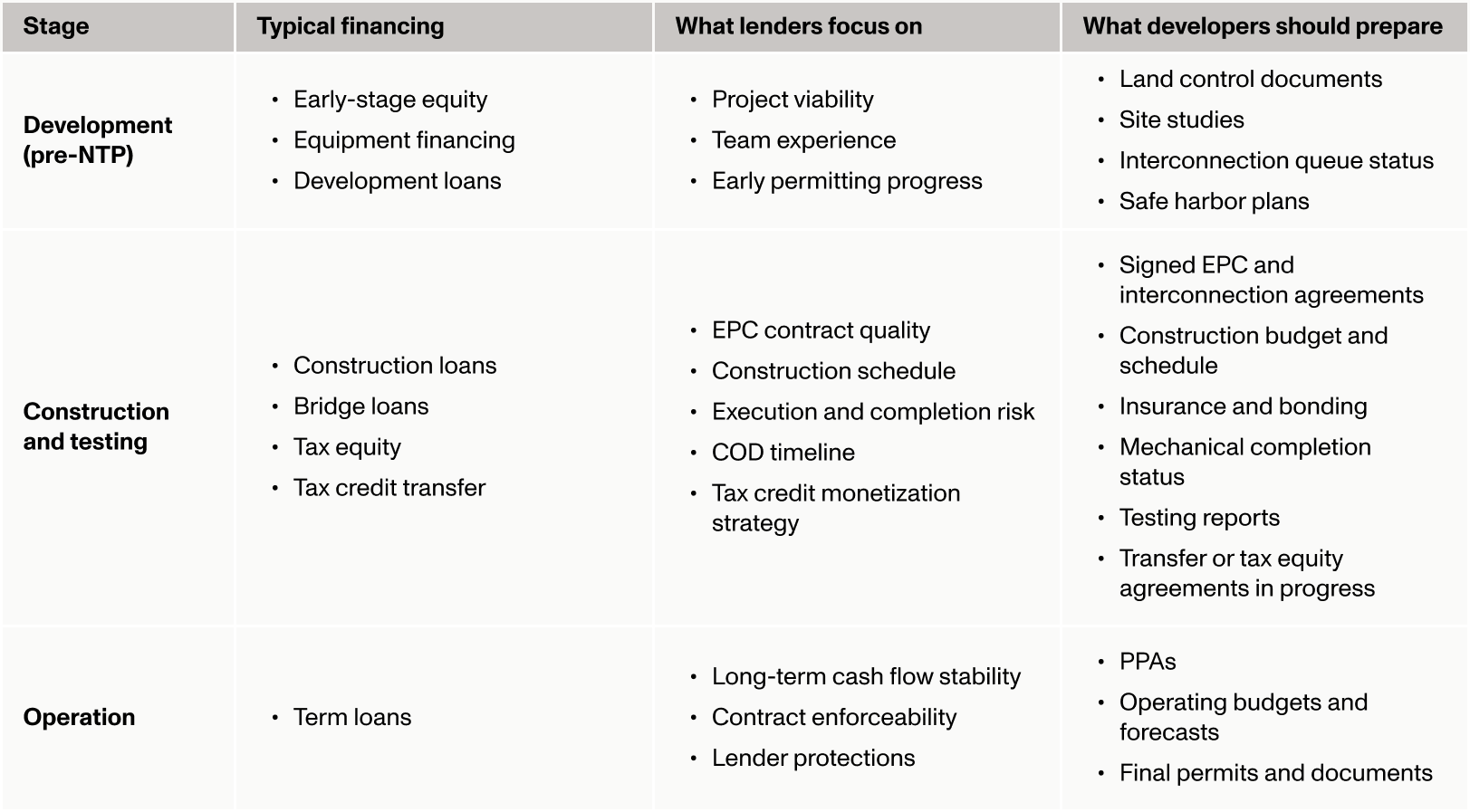
Lenders assess clean energy projects through the lens of risk and repayment. Their primary concern is whether a project will generate steady, predictable cash flows that can reliably service debt over time.
They typically focus on the following areas:
Offtake strength
Financing is easier with a strong buyer under a long-term power purchase agreement (PPA). Lenders review offtaker quality, contract tenor, and pricing terms to confirm stable revenue.
Contracted revenue
Beyond the offtake, lenders look for other sources of contracted cash flow, such as storage incentives, capacity payments, or RECs. High levels of contracted revenue reduce reliance on short-term energy markets and provide more predictable returns.
Developer experience
Lenders want to know if the sponsor has successfully completed similar projects in the past. A strong track record helps establish credibility and lowers perceived execution risk, especially in tougher financing conditions.
Technology maturity
Proven, commercially deployed technologies (e.g., utility-scale solar or lithium-ion storage) are more likely to meet lender risk thresholds than newer, less validated solutions. Emerging technologies can still attract capital, but usually require equity backing or risk mitigation strategies such as guarantees or performance insurance.
Project readiness
Project readiness includes having land rights secured, interconnection agreements in place, necessary permits obtained, and key project documentation prepared. The more complete and organized a project is, the more likely lenders are to engage seriously.
Lender priorities throughout the project finance lifecycle
Want more insights on lender sentiment and market trends? Download our 2025 mid-year market intelligence report for updated benchmarks and insights from across the clean energy debt market.
How the project finance process is becoming easier
Renewable energy project finance has historically been fragmented, with developers relying on existing relationships, one-off lender outreach, spreadsheets, and manual coordination to raise capital.
Crux brings the capital stack together in one platform, helping developers access a network of capital providers and navigate financing across development, construction, and operations.
Crux helps developers:
- Build lender-ready data rooms using standardized templates and documentation guidance, right in the Crux platform.
- Understand market dynamics and see how deal terms compare to current benchmark prices.
- Reduce friction in the diligence process with lender-specific requirements and workflows.
- Match with capital that fits each project’s profile, timeline, and risk appetite.
Looking to dig deeper on market dynamics? Download our whitepaper for more insights on how the clean energy finance landscape is evolving.
Renewable energy project finance FAQs
What’s the typical timeline for securing project finance from start to close?
Timelines vary by project size, existing lender relationships, risk profile, technology, and lifecycle stage. Larger or first-of-a-kind projects generally require more diligence and longer execution periods.
What are the finance options for smaller-scale projects?
Smaller-scale clean energy projects often face more limited finance options because traditional capital providers tend to prioritize larger deals. However, these developers can still access funding through community banks, mission-driven lenders, green banks, or specialized funds focused on distributed energy.
Transferable tax credits have also opened up new opportunities for smaller projects to monetize incentives by selling credits directly to third-party buyers.
What financial metrics do lenders focus on for credit and risk assessment?
Each lender varies in terms of how they determine a project's viability. That said, common metrics include:
- Debt service coverage ratio (DSCR): Net operating cash flow divided by annual debt service. Higher DSCR indicates a stronger ability to repay.
- Loan-to-value (LTV): Loan amount relative to total asset value. Lower LTV generally signals lower risk.
- Project internal rate of return (IRR): Overall project return; a higher IRR indicates stronger economics.
How do lenders assess construction and completion risk?
Lenders evaluate construction and completion risk by reviewing the credibility of the developer, contractors, and suppliers, along with project contracts and timelines. They often hire independent engineers to assess technical details such as equipment specs, interconnection feasibility, and energy yield projections. This helps ensure the project can be delivered on time, on budget, and at expected performance levels.
Share