

Critical mineral tax credits: What tax buyers need to know (updated 2026)

Share
.svg)

.svg)
.svg)
Want to explore more conversations like this?
View all blogs
Originally published May 2025. Updated August 2026 to reflect Crux’s 2026 Mid-Year Market Intelligence Report, PFE implementation, and current market conditions.
Critical minerals tax credits are transferable §45X advanced manufacturing production tax credits (PTCs) generated by companies that extract or process eligible critical minerals in the United States. The credit equals 10% of production cost, carries no per-unit cap, and — because it is a production credit — no recapture risk. What changed for buyers in 2026 is diligence. Section 45X is subject to all three prohibited foreign entity (PFE) tests, and its material assistance requirement applies to components sold on or after January 2026.
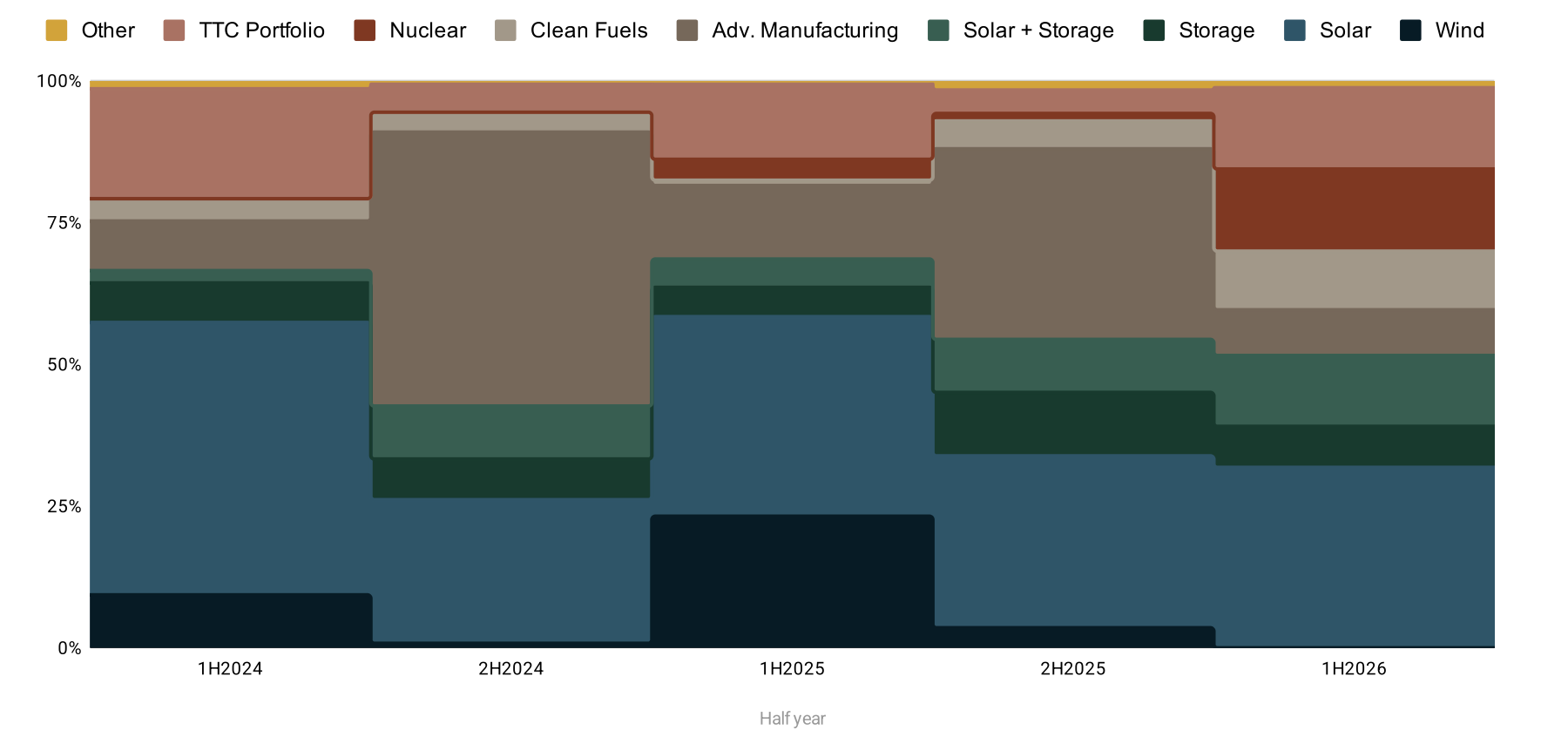
Crux expects $7-8 billion in 2026-vintage §45X credits to transact beginning in the second half of the year.Manufacturing credits fell to 7.5% of transferable tax credit volume in the first half of 2026, from 13.0% a year earlier, as buyers worked through new PFE diligence.
This guide covers how §45X critical mineral tax credits are generated, how they are priced, the risks buyers should evaluate, and current market trends.
Key takeaways:
- Section 45X eligibility runs off a list written into the statute, separate from the US Geological Survey (USGS) critical minerals list, and it does not update when the USGS list updates. 50 minerals qualify today, plus metallurgical coal, which the One Big Beautiful Bill (OBBB) added at a reduced rate. Copper appears on the USGS list and is not §45X-eligible.
- The credit equals 10% of production cost (2.5% for metallurgical coal), with no per-unit cap. The October 2024 final regulations allow certain material and extraction costs, plus §263A indirect costs. Because §45X is a production credit, it carries no recapture risk.
- Section 45X carries the full PFE regime — ownership, effective control, and material assistance — and all three reach 2026 credits for calendar-year taxpayers. The material assistance requirement applies to components sold on or after January 1, 2026, where §48E and §45Y tie the same requirement to the start of construction. Buyer diligence centers on the producer’s material assistance cost ratio (MACR) analysis and its supplier certifications.
- Crux expects $7–8 billion in 2026-vintage §45X credits to transact beginning in the second half of 2026. Manufacturing credits fell to 7.5% of transferable tax credit volume in the first half of the year, from 13.0% a year earlier, as buyers worked through new PFE diligence.
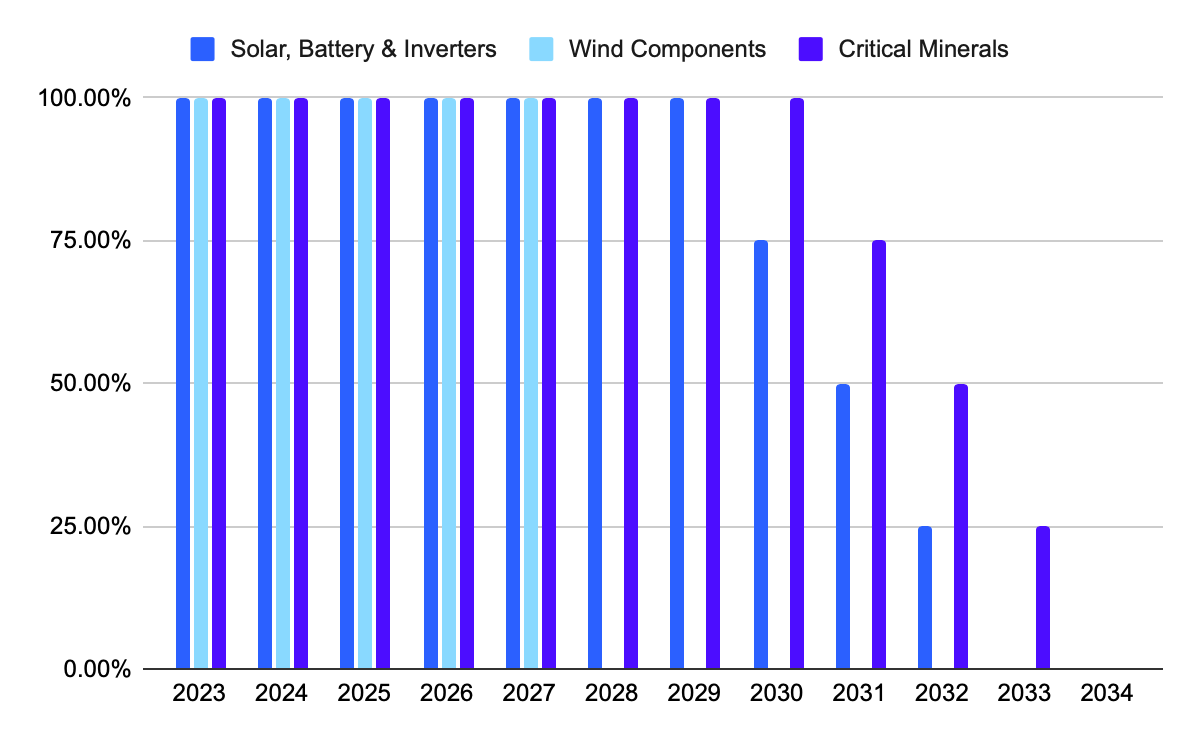
- Under the OBBB, the critical minerals tax credit phases down — 75% of value in 2031, 50% in 2032, 25% in 2033 — and is eliminated for credits produced in 2034 and later.
Which critical minerals qualify for §45X?
Two different lists get called "critical minerals," and only one determines §45X eligibility.
The US Geological Survey (USGS) maintains the government-wide list. The Energy Act of 2020 directed USGS to build and periodically update it against three criteria:
- The mineral must be essential to US economic or national security.
- The mineral’s supply chain must be vulnerable to disruption.
- The mineral must be essential to the production of energy, technology, or systems used for national defense.
USGS published its first list under that mandate in 2022 and expanded it in November 2025, adding 10 minerals — including copper and metallurgical coal — for a total of 60.
Section 45X eligibility runs off a separate list written into the statute, and that list does not move when the USGS list moves. 50 minerals qualify today, plus metallurgical coal, which the OBBB added at a reduced rate. Copper sits on the USGS list and is not §45X-eligible — a gap two bills now in House Ways and Means would close.
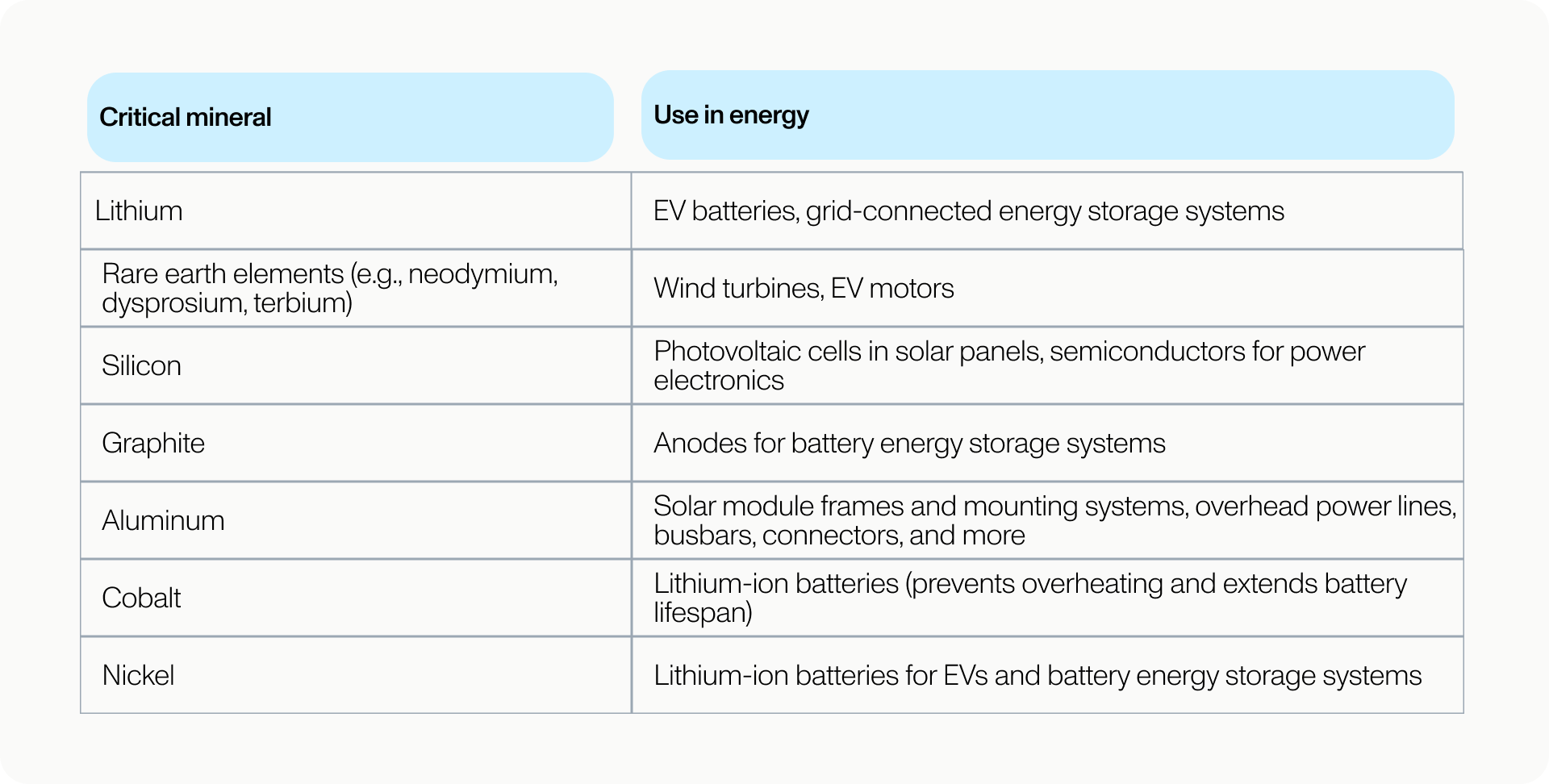
Select critical minerals and their use in energy
How is the value of the §45X tax credit for critical minerals calculated?
The §45X critical minerals PTC is calculated as 10.0% (or 2.5% in the case of metallurgical coal) of the production cost of a domestically produced or processed critical mineral sold to a third party in the US. In addition to the direct costs of production, there are several important rules regarding how companies can assess the value of their tax credits.
- Material and extraction costs. In draft guidance published in November 2023, the IRS prohibited including mineral acquisition costs from §45X critical minerals tax credit calculations. The final IRS guidance released in October 2024 allows certain material and extraction costs to be included for eligible critical minerals and electrode active materials. This change expanded the range of production costs eligible for §45X credits.
- Indirect costs. The final IRS guidance permits §263A indirect costs — employee benefits and payroll, depreciation or amortization of production equipment, and production-related taxes and insurance.
Some producers may elect direct pay instead of transferring. Transfers typically generate cash faster than IRS refund timelines, which is why most §45X credits reach the transfer market.
What PFE rules mean for §45X tax credit
The PFE rules exist because critical mineral supply chains run through China. The USGS reported in February 2026 that the US relies on China as a major source for 14 of the 33 critical minerals where import dependence is highest. China accounts for roughly 61% of mined rare earth supply and 91% of global refining capacity. Beijing has tightened export licensing since April 2025, and volumes of controlled compounds remain below historical levels. For a §45X buyer, that concentration is what makes PFE diligence heavier here than in other credit categories — the supply chain a producer has to document is the one China dominates.
Three tests apply to §45X credits.
- Ownership (guidance pending) — A taxpayer can not claim or sell credits if it is a PFE, or is owned or controlled by one. The US Department of the Treasury has not yet published operational rules on ownership mechanics and tracing; proposed regulations are expected later in 2026.
- Effective control (guidance pending) — Even with clean ownership, a project can be disqualified if a contract or license gives an SFE meaningful control over operations, such as dictating output, specifying component sources, or certain IP licensing arrangements entered after July 4, 2025. The statute identifies specific triggers, but Treasury has not yet defined “effective control” in formal guidance.
- Material assistance (interim guidance issued February 2026) — Manufacturers and project developers must show that PFE-sourced inputs stay below a cost threshold, calculated using the material assistance cost ratio (MACR). Thresholds that vary by component type — 50% for solar and inverters, 60% for batteries, and 85% for wind — and tighten annually.
IRS Notice 2026-15 (February 2026) established three safe harbor pathways for calculating the MACR:
- Identification safe harbor: The domestic content safe harbor tables serve as the exclusive list of components to evaluate — anything not listed is disregarded.
- Cost-percentage safe harbor: Use cost percentages from the safe harbor tables as proxies for actual direct costs.
- Certification safe harbor: Rely on supplier certifications attesting to the share of costs not sourced from a PFE. Certifications must be signed under penalty of perjury, retained for six years, and can generally be relied on unless there is reason to believe they are inaccurate.
The notice also established compliant methods for tracking components across facilities (individual tracking, de minimis assignment, and cost averaging) and clarified that §48E interconnection property requires a separate MACR calculation — a failure there does not disqualify the underlying facility.
How are §45X credits transacting in the market?
Crux expects $7–8 billion in 2026-vintage §45X credits to transact beginning in the second half of 2026, with some deals rolling into 2027 as PFE rules evolve and diligence standardizes.
Manufacturing credits fell to 7.5% of transferable tax credit volume in the first half of 2026, from 13.0% a year earlier, as buyers rotated toward categories with less PFE exposure. By tax code section, §45X accounted for 6.5% of volume, with §45Z at 6.7% — edging past §45X for the first time.
The shift happened against a market that stayed large. Total transfer volume reached $21 billion in the first half of 2026, and the second quarter was the largest quarter on record at $14.9 billion.
TTC market composition by tech type, H1 2024-H1 2026
How are critical minerals tax credits pricing?
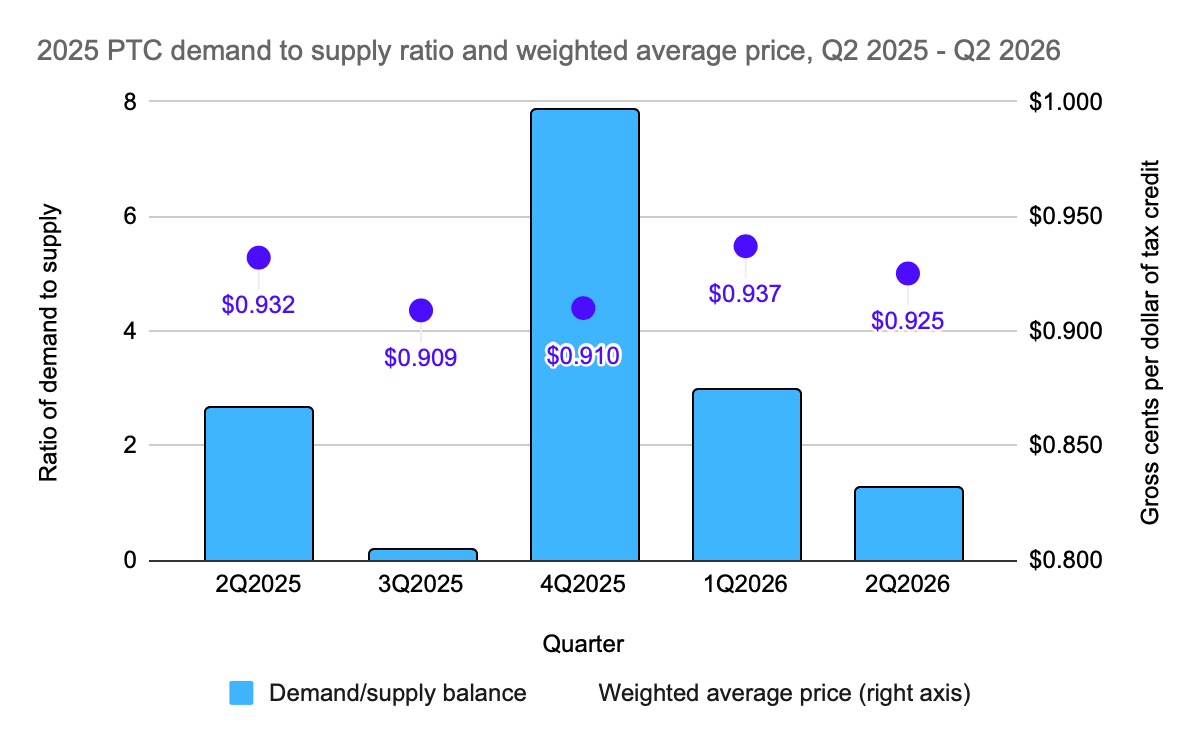
Market-wide, PTCs averaged $0.930 in the first half of 2026, below the $0.940–0.950 range typical of past years. Credits exempt from PFE rules command a premium of roughly $0.020, and legacy §45 credits — the largest PTC category outside the PFE regime — transacted at $0.94–0.96.
Section 45X is the most PFE-exposed segment of the market, and pricing on many §45X deals in the first half of 2026 fell below prior years. Crux notes that the deals that closed were likely the least PFE-exposed, which means the effective clearing price for harder fact patterns may sit lower still. A significant pool of credits remains unsold.
Section 45X demand to supply ratio and weighted average price, 2Q2025–2Q2026
Diligence support: insurance and indemnities
Buyers protect against tax risk in §45X transactions one of two ways: an indemnity from an investment grade (IG) producer, or insurance where the producer is not IG.
Advanced manufacturing carries the largest uninsured, non-IG share of any technology category, and the reason is specific. PFE is the risk buyers most want covered, and insurance for PFE provisions remains limited. MACR coverage exists but is rare, and with IRS guidance on effective control and ownership still outstanding, insurers cannot fully price a risk whose boundaries are undefined. Where insurance cannot close the gap, an IG producer's indemnity carries more weight.
Insurance costs for advanced manufacturing held roughly flat in the first half of 2026 at about 3.5% of credit value, though the range widened as full-wrap coverage became more common and more expensive. Coverage levels are negotiable up to 125–130% of credit value, with the additional margin absorbing interest and penalties that can accompany a disallowance.
Contract terms moved to match. Change-in-tax-law provisions appeared in 55% of first-half 2026 transfer agreements, up from 12% in the first half of 2024. Among deals with a quantitative indemnity cap, 71% set it above 100% of purchase price.
When does the §45X critical minerals credit expire?
The Inflation Reduction Act originally made the §45X credit for critical minerals permanent.
The OBBB introduced a phaseout:
Phaseout percentage for manufactured components and critical minerals
Metallurgical coal follows a separate schedule, eligible through 2029 at the reduced 2.5% rate.
Congress is working in the other direction. As of August 2026, several bills sit in the House Ways and Means Committee that would expand §45X — aligning the eligible minerals list with USGS and adding copper, raising the electrode active materials rate from 10% to 25%, and extending eligibility through 2041. None has seen floor action. The 2026 Mid-Year Market Intelligence Report tracks the full set.
Longer term, §45X becomes a larger share of available supply. Crux projects that storage ITCs and §45X advanced manufacturing PTCs together approach two-thirds of total tax credit supply by 2030, as standalone solar and wind credits phase out.
Further reading
For a broader overview of advanced manufacturing credits, see our essential guide to advanced manufacturing tax credits.
To learn more about the market for advanced manufacturing tax credits in H1 2026 and understand Crux’s predictions for the second half of the year, download our 2026 Mid-Year Market Intelligence Report.
For Crux's full collection of analysis on the prohibited foreign entity rules — updated as new guidance is released — visit our Prohibited Foreign Entity Rules resource hub.
Share