


How minimum tax rules affect clean energy tax credit purchases


Minimum tax rules can require certain large companies to pay additional tax when their regular tax bill falls below a specified minimum. For tax credit buyers, these rules can affect the savings a purchase delivers and when purchased tax credits can be used.
Three sets of rules may be relevant: the corporate alternative minimum tax (CAMT), the base erosion and anti-abuse tax (BEAT), and the Organisation for Economic Co-operation and Development’s (OECD) Pillar Two global minimum-tax framework. These rules do not apply to every buyer, and being within scope does not automatically rule out a tax credit purchase.
This guide explains how to identify which rules may apply to your company, what they mean for a purchase, and what to assess with your tax advisers before choosing tax credit types and purchase amounts.
Key takeaways
- BEAT and CAMT reach only very large corporations. BEAT applies to groups with average annual gross receipts of at least $500 million and a base erosion percentage of at least 3%; CAMT applies to corporations with average adjusted financial statement income (AFSI) above $1 billion.
- For buyers subject to BEAT, credit type determines value. Legacy §45 and §48 credits can keep up to 80% of their current-year benefit, while newer credits receive no BEAT offset.
- Purchased credits can offset CAMT. Transferable credits are general business credits, which can offset up to about 75% of net income tax liability, including CAMT.
- Pillar Two is a secondary consideration for most US-parented buyers. Foreign-parented buyers should model their US effective tax rate against the 15% floor.
What are BEAT, CAMT, and Pillar Two?
Base erosion and anti-abuse tax (BEAT)
Congress created BEAT in the Tax Cuts and Jobs Act of 2017 to limit the tax benefit of deductible payments to foreign related parties. For tax years beginning after 2025, the One Big Beautiful Bill (OBBB) set the general BEAT rate at 10.5%. A corporation within BEAT’s scope owes additional tax when that percentage of its modified taxable income exceeds its regular tax liability after specified tax credit adjustments. Most buyers without material cross-border, related-party payments to foreign entities are outside its scope.
Further reading: Understanding the base erosion and anti-abuse tax (BEAT) and transferable tax credits→
Corporate alternative minimum tax (CAMT)
Corporations within CAMT’s scope must compare their regular tax liability, including BEAT, with their tentative CAMT amount to determine whether they owe additional tax. AFSI starts with income reported in a company’s financial statements, adjusted under CAMT rules. The tentative CAMT amount is 15% of AFSI, reduced by applicable CAMT foreign tax credits.
If a corporation’s regular corporate tax liability plus its BEAT is below the tentative CAMT amount, then it must pay a CAMT liability in the form of a “top-up.” CAMT payments generate CAMT credits that carry forward indefinitely and can offset future regular tax after general business credits (GBCs).
Further reading: Understanding the corporate alternative minimum tax (CAMT) and transferable tax credits→
OECD’s Pillar Two global minimum-tax framework
Pillar Two’s global minimum tax rules apply to large multinational groups. The rules calculate an effective tax rate in each country where a group operates and can impose a top-up tax where that rate falls below 15%. Because the calculation is done country by country, items that reduce US taxes can pull the US effective tax rate toward 15% even when the group's global rate is well above it.
Under OECD guidance issued in July 2023, a buyer reduces its covered taxes only by the discount between a tax credit's face value and its purchase price. The buyer still applies the full face value against its regular US tax liability; only the Pillar Two effective tax rate calculation is limited to the discount.
Further reading: How Pillar Two affects IRA transferable tax credits→
Screening for minimum tax regime exposure
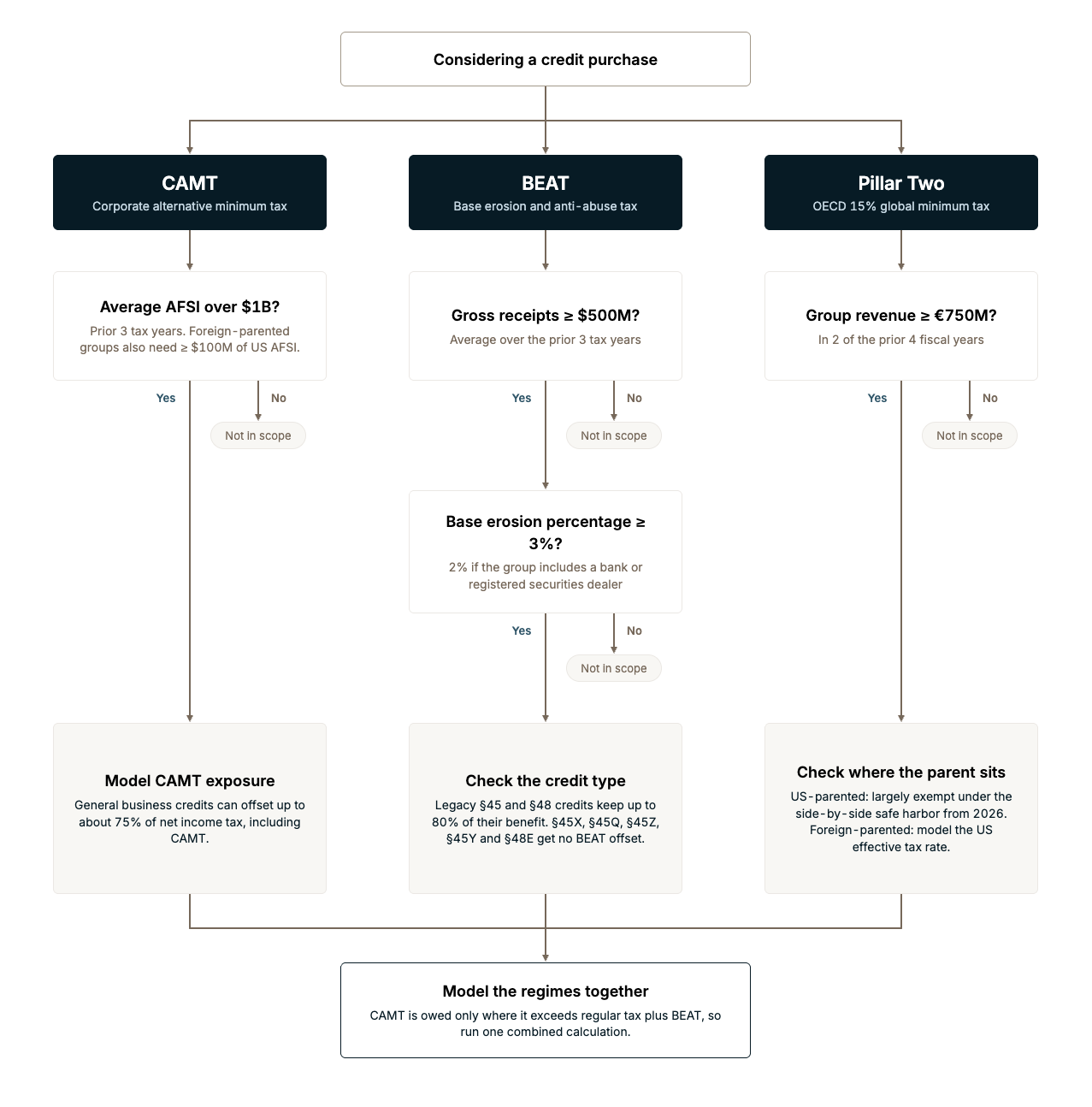
The flowchart below summarizes the threshold tests for each regime. It shows which analyses may apply, not the outcome of those analyses.
Which minimum tax regimes affect a tax credit purchase?
What does each regime mean for a tax credit purchase?
The three regimes raise different questions for a buyer:
BEAT: Which tax credits keep their value?
BEAT only applies to corporations whose group has average annual gross receipts of at least $500 million over three years and a base erosion percentage of at least 3% (2% for certain banks and securities dealers). The base erosion percentage generally measures certain deductions associated with payments to foreign related parties as a share of total deductions, with specified adjustments.
For a buyer in a BEAT position, tax credit value depends on whether the tax credit receives an offset in the BEAT calculation. Legacy §45 production tax credits (PTCs) and §48 investment tax credits (ITCs) qualify as “applicable §38 credits.” BEAT can preserve up to 80% of these tax credits’ value, subject to the buyer’s full BEAT calculation.
BEAT offset treatment by tax credit
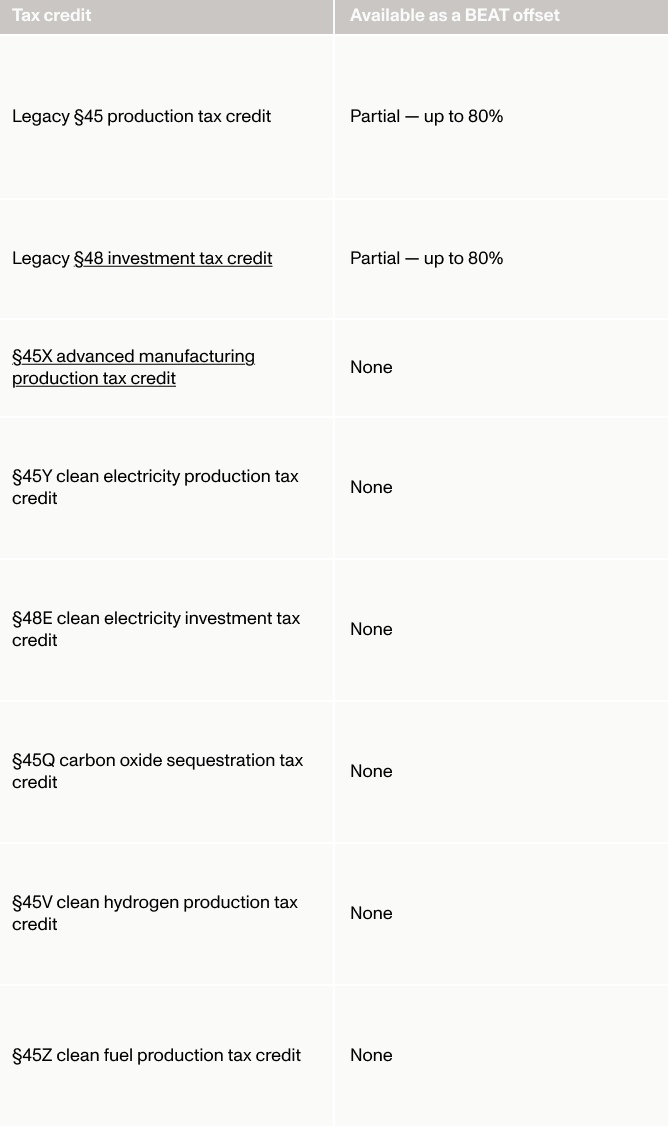
For example, a corporation in a BEAT position that buys $10 million of legacy §45 or §48 credits, with the full 80% offset available, would keep roughly $8 million of current-year federal tax benefit before the purchase price and other tax effects. The same purchase of a newer tax credit could eliminate the current-year benefit. Buyers should compare the resulting tax savings with the purchase price and transaction costs to determine whether a purchase is economical.
Legacy tax credits remain available in the transfer market. Qualifying §45 facilities can generate tax credits throughout their 10-year production periods, and projects that began construction before 2025 may continue to qualify under §48. For buyers that meet both BEAT tests, tax teams should model the after-tax result across regular tax, BEAT, and CAMT before choosing a tax credit type or purchase size.
CAMT: How do purchased tax credits fit alongside the calculation?
CAMT applies to corporations with three-year average AFSI above $1 billion. Foreign-parented groups must also have a US-subgroup average AFSI of at least $100 million.
CAMT has become more relevant since the OBBB. Changes such as bonus depreciation and R&D expensing lowered regular tax for many corporations, in some cases below the CAMT threshold. Notice 2026-7, added AFSI adjustments that can reduce CAMT liability for many corporations and give tax teams more certainty for modeling.
Purchased tax credits can offset CAMT. Transferable energy and manufacturing tax credits are GBCs, which can generally offset up to about 75% of net income tax liability, including CAMT. Unused eligible tax credits can generally be carried back three years or forward 22 years, subject to applicable limits. This can allow buyers to apply unused amounts against prior-year taxes or future tax liabilities rather than losing the benefit.
Tax credits purchased through a transfer receive the same treatment as tax credits from a tax equity partnership. Tax equity investments may require a separate CAMT analysis, because partnership accounting can affect AFSI; a direct purchase does not raise that issue.
Buyers with prior-year CAMT credits should assess how an additional tax credit purchase would affect their ability to use those existing credits. General business credits are applied first, so additional purchases can reduce the amount of prior-year CAMT credits usable that year. Tax advisors should model both options before determining the purchase amount.
Pillar Two: Where is the buyer's group headquartered?
Pillar Two applies to multinational groups with consolidated revenue of at least €750 million in at least two of the four preceding fiscal years.
The OECD's January 2026 side-by-side framework narrowed exposure for US companies. For US-parented groups, it eliminates future foreign Undertaxed Profits Rule exposure on US activities, making Pillar Two a secondary consideration for most US-parented buyers.
Foreign-parented buyers still need to model the effective tax rate of their US operations, particularly where it was already close to the 15% floor. Where relevant, they should also test the 17% threshold used for the OECD's transitional country-by-country reporting safe harbor in reporting years beginning in 2026.
Frequently asked tax credit buyer and investor questions
Could these regimes limit our ability to purchase or use tax credits?
They can affect how much of a purchased tax credit a buyer can use and when, but generally do not prevent a purchase. Annual use depends on the buyer’s tax liability, GBC limits, and any applicable minimum tax.
When does a purchase need closer review?
Most buyers may not have material exposure. BEAT and CAMT apply only to very large corporations, and Pillar Two has become a secondary consideration for most US-parented buyers. Ask your tax advisors for a closer review if your company:
- Meets or approaches BEAT’s gross-receipts and base erosion thresholds, particularly if considering newer tax credit types.
- Is within CAMT’s scope and expects regular tax liability to fall below its tentative CAMT amount.
- Is part of a foreign-parented multinational group with a US effective tax rate near Pillar Two’s 15% minimum.
What should buyers assess before moving forward?
Before committing, buyers and their tax advisors can:
- Confirm the relevant entities and groups. Identify the entity claiming the tax credit and the relevant group for each regime’s tests.
- Establish the regular-tax baseline. Estimate expected tax liability, available GBC capacity, and any carryforwards.
- Test each potentially relevant regime in order. Assess BEAT first, then CAMT, which accounts for BEAT, then Pillar Two. Account for any interaction in the company's overall model.
- Connect the analysis to the transaction. Assess the tax credit type, amount, tax year, purchase timing, expected use, and any carryforward implications.
For the broader purchase process, see the tax credit buyers' guide→
How can Crux support the transaction process?
Crux works alongside buyers and their tax advisors through each step of a purchase. Once advisors have assessed tax capacity and minimum tax exposure, a dedicated Crux deal team defines the buyer’s buy box, such as which credit types fit a buyer subject to BEAT, and sources credits underwritten to Crux’s standards.
Crux prices each opportunity against real transaction data and manages diligence, insurance, and documentation through funding. For buyers considering tax equity, Crux structures fully underwritten investments tailored to the buyer’s mandate and can co-invest alongside them.