


How PFE rules are changing tax credit diligence and pricing


Prohibited foreign entity (PFE) rules, enacted in the One Big Beautiful Bill (OBBB) in July 2025, now apply in some form to most new tax credits coming to market. The US Department of the Treasury's first piece of guidance on these rules, Notice 2026-15 (Feb. 12, 2026), addressed the material assistance test. Guidance on the ownership and foreign influence tests is still pending and expected by year-end.
While the risk of credit disallowance and recapture has always been part of transferable tax credit transactions, the new PFE requirements — coupled with the lack of guidance on key issues — prevent the market from effectively mitigating that risk. Until guidance is released, tax credit insurance largely excludes PFE, so buyers are underwriting the seller's balance sheet and the strength of legal analysis supporting its PFE position, in addition to the tax credit itself. That shift is now the single largest driver of tax credit pricing, according to Crux's 2026 Mid-Year Market Intelligence Report.
This article explores how PFE has changed the market and how tax credit buyers are underwriting a largely uninsured, all-or-nothing risk.
Key takeaways
- PFE compliance is all-or-nothing. If a seller fails a prohibited foreign entity test, the buyer can lose the entire tax credit. Treasury has yet to issue guidance on the ownership and foreign influence tests.
- Currently, tax credit insurance largely excludes PFE risk. Buyers rely on the seller’s indemnity and their own diligence, so seller creditworthiness and quality of legal analysis now carry more weight.
- Diligence scales with seller credit. The strength of the seller’s balance sheet or other credit support that covers PFE risks will have an impact on how much legal analysis and diligence buyers and their advisors will require. In general, the market expects to see “should”-level legal opinions plus adequate financial support.
- PFE exposure is now the largest driver of tax credit pricing. In H1 2026, tax credits exempt from PFE rules sold at a premium of about $0.015 for investment tax credits (ITCs) and $0.020 for production tax credits (PTCs). That premium is likely to widen as legacy supply shrinks.
- Buyers who prepare now will move first. Buyers with counsel, approvals, and diligence standards in place will be able to transact more easily once Treasury releases additional guidance.

Get our latest insights and favorite reads on the transferable tax credit market in your inbox.
How have PFE rules changed tax credit transferability?
PFE rules made eligibility for many tax credits depend on an all-or-nothing test that Treasury has not fully defined and insurance largely does not cover. If a seller fails a PFE test, the buyer can lose the entire tax credit.
How much a given tax credit is exposed depends on its tax code section and when the project began construction:
Applies to calendar-year taxpayers. Source: Crux, The State of Clean Energy Finance: 2026 Mid-Year Market Intelligence Report
Exposure to these rules is already reshaping the market. Crux estimates that just under $4 billion in PFE-exposed tax credits transacted in H1 2026, about 20% of the market. That share is expected to grow to at least 25% in H2 as legacy supply runs out. Buyers have also shifted toward tax credit types with limited PFE exposure: H1 2026 saw $1.7 billion in §45Z clean fuel transactions, more than the $1.1 billion recorded for all of 2025.
What are the new ITC recapture rules?
Beginning in 2028, a new PFE recapture rule allows the Internal Revenue Service (IRS) to recapture the full value of a §48E tax credit if the project makes certain payments that give a prohibited foreign entity effective control within 10 years of being placed in service. Unlike traditional §50 recapture, which steps down each year over a five-year window, PFE recapture is all or nothing for the full 10 years.
For a buyer, a longer recapture window means the seller's indemnity needs to hold up for longer. Insurers have also signaled limits: Marsh's Alisha Soares told Crux that recapture "tied to go-forward voluntary behavioral aspects will probably be carved out" of future PFE coverage.
For additional background on tax credit recapture, see Crux's recapture risk explainer.
Why won't tax insurance cover PFE risk, and who bears it instead?
Insurers struggle to price a risk when the regulatory boundaries have not been defined, so most policies exclude PFE risks. Without insurance, risk mitigation sits with the seller's indemnity and the buyer's own diligence.
"Until the guidance comes, PFE risk is not something the carriers can comprehensively underwrite," Soares said in Crux’s mid-year market intelligence report. Coverage for the material assistance test exists but remains rare. Ownership and influence are largely uninsurable until Treasury acts.
Insurance is still a standard requirement in transactions with non-investment-grade (non-IG) sellers, particularly for ITCs. It covers other tax risks even when it excludes PFE.
Where insurance can't close the gap, IG seller indemnities become much more valuable, because an IG seller can stand behind PFE risk directly.
“For deals that aren’t backed with an investment-grade indemnity, buyers are used to relying on insurance,” says Ted Lee, Senior Principal on Crux’s Tax Investor Coverage team. “Because insurance isn’t available for PFE risks, buyers are able to get comfortable through rigorous upfront diligence and strong contractual and financial protections. The deals that are currently moving forward have favorable facts and circumstances, including clear documentation, credible legal analysis, broad reps and covenants, and — where possible — backing by a creditworthy counterparty.”
What PFE documentation should buyers expect from tax credit sellers?
As with other newly introduced legislation and tax law, initial PFE diligence will likely require sellers to provide tax legal opinions or memos to support eligibility and compliance with PFE.
A legal opinion is a document produced by legal counsel (typically seller’s counsel) applying the relevant facts and circumstances to the law. It provides a conclusion at a specific level of confidence that the tax position will be sustained (e.g., “more likely than not,” “should,” “will”-level). These documents can also be prepared by a professional third-party firm, such as an accounting firm.
Sellers with more complex fact patterns or with a limited balance sheet to support their indemnity will likely require formal legal opinions at “should”-level or higher.
“Navigating PFE compliance and preparing proper diligence remains a challenging task for most sellers. Insurance coverage for PFE remains limited while guidance is outstanding,” Grace Chan, Principal on Crux’s Tax Credit Markets team, explains. “Crux works closely with our seller clients to ensure transaction readiness and that sellers are obtaining the right supporting documents to transact efficiently.”
Diligence responsibilities typically split two ways. Seller counsel or advisors prepare the PFE analysis and supporting documents. The buyer and its advisors review them and raise questions. Crux will also prepare memos that provide market context, analyze documents provided in the data room, and flag what's still outstanding.
Buyers should also understand the limits of the diligence paperwork:
- Opinions speak only as of their date. "If the facts or the law change afterward, that's outside the opinion's scope," Skadden's Paul Schockett told Crux in the 2026 mid-year market intelligence report. Expect sellers to update opinions once Treasury issues guidance.
- Ownership can be complex to diligence. Public-company ownership can be checked through US Securities & Exchange Commission filings. The ownership of private companies, including many developers, can be much harder to verify.
- Seller representations come with a knowledge qualifier. Some sellers represent that, to their knowledge, they meet PFE requirements; they do not make an absolute promise. That puts more weight on the indemnity terms and the buyer’s own diligence.
- Diligence continues after execution. Deals with multiple funding dates often require sellers to provide bring-down due diligence at each funding.
- Insurance may come later. Some transfer agreements now commit the parties to discuss adding PFE coverage once it becomes available.
How is PFE affecting tax credit pricing?
In the first half of 2026, Crux found that tax credits exempt from PFE rules sold at a premium of about $0.015 per dollar for ITCs and about $0.020 for PTCs. PFE exposure has now overtaken deal size and seller credit quality as the main driver of tax credit pricing.
The gap between columns reflects both seller credit quality and PFE exposure. Source: Crux, State of Clean Energy Finance: 2026 Mid-Year Market Intelligence Report
Market-wide average pricing for 2026 tax credits fell to $0.913 for ITCs and $0.930 for PTCs in H1 2026, below historical norms of $0.920–0.925 and $0.940–0.950, respectively. Within ITCs, §48E tax credits traded about $0.015 below legacy §48 tax credits across deal sizes. The premium for an IG seller narrowed to roughly $0.015 from $0.030 in 2025, a sign of how much PFE exposure now outweighs seller quality.
Range of prices for tax credits in H1 2026 by tax code section (P10-P90)
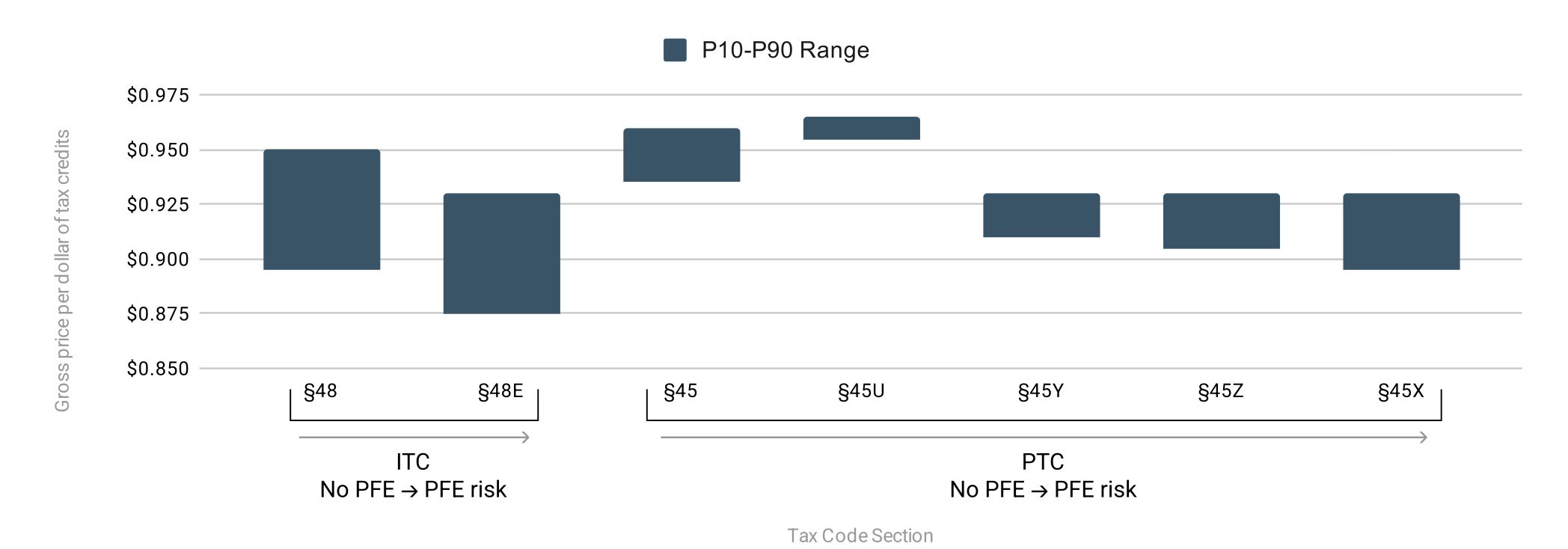
Two caveats matter for buyers:
- Observed discounts likely understate the true discount. The figures reflect only tax credits that sold. Deals with weaker PFE fact patterns largely didn't transact, so the price needed to clear the full inventory may be lower.
- The premium is likely to widen. As legacy §48 and §45 supply shrinks, buyers avoiding PFE risk will compete for fewer tax credits, pushing prices for these tax credits higher.
For buyers that can diligence PFE risk well, the discount is compensation for real, incremental risk.
What should tax credit buyers do now?
Tax credit buyers should prepare now so they can move quickly once Treasury issues guidance. That includes deciding how PFE risk fits into their overall strategy.
- Get transaction-ready. Guidance on ownership and influence is expected by year-end. Crux believes that many sellers subject to PFE rules are waiting for guidance before transacting — for example, Crux observed no utility-scale §48E tax credits transacting in Q3 2026 — in hopes that favorable guidance will allow them to gain better economic terms. That means the market could see more §48E and §45X transactions after guidance is published. Buyers with approvals, counsel, and diligence standards in place will be able to transact more easily. Buyers willing to transact pre-guidance, while there is still uncertainty, may be able to get favorable opportunities.
- Move early on legacy §48 supply. PFE-exempt tax credits are scarce and getting scarcer. Crux saw 2027-vintage legacy §48 tax credits beginning to transact in the third quarter.
- Find the right partners. Strong tax counsel and an experienced transaction team can turn PFE diligence from a reason to pass into a pricing advantage.
- Require clear documentation from sellers. At minimum, sellers should provide supplier certifications to demonstrate compliance with the material assistance rules, details on ownership and debt, and licensing or contract terms relevant to effective control.
Underwrite PFE risk with Crux
Crux has tailored diligence tools — including PFE-specific diligence checklists and compliance worksheets — to help tax credit buyers underwrite and price PFE risk in tax credit transactions. Our expert team thoroughly vets and de-risks every opportunity and provides benchmarking analysis to help tax teams understand terms in relation to other transactions.
Contact us to learn more about how we can help you find and underwrite tax credits that fit your mandate.