

§45Z clean fuel production credits: What tax credit buyers need to know (updated 2026)

Share
.svg)

.svg)
.svg)
Want to explore more conversations like this?
View all blogs
Originally published July 2025. Updated August 2026 to reflect final Treasury guidance, the One Big Beautiful Bill (OBBB), and current market conditions.
Section 45Z clean fuel production tax credits (PTCs) have become a growing part of the transferable tax credit market as buyers assess prohibited foreign entity (PFE) exposure alongside credit-specific risks. In the first half of 2026, Crux observed $1.7 billion in §45Z transaction volume — more than the $1.1 billion recorded across all of 2025. Section 45Z alone made up 6.7% of tax credit transaction volume in the H1 2026, edging past §45X (6.5%) for the first time.
That growth coincided with greater policy clarity and buyer interest in credit types with more limited PFE exposure. Initial Department of the Treasury guidance in January 2025 established the framework for the credit, while additional Treasury and Department of Energy (DOE) clarifications in early 2026 reduced uncertainty around qualification and credit calculation. For tax credit buyers, §45Z offers production-backed credits across a range of low-carbon fuels and a diligence profile distinct from wind, solar, and battery storage projects.
This guide explains how the credit works, which fuels qualify, what the 2026 guidance changed, and how the market is transacting.
Key takeaways:
- The §45Z clean fuel production credit is a federal, performance-based PTC that pays domestic producers of low-carbon transportation fuels up to $1.00 per gallon (or gallon equivalent) based on the fuel's lifecycle greenhouse gas (GHG) emissions.
- Eligible fuels include renewable natural gas (RNG), biodiesel, renewable diesel, sustainable aviation fuel (SAF), ethanol, and qualifying transportation hydrogen.
- Section 45Z sits largely outside the PFE restrictions that have shaped tax credit transactions through 2026. Only the ownership provision applies today. The effective control provision — the harder of the two to diligence — does not reach §45Z until tax years beginning after July 4, 2027, and the tax credit carries no material assistance requirement at all.
- Buyers have responded. In the first half of 2026, Crux observed $1.7 billion in transaction volume.
Which clean fuels qualify for §45Z?
The §45Z credit covers a range of clean fuel types that are produced domestically and sold for use in transportation.
Renewable natural gas
Organic matter from agricultural waste, municipal solid waste, and wastewater can be transformed into renewable natural gas that goes into compressed natural gas (CNG) to fuel vehicles. RNG, which can be integrated into natural gas pipelines, is produced using anaerobic digestion. Organic waste is put in sealed tanks where microorganisms break down the organic matter and produce raw biogas, which is then processed and upgraded to produce RNG. To qualify for §45Z, RNG must be sold for use as a transportation fuel, typically as CNG in vehicles.
Biodiesel
While RNG is made with organic matter, biodiesel uses vegetable oils or animal fats as feedstock. A chemical process called transesterification occurs when the animal fats or vegetable oils react with alcohol and a catalyst — usually sodium hydroxide or potassium hydroxide — to produce biodiesel and glycerin. As the name implies, biodiesel can be used to power diesel engines, and is typically blended with hydrocarbon-based diesel fuel.
Renewable diesel
Produced primarily through hydrotreating, renewable diesel uses feedstocks such as soybean and canola oil, animal fats, used cooking oils, and inedible corn oil. The hydrotreating process involves treating feedstocks with hydrogen at high temperatures and pressures in the presence of a catalyst. The process removes oxygen and creates a pure hydrocarbon chemically identical to petroleum diesel. This allows it to be used as a replacement fuel or a drop-in fuel, either at 100% concentration or blended in any proportion in existing diesel engines without modification.
Sustainable aviation fuel
Sustainable aviation fuel (SAF) is also chemically like conventional jet fuel, although it is made using renewable feedstock and has significantly fewer lifecycle greenhouse gas emissions. Several methods are used to produce SAF:
- In Fischer-Tropsch synthesis, biomass such as agricultural waste is gasified to produce syngas. Syngas is then converted into liquid hydrocarbons that can be used as jet fuel. SAF is blended with traditional jet fuel in differing proportions, ranging from 10% to about 50%.
- SAF can also be produced by chemically treating used cooking oil, animal fats, and oilseeds to make a hydrocarbon fuel or by converting alcohol such as ethanol into jet fuel.
Ethanol
Besides serving as a feedstock for SAF, ethanol can also be blended into gasoline to reduce emissions. Used in flex fuel vehicles, ethanol blends range from 10% to 85%. Corn is the main feedstock for ethanol fuel in the US. It is produced by fermenting the feedstock with yeast, which converts sugars into ethanol and carbon dioxide. The carbon intensity of ethanol can be reduced by integrating carbon capture and storage (CCUS) at ethanol production plants and by implementing sustainable agriculture practices to cultivate corn and other feedstocks.
Hydrogen
While not yet commonly produced as a clean fuel, hydrogen is an eligible fuel type. To qualify for the §45Z credit, hydrogen must be sold for use as a transportation fuel. Clean hydrogen used for other purposes can currently qualify for tax credits under the §45V credit.
Hydrogen can be produced from diverse feedstocks including fossil fuels (e.g., natural gas, coal), biomass, and water.
How is the §45Z credit value calculated?
The §45Z credit is unique in that it is a performance-based incentive. Unlike fixed-value tax credits such as the §45X advanced manufacturing credit, the value of a §45Z credit depends on how much a fuel reduces lifecycle GHG emissions relative to a petroleum baseline. Fuels with very low or zero emissions can earn up to $1.00 per gallon (or gallon equivalent), while those with higher emissions receive a proportionally smaller credit. This structure favors fuels that deliver the greatest emissions reduction,and it requires rigorous documentation and modeling to validate emissions intensity.
To qualify for the credit, fuels must haveGHG emissions below 50 kilograms of CO2 equivalent per million BTUs (kg CO2e/mmBTU). The credit amount is calculated using the following formula:
Credit per gallon (or gallon equivalent) = $1.00 × (1 – (Fuel GHG emissions ÷ 50))
Under this structure, a fuel with zero lifecycle emissions earns the full $1.00 per gallon; a fuel with 25 kg CO2e/mmBTU earns $0.50 per gallon; a fuel at or above 50 kg CO2e/mmBTU earns nothing.
How a producer establishes an emissions rate
In January 2025, the Internal Revenue Service (IRS) issued Notice 2025-11, designating the 45ZCF-GREET model as the methodology for calculating lifecycle GHG emissions for most fuels. The notice includes emissions tables for common fuel pathways:
- If a fuel and production method are listed in Notice 2025-11’s emissions tables, the producer uses the published emissions rate directly.
- If a fuel pathway is not listed, the producer must apply for a provisional emissions rate (PER), supported by a GREET-based lifecycle analysis. This ensures the credit amount aligns with the measured emissions profile of the fuel.
What did the June 2026 45ZCF-GREET update change?
In June 2026, the DOE released the June 2026 update to 45ZCF-GREET model to exclude induced land use change (ILUC) emissions from lifecycle carbon intensity calculations. The change improves §45Z tax credit values across the board for crop-based liquid fuel producers, and in some cases pushes marginal pathways over the qualification threshold.
The DOE’s user manual illustrates the effect by pathway:
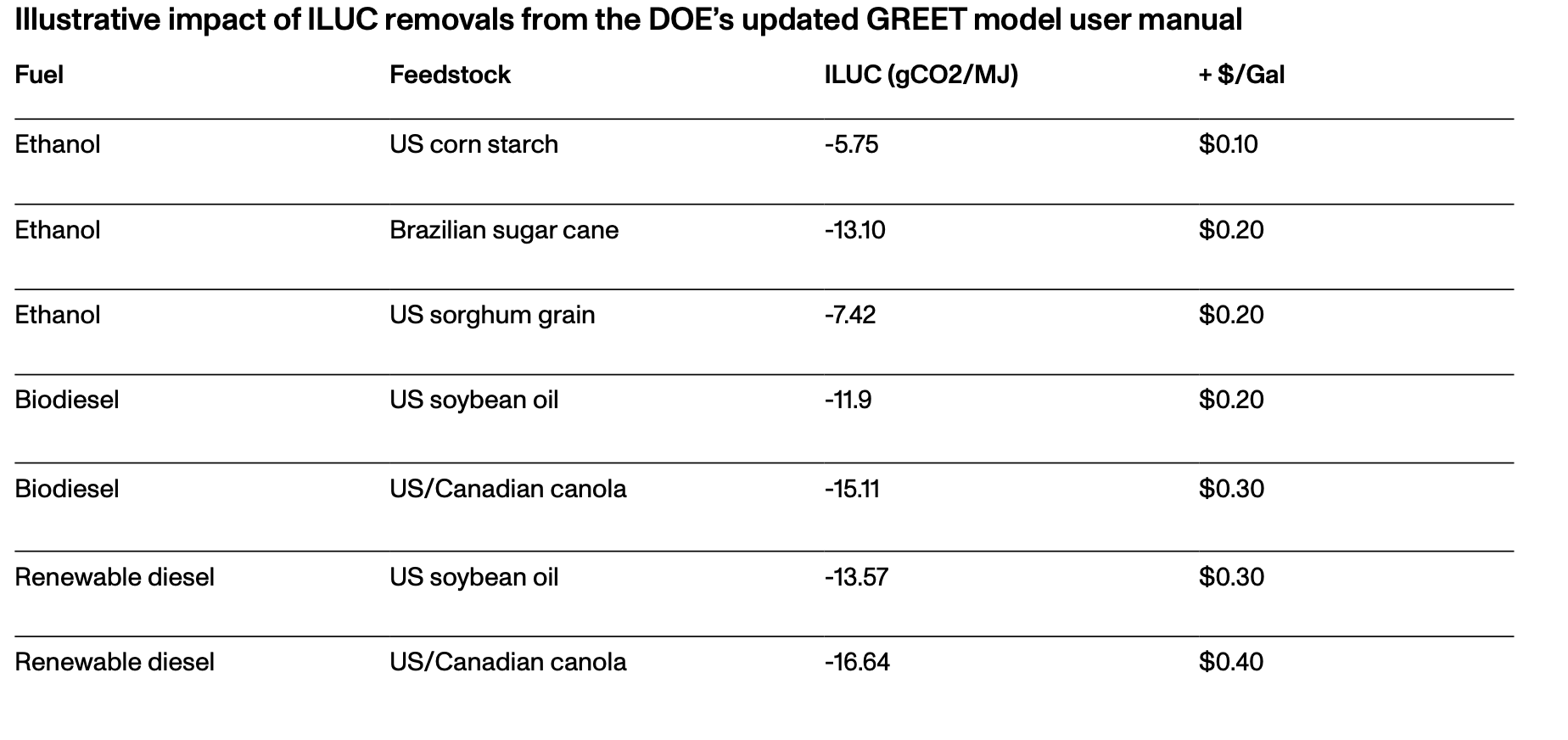
The benefit is uneven. Manure-based RNG and biogas producers are still waiting on further model updates to reduce carbon intensity, and producers using organic waste feedstocks need new pathways. Buyers diligencing a specific project should confirm which model version supports the seller's carbon intensity assumptions and whether the June update applies to that pathway.
What did the February 2026 proposed regulations change?
In February 2026, Treasury and the IRS published proposed §45Z regulations that formalize and build on the January 2025 guidance. Five changes matter most for §45Z buyers:
Confirmation of 45ZCF-GREET for non-SAF fuels
Producers of non-SAF fuels must use the 45ZCF-GREET model for lifecycle emissions calculations. SAF producers retain access to alternative methodologies under separate guidance.
Safe harbors for substantiating emissions rates
Third-party certification of emissions rates is now permitted, reducing the diligence burden for buyers and giving producers a clearer path to documented credit eligibility.
Safe harbors for documenting qualified sales via purchaser certificates
Purchaser certificates standardize the documentation buyers and producers exchange to substantiate that the fuel was sold for a qualifying transportation use.
Expanded definition of a "qualified sale"
Sales through intermediaries and wholesalers now qualify, not only direct sales from producer-to -end-user. This resolves a long-standing industry concern: most US fuel distribution flows through wholesalers and blenders, and the prior narrower interpretation created uncertainty about whether common distribution structures generated valid §45Z credits. For tax credit buyers, the expanded definition reduces a category of structural risk and broadens the pool of eligible deals.
A formalized two-step PER process
The proposed §45Z regulations formalized the PER process and added a two-step sequence:
- The producer first requests an emissions value from DOE, which conducts a technical lifecycle analysis.
- The producer then petitions the IRS with the DOE-determined emissions value to obtain a PER for the §45Z claim.
This sequencing is material for any producer pursuing a non-tabled fuel pathway, because PER timing affects when credits can be claimed and transferred.
What makes §45Z credits attractive to tax credit buyers?
Limited PFE exposure, with a runway into 2028
Section 45Z carries only the PFE ownership provision. The effective control provision applies to tax years beginning after July 4, 2027 — January 1, 2028 for calendar-year taxpayers — and §45Z has no material assistance requirement at all.
That distinction matters because market participants consistently report that ownership is easier to diligence than effective control, which has been the primary PFE pain point across the tax credit market. Sections 48E, 45Y, and 45X carry exposure through all three restrictions. Section 45Z carries one, and will for two more tax years.
The result is a tax credit with materially less regulatory uncertainty than much of the market — and a corresponding rotation of buyer interest toward it.
Production-backed value
Tax credits are generated only after qualifying fuel is produced and sold, so verification of size and value is tied to measurable output. Buyers' downside is a shortfall against forecast volume, not a purchase of tax credits that never materialize. Section 45Z also carries no recapture exposure.
Predictability from operating history
Buyers can further de-risk by seeking projects with several years of operational data. With consistent operations and maintenance, past production is a strong indicator of future output — more stable than the resource variability underlying wind and solar projects.
Policy support on the demand side
Clean fuels have drawn support across the political spectrum, and the first half of 2026 delivered a sequence of policy outcomes that strengthen the demand signal for domestic production.
The EPA’s final 2026–2027 Renewable Fuel Standard volumes, issued March 27, 2026, carried the most immediate market impact:
- The EPA reallocated 70% of 2023–2025 small refinery exemptions into 2026–2027 blending requirements, adding more than 1 billion incremental renewable identification numbers (RINs) annually to obligated demand.
- The EPA declined to finalize proposed limits on RIN generation for imported fuel or foreign feedstocks.
- Final bio-based diesel volumes were set at 9.07 billion gallons for 2026 and 9.20 billion gallons for 2027, roughly a 70% increase over 2025.
- D4 RINs rose more than 30% in the second quarter, and year-to-date domestic production climbed 11% year over year.
D4 RIN pricing softened in late July and early August on higher-than-anticipated June bio-based diesel production data and uncertainty around pending small refinery exemption decisions. D3 RINs for RNG continued on trend.
Combined with the §45Z extension through 2029 under the OBBB, these developments give buyers a longer view on demand than most tax credit categories offer.
How §45Z tax credits are transacting
In the first half of 2026, Crux observed $1.7 billion in §45Z transaction volume — more than the $1.1 billion recorded across all of 2025. Section 45Z accounted for 6.7% of tax credit transaction volume in the half, edging past §45X (6.5%) for the first time and demonstrating the rotation away from perceived PFE risk.
Total clean fuels transaction volume, 2025 and H1 2026
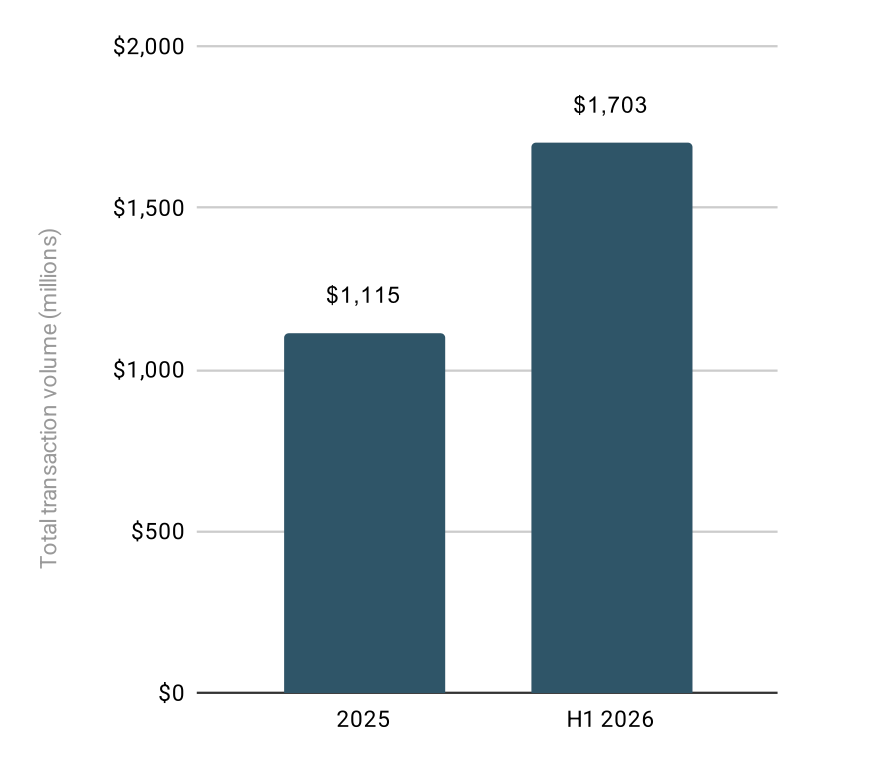
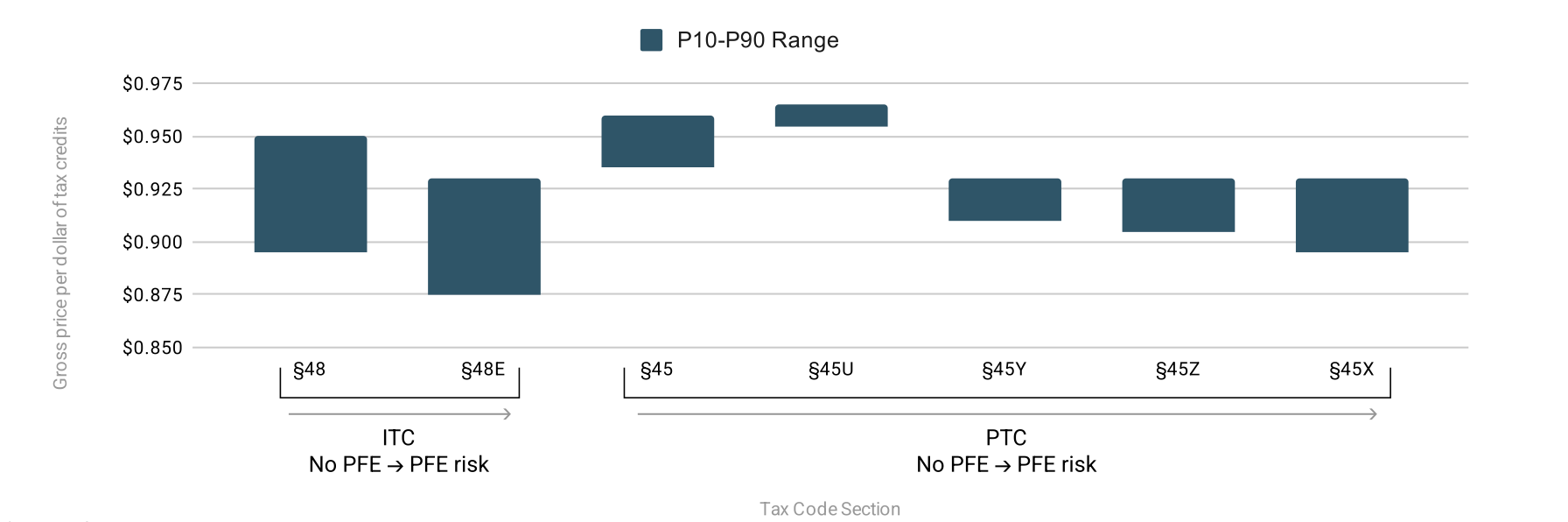
Pricing remains slightly below other tax code sections. In the first half of 2026, §45Z averaged $0.913 for 2026-vintage tax credits and $0.900 for 2025-vintage tax credits. For comparison, PTCs market-wide averaged $0.930 over the same period, and legacy §45 tax credits — exempt from PFE rules entirely — typically transacted at $0.94 to $0.96.
Two factors explain the discount. Section 45Z projects still carry risk tied to carbon-intensity calculations, and the segment has fewer investment-grade sellers than solar, wind, or nuclear.
Range of prices for tax credits in H1 2026 by tax code section (P10-P90)
§45Z due diligence and insurance considerations
Buyers of §45Z credits might face a more complex due diligence process given the sector’s reliance on agricultural commodities and diverse production technologies. Key due diligence areas include:
- Feedstock supply risk: Buyers need to assess the stability and longevity of feedstock suppliers. Unlike wind or solar, where the "fuel" (wind, sun) is naturally occurring, feedstock sources like dairies can go out of business, leaving a project without its essential input.
- Supplier track record: Evaluating the operator's track record across multiple projects can de-risk a transaction. Buyers often prefer to work with experienced operators rather than those on their first project.
- Financial health of suppliers: For projects involving US Department of Agriculture-backed loans, due diligence extends to scrutinizing the audited financials of farms over several years to understand their resilience to market fluctuations. Despite such diligence, project failures due to feedstock supplier issues have occurred.
- Carbon intensity calculation clarity: The due diligence process should include verifying that the fuel’s emissions rate is listed by the IRS in Notice 2025-11 or supported by an approved PER.
What's next for §45Z in 2026 and beyond?
Treasury has signaled that it is targeting November 2026 for a final §45Z rule, with GREET model updates likely near that timeframe. Crux expects the final rule to advance in the back half of the year alongside the upcoming proposed rule on PFE compliance, which should further unlock tax-oriented capital for the segment.
The 2029 phaseout is worth planning around, because §45Z is now large enough to move the whole supply curve. Crux projects new tax credit supply growing from $77 billion in 2026 to roughly $95 billion in 2029, then easing to about $91 billion in 2030 — a pullback driven largely by the scheduled phaseout of §45Z after 2029.
For buyers, that shape argues for building familiarity with the segment now rather than at the point of scarcity.
Further reading
Section 45Z credits represent one of the most dynamic and fastest-growing segments of the transferable tax credit market. Buyers who develop familiarity with the credit’s unique characteristics will be well positioned as the market matures.
Explore Crux’s The Ultimate Guide to §45Z Clean Fuel Tax Credits for more on what manufacturers and buyers need to know about §45Z PTCs.
Check out Crux’s 2026 Mid-Year read on tax credit volume, pricing, and insurance across the market.
For a deeper look at the February 2026 proposed guidance, see IRS releases new proposed 45Z guidance.
Read What the updated 45ZCF-GREET model means for clean fuel producers — the June 2026 model update and its effect on tax credit volume.
To learn more about the final 2026–2027 RFS, see What final 2026–2027 RFS volumes mean for RNG, renewable diesel, SAF, and ethanol producers.
Share