

§45X tax credits: A guide for manufacturers (2026)

Share
.svg)

.svg)
.svg)
Want to explore more conversations like this?
View all blogs
The §45X advanced manufacturing production tax credit (AMPTC) rewards US-based manufacturers of solar components, battery components, inverters, and critical minerals with a per-unit tax credit tied to production output. Tax credits are transferable — they can be sold for cash to a third-party tax credit buyer — making them a powerful source of working capital for manufacturers. Section 45X credits are among the most liquid and in-demand in the transferable tax credit market, with typical pricing of $0.91–0.94 per dollar of credit value. The One Big Beautiful Bill (2025) preserved §45X transferability but eliminated wind component eligibility after 2027, introduced a phasedown for critical minerals beginning in 2031, and added new prohibited foreign entity (PFE) compliance requirements effective January 1, 2026.
§45X tax credit FAQs
What is the §45X tax credit?
The §45X tax credit, created by the Inflation Reduction Act (IRA) and modified in the One Big Beautiful Bill (OBBB), provides a tax incentive for domestic manufacturers under §45X of the Internal Revenue Code (IRC).
Manufacturers are entitled to receive a production tax credit for solar components, wind energy components, battery components, or the refining or recycling of critical minerals. The value of the tax credit is calculated based on either a fixed dollar amount per unit of production, per unit of electrical capacity, or as a percentage of the cost of production. Section 45X tax credits are transferable.
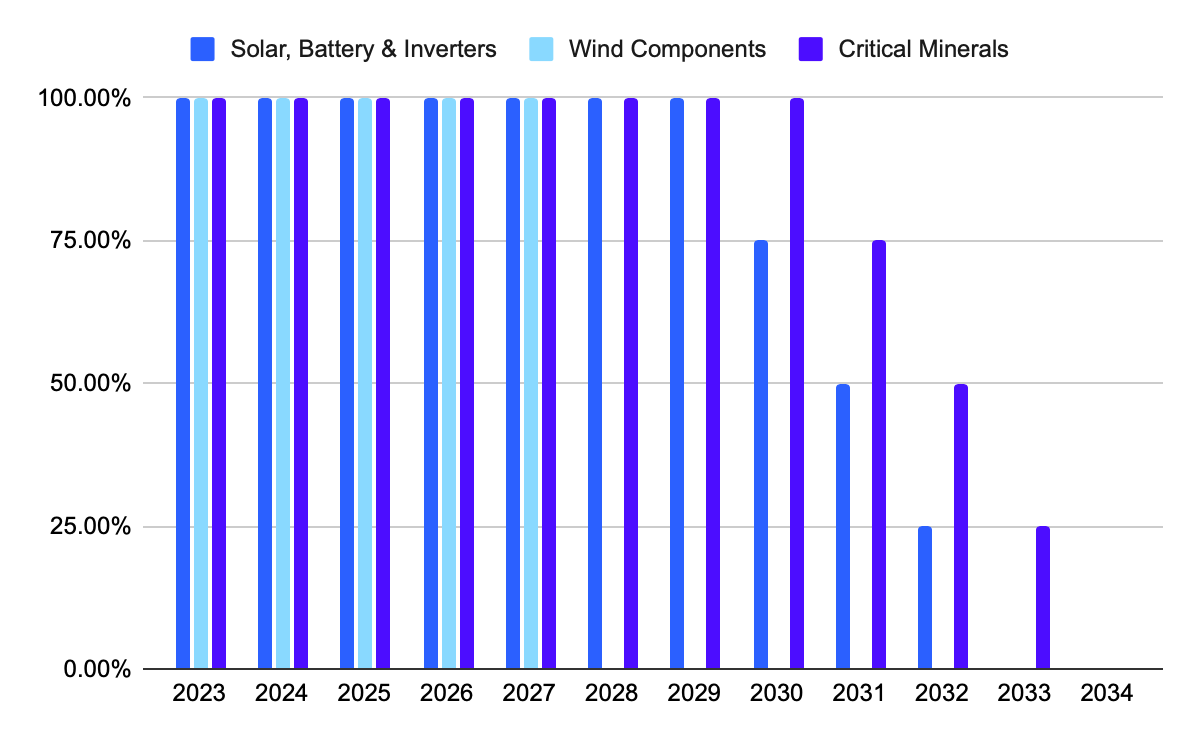
The OBBB modified the program's timeline in two important ways. First, wind components are no longer eligible for §45X credits generated after 2027. Second, critical minerals — previously exempt from the phaseout — are now subject to a staged phaseout from 2031 through 2034. For all other manufactured goods (solar components, battery components, and inverters), the original phasedown schedule remains in effect: 75% of full credit value in 2030, 50% in 2031, and 25% in 2032.
Phaseout percentage for manufactured components and critical minerals
What is the difference between §48C and §45X tax credits?
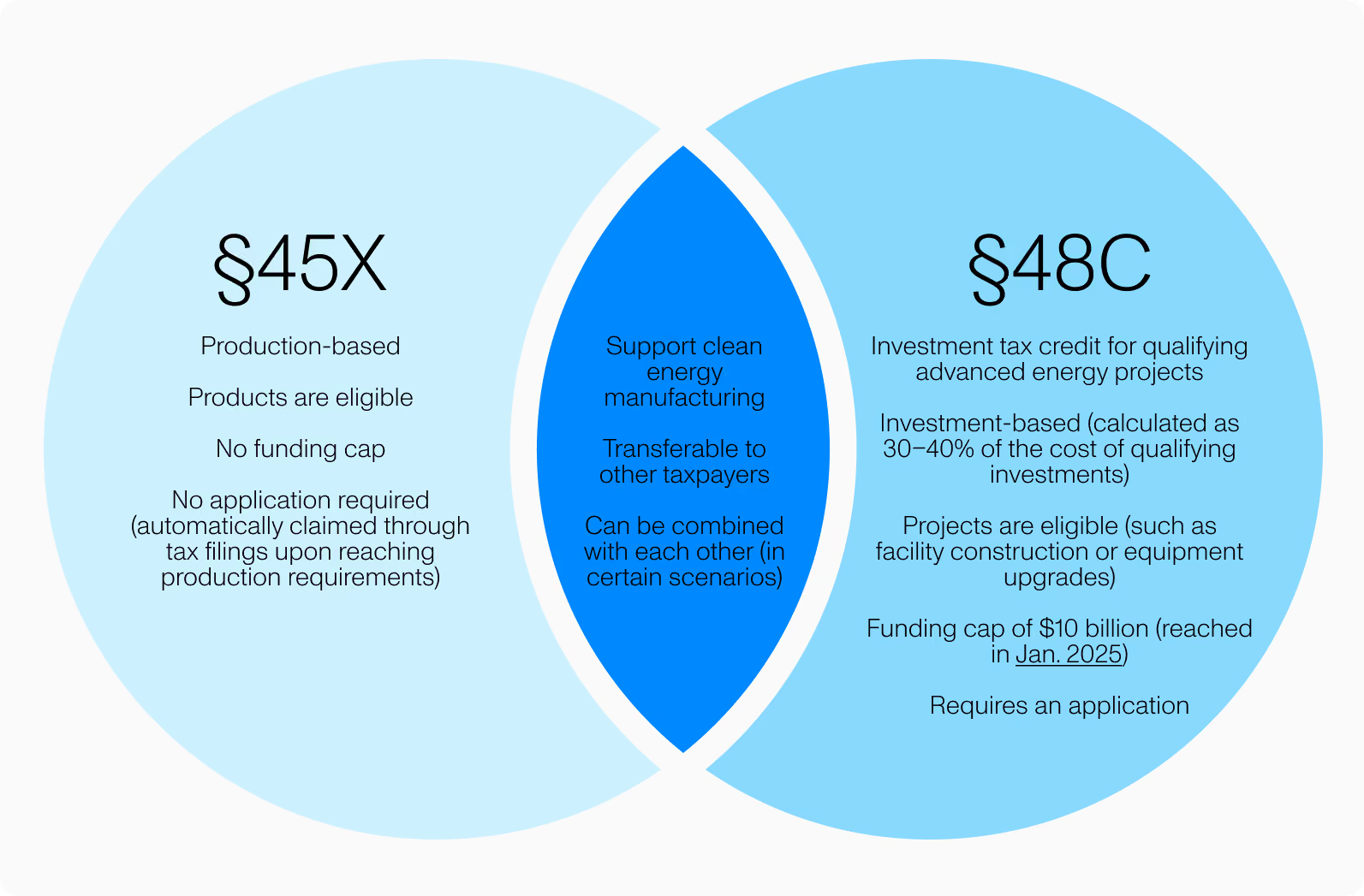
There are two different types of advanced manufacturing tax credits: §45X credits and §48C credits. Manufacturing facilities that are eligible for §45X may alternatively be eligible for an investment tax credit, §48C, for qualifying advanced energy projects. This is a one-time credit worth 30–40% of the value of an investment in a new manufacturing facility. Projects seeking §48C credits must apply under one of three categories:
- New investment in clean energy manufacturing or recycling.
- Reduction of greenhouse gas emissions from existing industrial facilities.
- New critical mineral production or recycling.
Unlike most other clean energy tax credits, including §45X, the total allocation under §48C is capped at $10 billion. The first $4 billion was awarded in March 2024 and the remaining $6 billion was allocated in January 2025, exhausting the full $10 billion cap. There are no announced plans for additional funding rounds, and the OBBB made no changes to the §48C structure or availability.
Can a facility claim both §45X and §48C tax credits?
Facilities that received an award under the §48C program and claimed the tax credit associated with it are not eligible for §45X tax credits. Some facilities may include multiple production lines and may earn §48C for some portion of their operations but not for the full facility operation. The portion of a facility not covered under the §48C program would still be entitled to claim §45X tax credits associated with its production through the end of 2032.
What projects and technologies qualify for a §45X tax credit?
To be eligible for the §45X PTC, a producer must:
Offer eligible products
Manufacturers are entitled to receive a production tax credit if they produce:
- Solar energy components, including solar modules, photovoltaic cells (thin film and crystalline), photovoltaic wafers, solar-grade polysilicon, torque tubes (for solar tracking devices), structural fasteners (for solar tracking devices), and polymeric backsheets.
- Wind energy components (until end of year, 2027), including blades, nacelles, towers, offshore wind foundations (fixed and floating platforms), and offshore wind vessels. Wind energy components produced in 2028 and after will not be eligible for the tax credit.
- Inverters, including central inverters, commercial inverters, distributed wind inverters, microinverters, residential inverters, and utility inverters.
- Battery components, including electrode active materials, battery cells, and battery modules.
Facilities that refine or recycle critical minerals are also eligible for the tax credit. Critical minerals are a set of 60 different minerals that the US Department of Energy, the Department of the Interior, and the US Geological Survey deem essential for supporting clean energy. The list includes:
- Aluminum
- Chromium
- Graphite
- Magnesium
- Manganese
- Nickel
- Tin
- Titanium
- Zinc
- Zirconium
Follow domestic manufacturing requirements
The Internal Revenue Service (IRS) defines the process of §45X eligible manufacturing as “substantial transformation of inputs into a complete and distinct eligible component,” not simply that which would result from “minor assembly” or “superficial modification.”
Take a battery manufacturer assembling battery modules out of battery cells as an example. A minor assembly might be simply packaging pre-made battery cells without changing the cells — that would not be eligible for the tax credit. If the manufacturer integrates the cells into a new battery module with original wiring, however, that would be eligible as substantial transformation.
Finished goods must be produced in the US, but subcomponents or constituent elements (e.g., steel, framing, electrical components) do not need to be sourced in the US. However, a specified percentage of the materials that make up a finished product cannot be sourced from producers that qualify as a prohibited foreign entity. The manufactured component must also be sold to a third party to earn the AMPTC.
Comply with prohibited foreign entity requirements
Manufacturers claiming the §45X credit must satisfy rules restricting participation by prohibited foreign entities (PFEs). These rules, enacted in the OBBB and effective beginning January 1, 2026, apply on top of the domestic manufacturing and contract manufacturing requirements described above. They represent some of the most significant new compliance obligations for §45X manufacturers.
Compliance is assessed through up to three tests:
- Ownership (guidance pending) — A taxpayer can not claim or sell credits if it is a PFE, or is owned or controlled by one. The US Department of the Treasury has not yet published operational rules on ownership mechanics and tracing; proposed regulations are expected later in 2026.
- Effective control (guidance pending) — Even with clean ownership, a project can be disqualified if a contract or license gives an SFE meaningful control over operations, such as dictating output, specifying component sources, or certain IP licensing arrangements entered after July 4, 2025. The statute identifies specific triggers, but Treasury has not yet defined “effective control” in formal guidance.
- Material assistance (interim guidance issued February 2026) — Manufacturers and project developers must show that PFE-sourced inputs stay below a cost threshold, calculated using the material assistance cost ratio (MACR). Thresholds that vary by component type — 50% for solar and inverters, 60% for batteries, and 85% for wind — and tighten annually.
IRS Notice 2026-15 (February 2026) established three safe harbor pathways for calculating the MACR:
- Identification safe harbor: The domestic content safe harbor tables serve as the exclusive list of components to evaluate — anything not listed is disregarded.
- Cost-percentage safe harbor: Use cost percentages from the safe harbor tables as proxies for actual direct costs.
- Certification safe harbor: Rely on supplier certifications attesting to the share of costs not sourced from a PFE. Certifications must be signed under penalty of perjury, retained for six years, and can generally be relied on unless there is reason to believe they are inaccurate.
The notice also established compliant methods for tracking components across facilities (individual tracking, de minimis assignment, and cost averaging) and clarified that §48E interconnection property requires a separate MACR calculation — a failure there does not disqualify the underlying facility.
For Crux’s full, continually updated analysis on the prohibited foreign entity rules, visit our Prohibited Foreign Entity Rules Resource Hub.
Adhere to contract manufacturing arrangements
The IRS defines a contract manufacturing arrangement as “any agreement providing for the production of an eligible component,” other than “a routine purchase order for off-the-shelf property.”
Take, for example, a US solar company contracting a third-party manufacturer to produce custom solar materials. Because the materials are produced to the company’s specifications and aren’t standard, off-the-shelf items, this qualifies as a contract manufacturing arrangement in which the manufacturer is entitled to the §45X credit.
However, if the manufacturer has a contract manufacturing agreement with an unrelated entity, the contracting party (the solar company) may claim the AMPTC instead.
If a contract manufacturing agreement exists, the tax credit seller (whether the manufacturer or the contracting party) should clearly document which entity is entitled to claim the AMPTC. IRS regulations require all parties to the contract manufacturing arrangement to sign a certification statement acknowledging who will claim the §45X credits and a penalty of perjury statement.
State of the §45X market
Section 45X pricing: Market resilience amid shifting demand dynamics
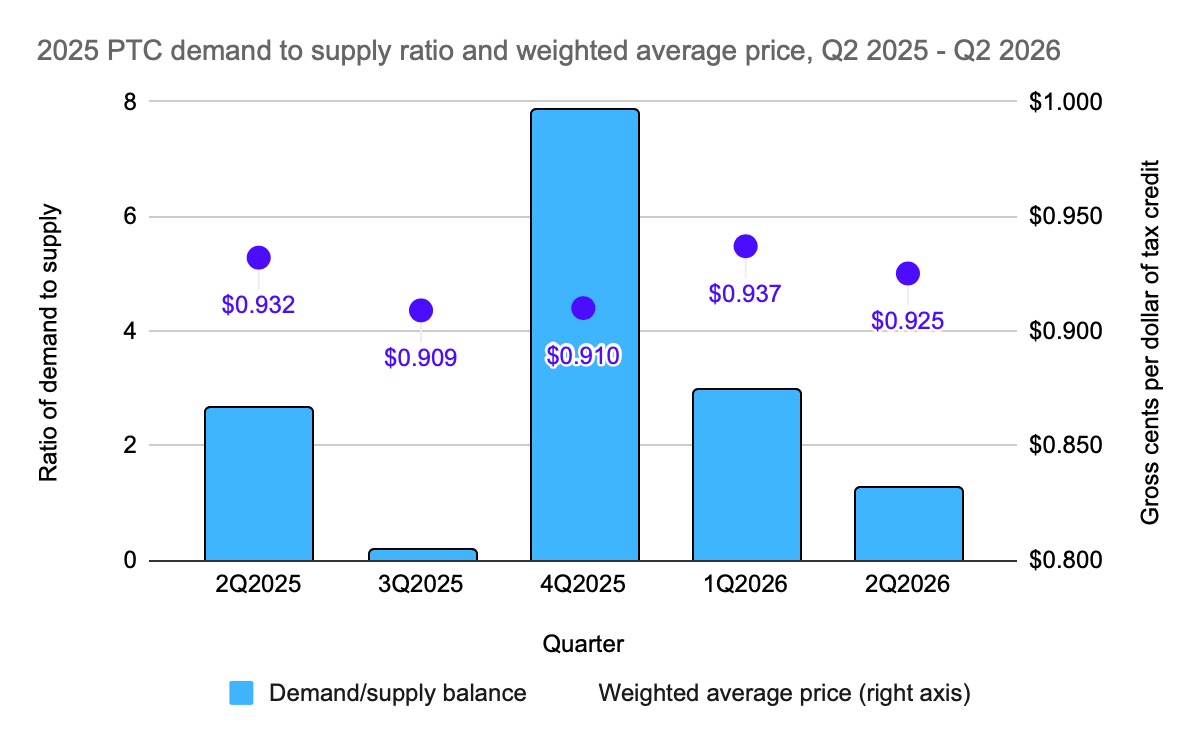
Section 45X credit pricing has matured significantly as the credit category has become well-established among buyers. It is relatively common for §45X credits to transact at $0.91–0.94 on the dollar. In 2025, pricing faced headwinds as the OBBB reduced corporate tax liabilities by an estimated 20–30%, temporarily softening buyer demand. Weighted average pricing bottomed near $0.910 in Q3 and Q4 2025, recovered to a series high of $0.937 in Q1 2026, and eased modestly to $0.925 in Q2 — notably resilient given that the demand-to-supply ratio more than halved over the same period. Notice 2026-15 established safe-harbor pathways that reduce the burden for many manufacturers, but PFE compliance has nonetheless become the single most consequential factor stalling deals in the current market. Insurance capacity for PFE-related risk remains thin, adding further friction. Crux expects pricing to firm into the second half of 2026 as buyers gain clarity on tax liabilities and PFE treatment.
Section 45X demand to supply ratio and weighted average price, 2Q2025–2Q2026
What does this mean for sellers?
Transferring §45X tax credits remains one of the most effective ways for manufacturers to unlock immediate cash value from their production. The market for §45X tax credits has matured following the passage of the IRA in 2022 — more buyer demand, established transaction infrastructure, and settled IRS guidance have made §45X one of the most actively traded credits on the market.
However, the value proposition for sellers has evolved. Section 45X was once regarded as among the simplest credits to diligence and transact — and relative to investment tax credits, it retains key structural advantages: there is no recapture risk, and once a manufacturer demonstrates product eligibility and a completed sale, the credit claim is well-understood by the market.
But the introduction of MACR calculations and additional PFE compliance requirements effective January 1, 2026 has made §45X one of the more complex credits on the market in terms of diligence burden. Manufacturers must now:
- Calculate their MACR — a precise cost-based formula determining whether a product meets the material assistance threshold to qualify as non-PFE. This is a granular, component level calculation unlike anything required by other common tax credits.
- Map their direct supply chains — identifying the PFE status of constituent material suppliers across their full input base.
- Obtain supplier certifications — attesting to the non-PFE sourcing of inputs, and be prepared for buyers to scrutinize whether those certifications are credible.
- Document all of the above in a compliance package — which buyers and their counsel will review as a central component of due diligence.
How to leverage the §45X tax credit
The IRS has articulated a defined tax credit value for each eligible component included in the §45X regulation. To generate the §45X credit, manufacturers must follow certain steps.
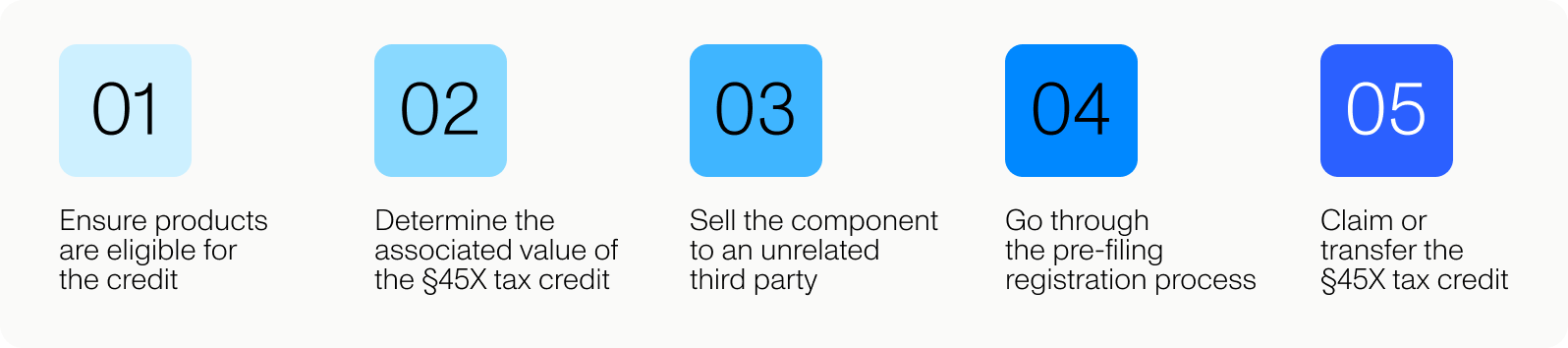
1. Ensure products are eligible for the credit
Using the previously-mentioned eligibility information, producers must carefully check that their business can use the credit.
2. Determine the associated value of the §45X tax credit
Each §45X-eligible good has an associated tax credit value. Three primary methods are used to determine the credit rate of an eligible good:
- The production volume of a component, based on size or weight: Solar-grade polysilicon, for instance, is entitled to a $3/kg credit, while solar wafers earn a credit worth $12 per square meter.
- The volume, based on electrical capacity: For example, a solar panel might net $0.07 per watt.
- A percentage of production cost, typically applied to critical minerals, normally worth 10% of the production cost.
To calculate the value of a §45X tax credit, multiply the credit rate by the production volume.
For example, say a company produces solar modules that are eligible for a $0.07 credit per watt. If it sells 10 million watts of solar modules, its tax credit will be $700,000.
For eligible components other than wind energy components and applicable critical minerals, the §45X credit phases down to 75% for components sold in 2030, 50% in 2031, and 25% in 2032; no credit is available thereafter. Wind energy components are ineligible for the credit if produced and sold after December 31, 2027. Applicable critical minerals other than metallurgical coal phase down to 75% in 2031, 50% in 2032, and 25% in 2033; no credit is available thereafter. Metallurgical coal is ineligible if produced after December 31, 2029.
3. Sell the component to an unrelated third party
The §45X credit is generated and claimed annually. Manufacturers must ensure the credits claimed are tied to eligible products sold to a third party within a given year.
Products may have been produced in a preceding tax year, but until they are sold, the manufacturer is not entitled to claim a §45X credit associated with the good.
Keep these important aspects in mind when preparing to sell to an unrelated third party:
§45X tax credits are refundable via direct pay
Direct pay allows entities to receive a tax credit as a cash payment as opposed to a reduction of tax liability. Therefore, if the credit exceeds your tax liability, you receive the excess as a cash refund from the IRS.
Manufacturers will calculate the total value of the §45X credits generated during a tax year and file that amount on their annual tax filings. Refunds will only be issued annually, following the receipt of the tax filing, and will not be issued quarterly following quarterly estimated return filings.
Companies are eligible to take direct pay for up to a five-year period, unless they revoke the direct pay election before the end of that period. Companies cannot re-elect direct pay after revoking that election or after the end of the five years.
§45X credits can be sold to a related party under certain circumstances
While the eligible products or components must be sold to an unrelated third party to generate the tax credit, the IRS has outlined certain circumstances under which a sale to a related person may be treated as a sale to an unrelated person (the “related person election”).
Before the sale, the related person must make the election with the IRS and may be required to supply information as a condition of the election. This ensures that companies working closely together can still benefit from the credit without going through a third-party buyer.
4. Go through the pre-filing registration process
Pre-filing registration with the IRS is a feature of both the transfer and direct pay methods of claiming the credit. The pre-filing registration portal opened in December 2023.
Companies that generate §45X credits should anticipate supplying basic facility information in the pre-filing registration portal. The IRS publishes a detailed guide describing the application process for each tax credit-eligible entity and tax credit type.
In general, the IRS recommends that applicants allow 120 days to process the pre-filing registration, though the process can be faster. At the end of the process, the IRS will supply a registration number, which is typically required in any tax credit transfer deal or direct pay filing.
Companies listing their credits on Crux can enter the pre-filing registration number and share the status of their application if the number has not yet been received.
5. Claim or transfer the §45X tax credit
US taxpayers who have determined they are entitled to the §45X tax credit have several options for claiming or monetizing the credit. A company intending to claim the §45X will file IRS Form 7207 with their annual return.
A separate form must be completed for each eligible facility owned or controlled by the taxpayer. §45X credits are eligible for direct pay and transferability. The credit claims process is similar in both cases, but the monetization method differs.
In both cases, the taxpayer will annually register their facility through the IRS pre-filing registration portal and indicate whether they are taking direct pay or transferring the credits.
To file for direct pay, the taxpayer must complete pre-filing registration for each facility and file Form 3800 with their annual tax return. Companies electing to take direct pay for a tax year are generally presumed to take direct pay for the subsequent four tax years unless they revoke their election and choose to transfer the credits. Once revoked, the taxpayer cannot re-elect direct pay for any remaining five-year direct pay entitlement balance.
Transferring §45X tax credits
§45X tax credits are among the most desirable and transactable tax credits in the transferable tax credit market. There are no limitations on the time period within which the company can transfer its credits — as long as the credit is generated, it can be sold in the transfer market.
Similar to direct pay, the taxpayer must complete the pre-filing registration process, file Form 7207 for each facility, and file Form 3800 with their annual returns to transfer credits.
To transfer the tax credits to a buyer, the taxpayer typically estimates their annual §45X production volume and secures a buyer directly or through an intermediary (such as a financial institution, tax firm, or transparent marketplace). The seller can ensure their credits are highly transactable by lining up due diligence items, legal memos, and sales documentation before engaging with prospective buyers.
In general, larger deals (over $50 million in annual credit volume) tend to attract the strongest pricing. It is relatively common for §45X credits to transact around 92–95% of their face value and to settle on a quarterly basis (in arrears for credits generated during the preceding quarter). Strong credit pricing and timely settlement can make transferability the most cost-effective mechanism for a company to claim its §45X credits when accounting for the time value of money.
Sell your §45X tax credits with Crux
Section 45X tax credits can create a meaningful source of cash flow for manufacturers investing in US clean-energy supply chains. Transferability gives manufacturers a practical way to monetize those credits, but buyers need clear, well-organized diligence before they can transact with confidence.
Crux helps sellers get transaction-ready. Our §45X-specific diligence checklists streamline the process, and our team knows how buyers assess PFE exposure. We help manufacturers identify the documentation and analysis needed to address that risk and make buyers comfortable moving forward.
Crux executed some of the first §45X transactions and continues to help shape the market. Every transaction is informed by our proprietary $85 billion dataset and real-time pricing benchmarks, giving sellers a clearer view of market pricing and commercial terms as they bring credits to market.
Further reading
Leveraging insights from Crux’s authoritative dataset on the transferability market, and Clean Investment Monitor, and the US Department of Energy, this advanced manufacturing ebook outlines what manufacturers and buyers need to know about §45X PTCs.
Explore the 2026 Mid-Year Market Intelligence Report for Crux’s deep dive into transferable tax credit market dynamics, including §45X pricing and transaction trends.
Read Crux’s summary of final §45X guidance from Treasury, covering the key rules unlocking billions in clean energy manufacturing credits.
For guidance on selling §45X credits, read Crux’s best practices for making tax credits more attractive to buyers.
Share