

Tax credit insurance: Coverage, cost, and how to procure

Share
.svg)

.svg)
.svg)
Want to explore more conversations like this?
View all blogs
Tax credit transferability has made it easier than ever for developers and manufacturers to turn clean energy incentives into cash by selling investment tax credits (ITCs) and production tax credits (PTCs) directly to third-party buyers. As the market matures, so too does standardization around how to manage transaction risks.
Risk mitigation is critical for buyers evaluating a seller's ability to stand behind the tax credit. Tax credit insurance has emerged as a key vehicle to manage risk. Crux’s data shows that 60–70% of ITC deals included insurance in the first half of 2025.
This article breaks down what tax credit insurance covers, how it works, and what developers and manufacturers need to know to obtain a strong policy.
Go deeper: Download A Guide to the Tax Credit Insurance Market
Key takeaways
- Who does tax credit insurance protect? The buyer is typically the insured party, while the seller generally procures and pays for the policy.
- What does it cover? Policies are tailored to a specific tax treatment and can address risks such as credit eligibility, tax basis, bonus credit qualification, recapture, and transaction structure.
- How does it fit into a transaction? Insurance can complement seller representations, indemnities, and buyer diligence; it does not replace the need to address those elements in the purchase agreement.
- What should sellers do first? Align with the buyer on coverage scope early, then prepare the diligence and legal materials underwriters will need.
What is tax credit insurance?
Tax credit insurance is a third-party policy designed to protect buyers from financial loss if the Internal Revenue Service (IRS) disallows, reduces, or recaptures transferred clean energy tax credits. While buyers are the insured party, sellers typically procure and pay for the policy, often rolling the cost into the deal price.
Insurance can give buyers additional protection against specified tax risks and help sellers meet buyer requirements, particularly where the seller’s indemnity alone may not provide sufficient comfort.
Top risks in tax credit transfer deals
Clean energy tax credit transactions carry several types of risk that buyers expect sellers to address, especially when the seller does not have investment-grade credit. The vast majority of insured deals involve non-investment-grade sellers; insurance often acts as a substitute for credit quality to help boost buyer confidence.
Here are the main risks that policies typically address:
Eligibility and qualification risk
If a project fails to meet IRS criteria (e.g., placed-in-service requirements), the credit can be disallowed.
Basis risk
For ITCs, if the tax basis is overstated (often because the project was valued above its actual cost via appraisal), the IRS may reduce the credit amount. This can also lead to excessive credit transfer, where more credit is sold than was actually earned, potentially triggering clawbacks for the buyer.
Recapture risk
If, within five years after it is placed in service, an ITC project is sold, taken offline, or damaged without being rebuilt, the IRS can take back, or recapture, the credit. However, this is very rare: Crux research shows that recapture has occurred in just 0.5% of deals, and 80% of advisors have never seen it happen.
Recapture risk only applies to ITCs; PTCs cannot be recaptured because the credit is only generated after the electricity or manufactured component is produced.
Adder risk
If a project fails to meet bonus credit criteria (e.g., prevailing wage and apprenticeship, domestic content, or energy community), the IRS may reduce the total credit amount.
Placed-in-service risk
If a project is not placed in service as planned, the buyer may not receive the credits in the expected timeframe or full amount.
Structural risk
Missteps such as circular cash flows, incorrect entity structuring, or payment documentation errors can invalidate an otherwise valid transfer.
Each of these risks can delay a transaction, trigger buyer pushback, or lead to post-closing disputes if not properly addressed. That’s why buyers expect sellers to stand behind their credits through strong representations and indemnities, and why they increasingly seek added protection through insurance.
Prohibited foreign entity (PFE) risk
As of 2026, tax credit insurance does not currently cover prohibited foreign entity (PFE) risk. Buyers and sellers evaluating PFE-exposed credits should address that risk through diligence and transaction documentation rather than assuming it will be insured. Learn more about PFE risk in the current market.
What tax credit insurance covers: ITCs vs PTCs
While policies are tailored to each deal, the covered risks often differ slightly between ITC and PTC transactions:
- ITC policies often cover basis risk, adder risk, placed-in-service risk, and recapture risk. They may also address structural risk, ensuring that errors in entity setup, payment flows, or documentation don’t jeopardize the transfer.
- PTC policies typically focus on eligibility and qualification risk. Because §45 production tax credits are earned annually over 10 years, coverage can span the full term or apply to only the credits transferred. For newer incentives such as §45X advanced manufacturing credits and §45Z clean fuel credits, policies often use shorter terms tied to the project’s expected output or the statutory credit period.
Insurance adoption by project type and deal size: ITCs
Crux data reveals a significant variation in insurance adoption depending on the project profile and credit type. In 1H2025, about 80% of storage ITC deals were insured, reflecting higher risk and merchant exposure. Residential solar ITCs were also frequently insured due to ongoing market volatility.
By contrast, insurance was far less common in utility-scale solar ITC deals (25% of deals) because a larger portion of these deals came from investment-grade sellers. Only 11% of sub-$10 million commercial and industrial (C&I)/community solar deals included coverage because the cost of insurance makes it uneconomical, and policies can be hard to find for deals of this size. However, 67% of C&I deals over $10 million were insured due to factors such as stronger buyer requirements and more favorable insurance economics.
In terms of overall ITC deal size, mid-sized ITC transactions ($10–150 million) are most often insured, balancing cost and coverage efficiency. Smaller deals typically fall below insurer minimums, while very large deals (≥$300 million) are more likely to be generated by investment-grade entities where buyers don’t need to rely on insurance.
Insurance adoption by project type: PTCs
Compared to ITCs, PTC insurance rates are typically lower because of the credit’s longer-term structure, more predictable risk profile, and fewer buyer requirements. PTCs also avoid certain ITC-specific risks such as recapture and basis risk, contributing to lower coverage needs. For example, wind PTCs are rarely insured given the credit’s maturity and wind’s operational stability, which reduces the commercial need for coverage. For advanced manufacturing PTC deals, insurance rates have declined as the credit matures, stabilizing at around 40%.
Percentage of deals with insurance by technology and credit type in 1H2025

Core components of a tax credit insurance policy
Tax credit insurance policies are built around a specific covered tax treatment — the tax position the insurer agrees to back. While each policy is bespoke, most include the following core components:
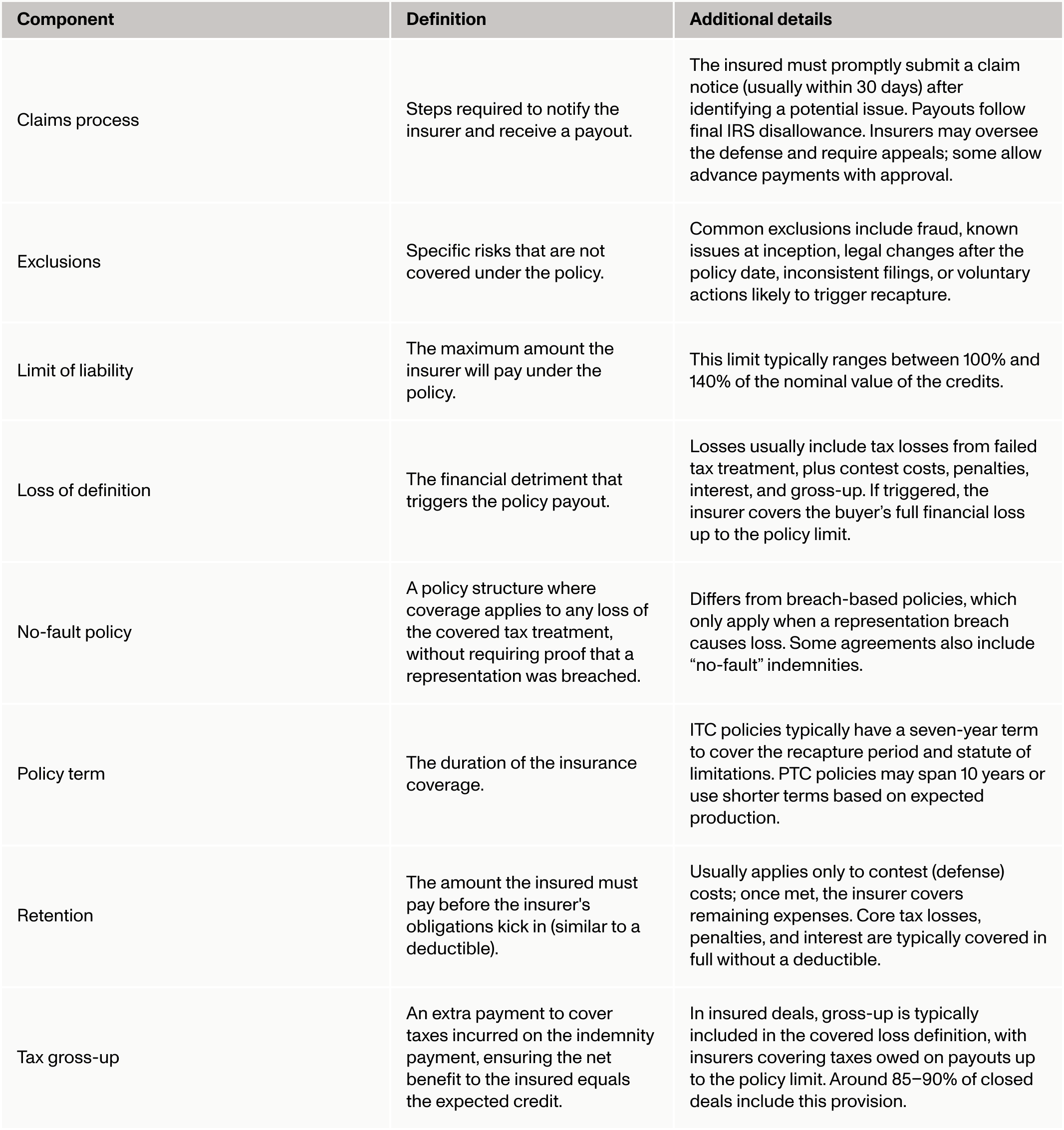
Before binding a policy, buyers and sellers should confirm that the covered tax treatment, limits, exclusions, and policy term align with the transaction’s risk allocation and timing.
Looking for more clarification on policy language? See our tax credit insurance glossary for quick definitions of common terms.
Tips for tax credit sellers procuring insurance
Sellers are typically responsible for procuring tax credit insurance. Careful planning is vital to ensure the policy meets buyer expectations and minimizes costly surprises.
Here are four expert-sourced best practices for navigating the insurance procurement process:
Align on insurance scope
Our survey of advisors shows that misalignment between the buyer and seller over the scope of the insurance policy is one of the top three causes of transaction delays or derailment. To avoid issues, confirm key coverage terms before or shortly after the term sheet stage. If you’re unsure where to begin, Crux’s partner network can connect you with experienced insurance brokers to help guide you through the process.
Prioritize diligence readiness
About 40% of advisors say due diligence misalignment negatively affects tax credit deals. Because insurers often request the same materials as buyers, any gaps can lead to narrower coverage, higher premiums, or binding delays, making it critical to align your diligence stack with insurer expectations. It’s also important to leave enough time for brokers and underwriters to complete their review — rushed timelines can stall closings or limit coverage.
Prepare for insurer basis scrutiny
If your project involves an ITC basis step-up, anticipate rigorous diligence by the insurer. Be prepared for the insurer to cap the value of the step-up it is willing to insure, potentially requiring you to retain some risk. This includes working with your partner early to ensure materials are defensible and aligned with market norms.
Leverage legal documentation for underwriters
While buyer legal counsel may avoid relying on seller legal opinions, Crux has found that the majority of insurers/insurance brokers (60%) will review seller counsel legal opinions and memos in depth. Ensure these documents are high quality and ready to expedite the underwriting process.
Explore today’s tax credit insurance market landscape
Tax credit insurance is commonly used in transferable credit transactions, particularly where buyers seek additional protection against specified tax risks. When the policy scope, diligence, and transaction documents are aligned, insurance can support a smoother closing and give buyers added confidence in the credit.
For deeper insights and data on tax credit insurance, download A Guide to the Tax Credit Insurance Market.
Further reading
To understand a material risk that tax credit insurance does not currently cover, read our guide to PFE risk in tax credit transactions.
For definitions of common policy terms, visit our tax credit insurance glossary.
Share