

 “The Crux of it” blog
Tax credit insurance vs. investment-grade parent indemnities: Who stands behind your tax credit?


For most of the transferable tax credit market's short history, seller creditworthiness has been one of the biggest drivers of price. Buyers want to know the seller's credit quality and whether they can back the value of the tax credit if the Internal Revenue Service (IRS) later reduces or disallows it. Tax credits from investment-grade (IG) sellers have commanded a premium as a result, and non-IG sellers have typically turned to tax credit insurance to give buyers comparable comfort.
Prohibited foreign entity (PFE) rules — which determine whether a project is eligible for tax credits based on its exposure to certain foreign entities in its ownership, influence, and/or supply chain — complicated matters in 2026. In H1 2026, whether a tax credit was subject to PFE rules became a large factor in pricing, according to Crux's 2026 mid-year market intelligence report. At the same time, absent final IRS guidance on PFE rules, tax credit insurance policies generally don't cover PFE risk.
That leaves buyers with a key question for every deal: Who will stand behind the risks insurance won't cover? This article explores what each form of protection covers, what the market is actually doing, and how buyers can match credit support to the real risk of the tax credits they're buying.
Key takeaways:
- Buyers care who stands behind the indemnity. Nearly every deal includes a seller's indemnity, but it's only as strong as the balance sheet backing it. An IG-rated seller or parent is the backstop buyers value most.
- Layering protection is common, except with an IG guarantor. Buyers frequently pair tax credit insurance with an indemnity or guaranty from a non-IG counterparty. When the guarantor is IG, they rarely add insurance: deals with both an IG seller and insurance made up just 4.5% of H1 2026 power volume. Other categories recorded no such deals.
- Insurance doesn't cover PFE risk yet. That makes an IG indemnity the most widely accepted protection for PFE-exposed tax credits; an IG seller can stand behind that risk directly.
- An IG guaranty is usually enough on its own, as long as the rated entity signs it, the negotiated guaranty cap exceeds the value of the tax credits, PFE risk is expressly covered, and the term matches the full exposure period.
- For much of today's supply, an IG backstop isn't available. Nearly all current §48E and clean fuel volume comes from non-IG sellers, so buyers stack insurance, non-IG guaranties, legal opinions, contract protections, and price to manage risk.

Get our latest insights and favorite reads on the transferable tax credit market in your inbox.
What does each form of protection cover?
Nearly every tax credit transfer starts with a seller's indemnity: the seller operates the project, so the seller promises to make the buyer whole if something goes wrong. If the seller’s own balance sheet isn’t strong enough to provide that indemnity, tax credit buyers typically look to one of two backstops: tax credit insurance or a guaranty (sometimes called a parent indemnity) from a creditworthy parent.
Source: Crux analysis
The biggest practical difference is flexibility. Insurance is a standardized product with defined coverage and exclusions, and any change requires approval from multiple carriers. A guaranty is a direct contract with one counterparty, so buyers can ask for specific requirements. In one recent transaction Crux observed, an experienced IG Fortune 500 buyer needed protection that lasted through the full recapture period, the statute of limitations, and any audit appeals that followed — a term most insurance markets won't write. It chose to buy only from IG sellers that could tailor a guaranty to those terms.
For a deeper look at insurance policy structure, coverage levels, and cost, download our guide to the tax credit insurance market.
How does the market handle tax credit insurance versus indemnities?
Layering protection is standard in tax credit transfers. Nearly every deal includes a seller's indemnity, and many add tax credit insurance as a second source of recovery. The exception is an IG guarantor. In H1 2026, most transaction volume in every technology category relied on either an IG seller standing behind the tax credit or insurance on a tax credit from a non-IG seller — rarely both.
Prevalence of insurance by technology category, H1 2026
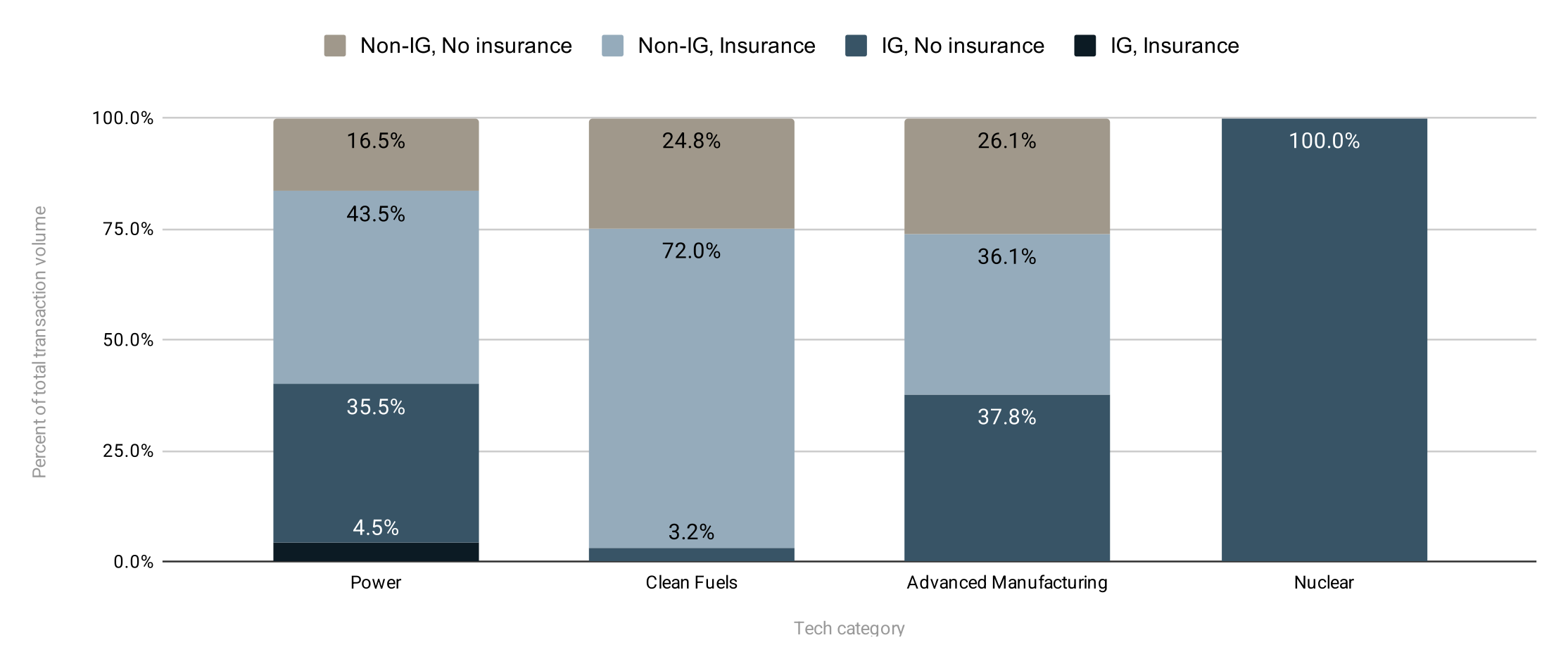
Deals with both an IG seller and insurance made up just 4.5% of power volume and none of the volume in clean fuels, advanced manufacturing, or nuclear.
Beyond that, the mix varies widely by technology:
- Nuclear (§45U) volume came entirely from IG sellers without insurance.
- Clean fuels sat at the other end: 72.0% of volume came from non-IG sellers with insurance, and IG sellers accounted for just 3.2% of volume.
- Power and advanced manufacturing split more evenly between the two paths.
The remaining volume — non-IG sellers without insurance — generally transacts at a lower price and/or involves highly experienced sponsors or sophisticated buyers who can diligence the risk deeply enough to transact without either an insurance or IG wrap.
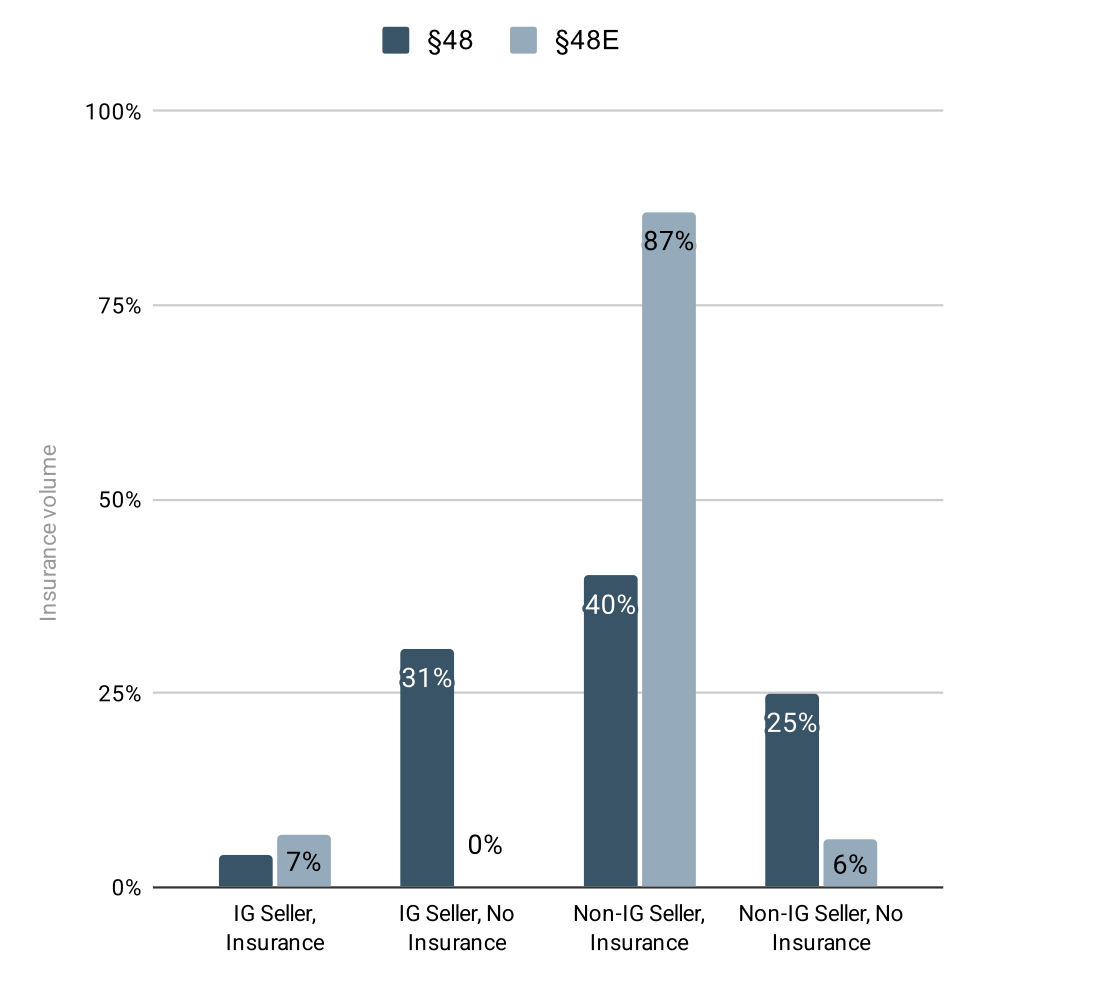
IG sellers comprise the majority of the supply of §48 tax credits transacting without insurance (31% of total §48 volume). IG sellers have mostly been selling legacy §48 tax credits so far, which explains their small share of §48E volume. As their §48 pipelines run out, they’re likely to bring §48E tax credits to market, so IG-backed §48E supply should grow over time.
Insurance coverage on IG and non-IG ITCs, §48 and §48E
Crux has observed that a buyer’s preference often comes down to familiarity. Many large corporate buyers prefer an IG guaranty because it is more straightforward to negotiate, underwrite, and explain to an internal approval committee. In one transaction where an IG utility bought tax credits from another IG utility, for example, the appeal was transacting with a company much like itself: a counterparty with a known business, public financials, and a credit rating its committee could easily verify. Conversely, other buyers may prefer insurance. Insurance is a familiar concept, and "this credit is insured" is an easy message to bring to leadership.
PFE rules have made the IG path more valuable. Insurance does not currently cover PFE risk, so an IG indemnity is the most widely accepted form of protection for PFE-exposed tax credits.
When is a parent indemnity enough on its own?
When the guarantor is investment grade, a parent indemnity is usually enough. An IG parent putting its balance sheet behind a tax credit signals confidence in the project.
The details still matter. Before relying on a guaranty alone, buyers should confirm:
- Is the guarantor the rated entity? An IG guaranty has to come from the rated entity itself, not an unrated subsidiary. Buyers will want to review the guarantor's standalone financials. They see the most value when the IG parent signs it or insurance is added.
- Does the indemnity/guaranty cap cover more than the face value of the credits? Interest, penalties, and contest costs can push losses above the credit's face value. In H1 2026, 71% of deals with a quantitative indemnity cap set it above 100% of the purchase price.
- Is PFE risk expressly covered? Insurance does not currently cover this, so a guaranty is the only form of credit support that can cover it — and only to the extent that the indemnity does. Buyers should verify that the transfer agreement includes PFE reps and covenants and that a breach of them triggers the indemnity.
- Does the indemnity/guaranty term match the exposure? Protection should run through the recapture period, the statute of limitations, and any audit appeals. PFE rules add a 10-year recapture window for §48E tax credits starting in 2028. Because the trigger is a seller’s future action, which insurers typically exclude, a long-dated guaranty is especially valuable.
Sellers rarely offer insurance on top of an IG guaranty, because they'd be paying for a policy that provides protection already covered in the guaranty. When an IG seller offers insurance instead of a guaranty, it's often because the seller wants to avoid adding a contingent obligation that could affect its own credit profile.
When is layering protection not an option?
For much of today's supply, an IG guaranty simply isn't available. As the data above shows, nearly all current §48E and clean fuel volume comes from non-IG sellers. Section 48E credits are among the tax credits most exposed to PFE rules, which means the buyers who most need protection against PFE risk are often the least able to get it from an IG guarantor. That should ease as IG sellers move from §48 to §48E, but for now it leaves a gap.
Insurance can step in to cover non-PFE risks for non-IG sellers. But because policies exclude PFE risk, an insured tax credit that is subject to PFE, from a non-IG seller, leaves that risk backed only by the seller or a non-IG parent. Without an IG backstop, buyers are seeking protection from other pieces:
- Insurance for non-PFE transaction risks, such as eligibility, adders, and basis risks.
- PFE legal opinion or memo that documents the seller's status under the current rules.
- MACR legal opinion or memo that outlines and confirms the amount of inputs derived from a covered nation.
- Seller representations attesting to their foreign entity status.
- Change-in-law provisions, which appeared in 55% of H1 2026 transfer agreements, up from 12% in H1 2024.
- Clauses to revisit coverage once PFE insurance becomes available, which some buyers now request upfront.
- Price, with PFE-exposed investment tax credits (ITCs) trading about $0.015 below exempt ITCs and production tax credits about $0.020 below.
- PFE-exempt tax credits, such as legacy §48 and §45 credits, remain the preference for several buyers wanting to avoid PFE diligence.
For a more detailed look at how buyers are getting comfortable with PFE risk, read our article on how PFE rules are changing tax credit diligence and pricing.
What changes when Treasury releases guidance?
Insurers expect to begin offering PFE coverage once the US Department of the Treasury and the IRS issue guidance on the ownership and effective control rules. Underwriters will likely require robust third-party legal opinions at a formal "should" or "more likely than not" level, and coverage for recapture tied to a seller's voluntary future actions will likely be carved out. Long exposure periods could make that coverage expensive.
Until then, IG supply will remain scarce and will price accordingly. Buyers who match credit support to the actual risk of each tax credit — an IG guaranty where it's available, insurance plus contractual protections where it isn't — will have the widest range of tax credits to choose from.
Crux works closely with developers, manufacturers, and project sponsors to prepare them to transact effectively under PFE rules. With resources such as PFE-specific diligence checklists and our §48E Transaction Readiness Guide for Crux clients, we’re working to ensure a pipeline of verified, transaction-ready tax credits.
To find high-quality, diligenced tax credits that fit your risk profile, contact the Crux team.